Minerals and Energy Resources — NCERT Solutions
Madhya Pradesh Board · Class 10 · Social Science
NCERT Solutions for Minerals and Energy Resources, Madhya Pradesh Board Class 10 Social Science: 12 textbook questions solved step by step.
Interactive on Super Tutor
Studying Minerals and Energy Resources? Get the full interactive chapter.
Quizzes, flashcards, AI doubt-solver and a step-by-step study plan — built for NCERT solutions and more.
Free trial, no card needed.
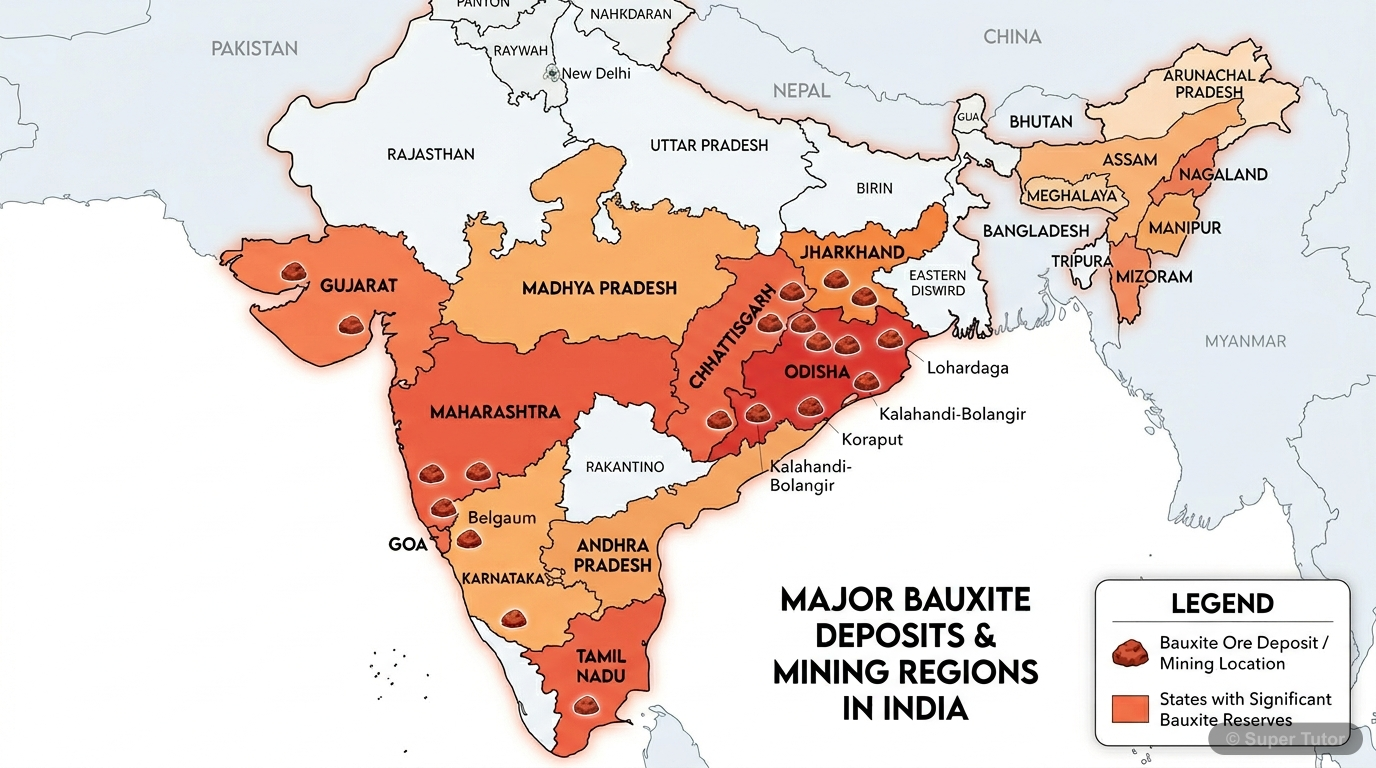
One of 33 illustrations for Minerals and Energy Resources in Super Tutor — alongside flashcards, concept maps and practice questions.
The first 6 solutions are open to read. The other 6 are free with a Super Tutor account.
Exercises
1(i)Which one of the following minerals is formed by decomposition of rocks, leaving a residual mass of weathered material?
(a) coal
(b) bauxite
(c) gold
(d) zincShow solution
Correct option: (b) bauxite
Bauxite is formed by the decomposition (weathering) of rocks over a long period of time. The process leaves behind a residual mass of weathered material rich in aluminium hydroxide. Coal is formed from plant remains, while gold and zinc are found in veins/lodes or sedimentary strata — not as residual weathered masses.
1(ii)Koderma, in Jharkhand is the leading producer of which one of the following minerals?
(a) bauxite
(b) mica
(c) iron ore
(d) copperShow solution
Correct option: (b) mica
Koderma in Jharkhand is the leading producer of mica in India. The mica belt of Jharkhand (Koderma–Gaya–Hazaribagh belt) is one of the most important mica-producing regions in the world.
1(iii)Minerals are deposited and accumulated in the stratas of which of the following rocks?
(a) sedimentary rocks
(b) metamorphic rocks
(c) igneous rocks
(d) none of the aboveShow solution
Correct option: (a) sedimentary rocks
In sedimentary rocks, minerals are deposited and accumulated in layers (strata) over millions of years. Minerals such as coal, iron ore, gypsum, potash salt, and sodium salt are found in sedimentary rock formations.
1(iv)Which one of the following minerals is contained in the Monazite sand?
(a) oil
(b) uranium
(c) thorium
(d) coalShow solution
Correct option: (c) thorium
Monazite sand is a placer deposit found along the coast of Kerala and other coastal areas of India. It contains thorium in large quantities, making India one of the world's largest reserves of thorium, which is used as nuclear fuel.
2(i)(a)Distinguish between ferrous and non-ferrous minerals in not more than 30 words.Show solution
Given: Two categories of metallic minerals.
Distinction:
| Ferrous Minerals | Non-Ferrous Minerals |
|---|---|
| Contain iron as a constituent. | Do not contain iron. |
| Examples: iron ore, manganese, nickel, cobalt. | Examples: copper, bauxite, lead, gold, silver, tin. |
Ferrous minerals provide a strong base for the development of metallurgical industries, while non-ferrous minerals play a vital role in a number of industries such as electrical, electronics, and aerospace.
2(i)(b)Distinguish between conventional and non-conventional sources of energy in not more than 30 words.Show solution
Distinction:
| Conventional Sources | Non-Conventional Sources |
|---|---|
| Traditional sources used for a long time; mostly non-renewable. | Relatively newer sources; mostly renewable and environment-friendly. |
| Examples: coal, petroleum, natural gas, firewood. | Examples: solar energy, wind energy, tidal energy, biogas, geothermal energy. |
Conventional sources are exhaustible and cause pollution, whereas non-conventional sources are inexhaustible and cleaner alternatives.
Free with a Super Tutor account
Free with a Super Tutor account
Free with a Super Tutor account
Free with a Super Tutor account
Free with a Super Tutor account
Free with a Super Tutor account
6 more solved questions in Minerals and Energy Resources
They are free with a Super Tutor account, along with practice quizzes and flashcards for this chapter. Free to start, no card needed.
Frequently Asked Questions
What are the important topics in Minerals and Energy Resources for Madhya Pradesh Board Class 10 Social Science?
Are these NCERT Solutions for Minerals and Energy Resources free?
How should I revise Minerals and Energy Resources for the Madhya Pradesh Board Class 10 board exam?
Sources & Official References
Content is aligned to the official syllabus. Refer to the board website for the latest curriculum.
More resources for Minerals and Energy Resources
Practice Quiz
Test yourself with a quick quiz
Important Questions
Exam-style questions with answers
Revision Notes
Key points for last-minute revision
Chapter Summary
Understand the chapter at a glance
Concept Maps
See how topics connect
Study Plan
Step-by-step plan for this chapter
Flashcards
Quick-fire cards for active recall
Syllabus
What topics to cover
For serious students
Get the full Minerals and Energy Resources chapter — start free.
Quizzes, flashcards, an AI doubt solver and a study plan for Madhya Pradesh Board Class 10 Social Science. Free to start, no card needed.