Minerals and Energy Resources — Revision Notes
Madhya Pradesh Board · Class 10 · Social Science
Minerals and Energy Resources revision notes for Madhya Pradesh Board Class 10 Social Science: 4 topics in quick points.
Interactive on Super Tutor
Studying Minerals and Energy Resources? Get the full interactive chapter.
Quizzes, flashcards, AI doubt-solver and a step-by-step study plan — built for revision notes and more.
Free trial, no card needed.
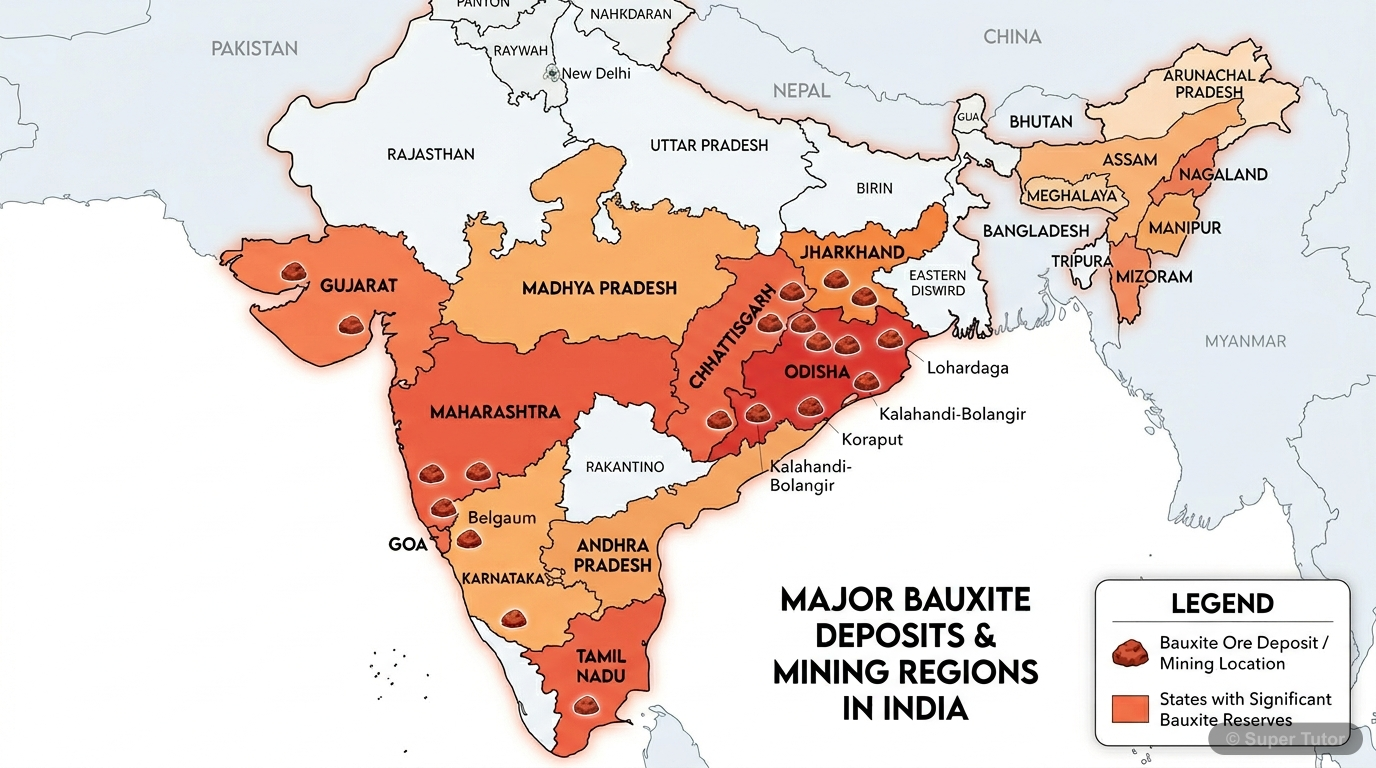
One of 33 illustrations for Minerals and Energy Resources in Super Tutor — alongside flashcards, concept maps and practice questions.
Key Topics to Revise
1. Minerals: Meaning, Occurrence, and Classification
- A mineral is a homogenous, naturally occurring substance with a definable internal structure.
- Over 2000 minerals have been identified, but only a few are abundantly found in most rocks.
- Limestone is an example of a rock consisting of a single mineral.
2. Ferrous and Non-Ferrous Minerals of India
- Ferrous minerals account for about three-fourths of the total value of production of metallic minerals.
- Iron ore is the backbone of industrial development.
- Magnetite is the finest iron ore, with iron content up to 70 per cent and excellent magnetic qualities.
3. Coal, Petroleum, Natural Gas, and Nuclear Energy
- Coal is the most abundantly available fossil fuel in India and is a conventional source of energy.
- Coal is classified by degree of compression into peat, lignite, bituminous and anthracite.
- Anthracite is the highest quality hard coal.
4. Electricity and Non-Conventional Sources of Energy
- Electricity is a basic requirement for economic development and is an index of development through per capita consumption.
- Hydro electricity is generated from fast flowing water and is a renewable resource.
- Thermal electricity is generated by using coal, petroleum and natural gas, so it depends on non-renewable fossil fuels.
Get complete notes with diagrams and examples
Full NotesKey Concepts
Frequently Asked Questions
What are the important topics in Minerals and Energy Resources for Madhya Pradesh Board Class 10 Social Science?
How should I revise Minerals and Energy Resources for the Madhya Pradesh Board Class 10 board exam?
Sources & Official References
Content is aligned to the official syllabus. Refer to the board website for the latest curriculum.
More resources for Minerals and Energy Resources
Practice Quiz
Test yourself with a quick quiz
Important Questions
Exam-style questions with answers
Chapter Summary
Understand the chapter at a glance
Concept Maps
See how topics connect
Study Plan
Step-by-step plan for this chapter
Flashcards
Quick-fire cards for active recall
Syllabus
What topics to cover
NCERT Solutions
Every textbook question solved step by step
For serious students
Get the full Minerals and Energy Resources chapter — start free.
Quizzes, flashcards, an AI doubt solver and a study plan for Madhya Pradesh Board Class 10 Social Science. Free to start, no card needed.