Power-sharing — Revision Notes
Madhya Pradesh Board · Class 10 · Social Science
Power-sharing revision notes for Madhya Pradesh Board Class 10 Social Science: 4 topics in quick points. Includes Why Power-sharing Matters, Belgium.
Interactive on Super Tutor
Studying Power-sharing? Get the full interactive chapter.
Quizzes, flashcards, AI doubt-solver and a step-by-step study plan — built for revision notes and more.
Free trial, no card needed.
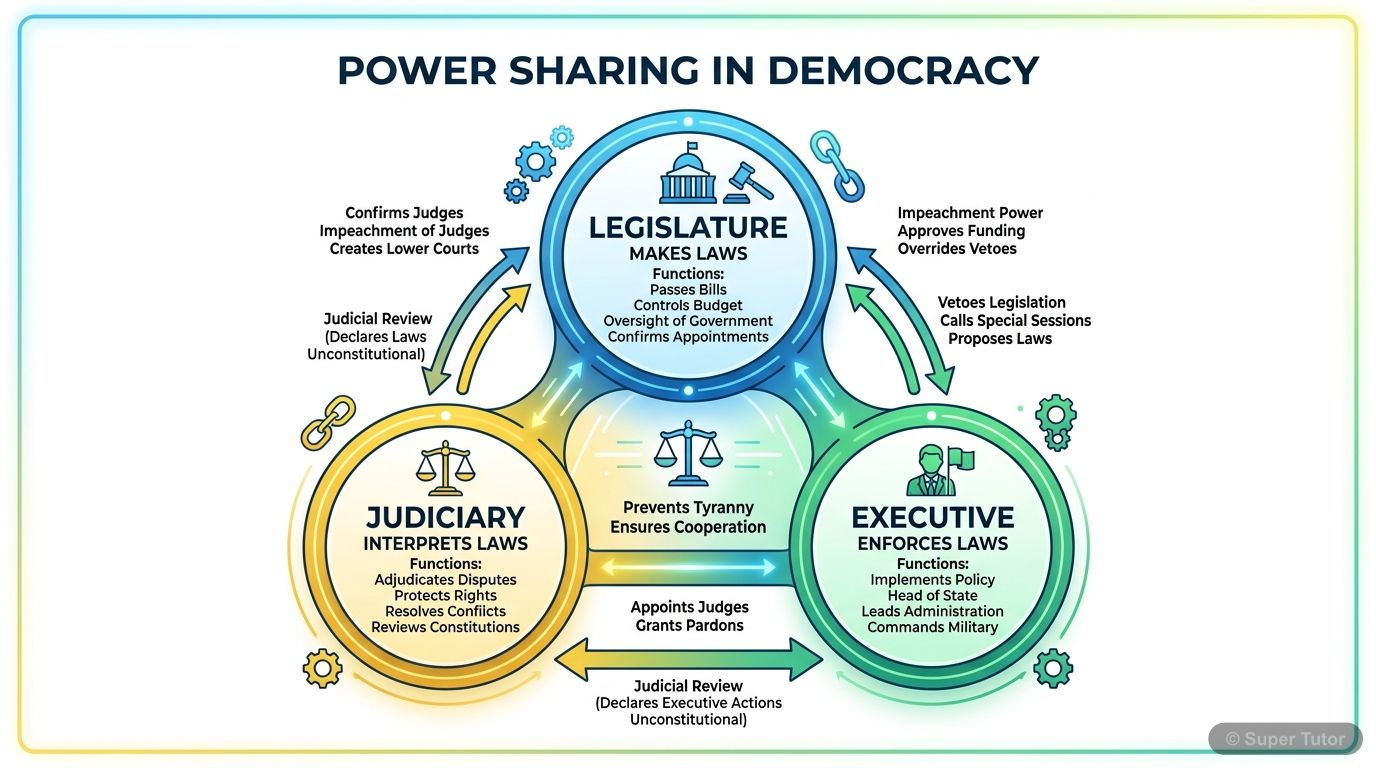
Learn better with visuals Super Tutor pairs illustrations like this with notes and quizzes for Power-sharing.
Key Topics to Revise
1. Why Power-sharing Matters
- A democracy works best when power is not concentrated in one hand.
- If one group forces its rule on others, social conflict can grow.
- Power-sharing helps maintain peace and stability in a country.
2. Belgium: Accommodation through Power-sharing
- Belgium is smaller in area than Haryana and has a population a little over one crore.
- 59% of Belgium's population lives in the Flemish region and speaks Dutch.
- 40% live in Wallonia and speak French.
3. Sri Lanka: Majoritarianism and Conflict
- Sri Lanka is an island nation off the southern coast of Tamil Nadu.
- It has about two crore people, about the same as Haryana.
- Sinhala-speakers are 74% of the population.
4. Why Power-sharing is Desirable
- Power-sharing reduces the chance of conflict between social groups.
- It helps prevent violence and political instability.
- Tyranny of the majority can harm the majority too, not only minorities.
Get complete notes with diagrams and examples
Full NotesKey Concepts
Frequently Asked Questions
What are the important topics in Power-sharing for Madhya Pradesh Board Class 10 Social Science?
How should I revise Power-sharing for the Madhya Pradesh Board Class 10 board exam?
Sources & Official References
Content is aligned to the official syllabus. Refer to the board website for the latest curriculum.
More resources for Power-sharing
Practice Quiz
Test yourself with a quick quiz
Important Questions
Exam-style questions with answers
Chapter Summary
Understand the chapter at a glance
Concept Maps
See how topics connect
Study Plan
Step-by-step plan for this chapter
Flashcards
Quick-fire cards for active recall
Syllabus
What topics to cover
NCERT Solutions
Every textbook question solved step by step
For serious students
Get the full Power-sharing chapter — start free.
Quizzes, flashcards, an AI doubt solver and a study plan for Madhya Pradesh Board Class 10 Social Science. Free to start, no card needed.