Business Environment — NCERT Solutions
Madhya Pradesh Board · Class 12 · Business Studies
NCERT Solutions for Business Environment, Madhya Pradesh Board Class 12 Business Studies: 14 textbook questions solved step by step.
Interactive on Super Tutor
Studying Business Environment? Get the full interactive chapter.
Quizzes, flashcards, AI doubt-solver and a step-by-step study plan — built for NCERT solutions and more.
Free trial, no card needed.
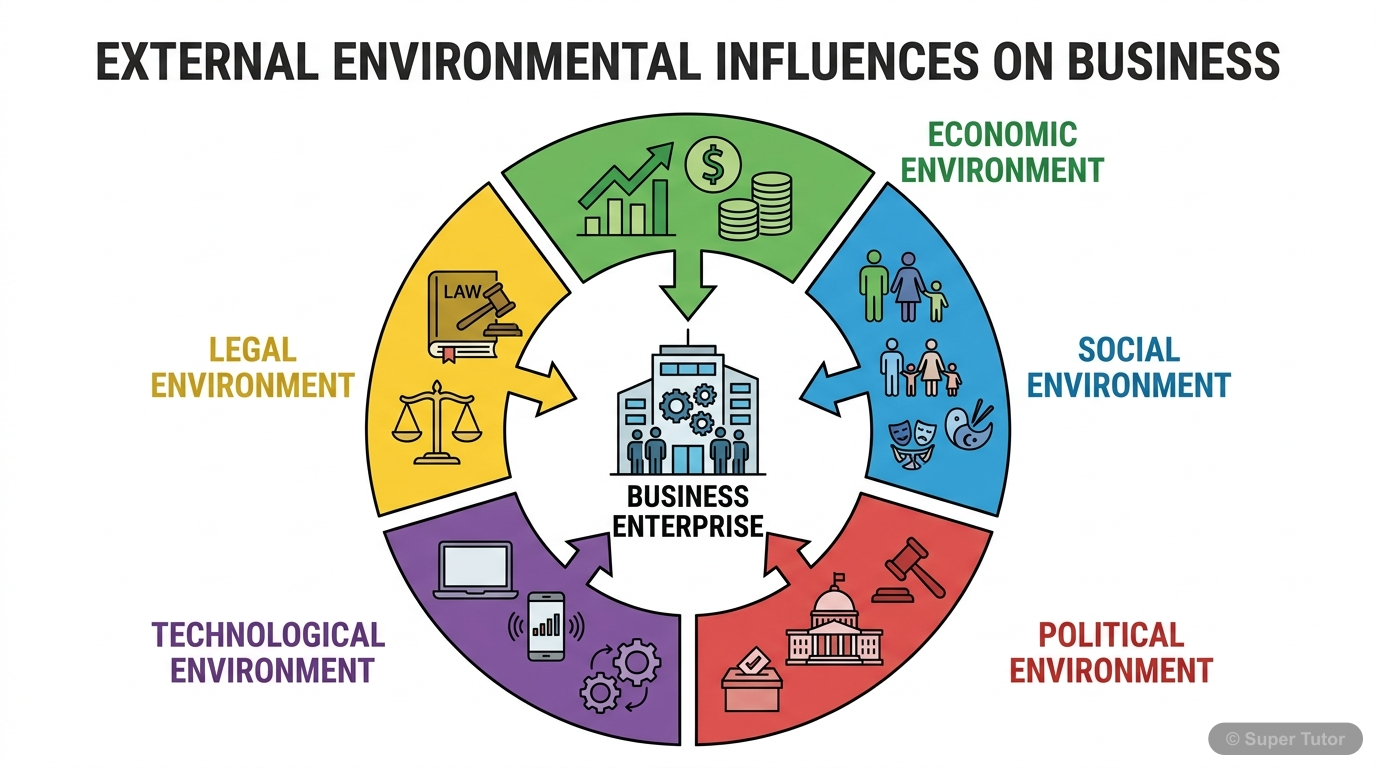
One of 11 illustrations for Business Environment in Super Tutor — alongside flashcards, concept maps and practice questions.
The first 7 solutions are open to read. The other 7 are free with a Super Tutor account.
Very Short Answer Type
1What is meant by business environment?Show solution
Business Environment — Meaning:
The term business environment refers to the totality of all individuals, institutions and other forces that are outside a business enterprise but that potentially affect its performance.
In other words, it is the sum total of all external forces — specific as well as general — that surround and influence the functioning of a business firm.
Key features of the definition:
- It includes all external forces (economic, social, political, legal, technological).
- These forces are outside the control of the business.
- They have a direct or indirect impact on business decisions and performance.
Example: Changes in government tax policy, consumer preferences, technological innovations, etc., all form part of the business environment.
2How does understanding of business environment help in improving performance of a business?Show solution
Understanding Business Environment and Performance Improvement:
Understanding the business environment helps in improving performance in the following ways:
- Identification of Opportunities: A firm that continuously monitors its environment can identify emerging opportunities (e.g., a new market segment) and exploit them before competitors — gaining first-mover advantage.
- Early Warning Signals: Understanding the environment helps managers detect threats (e.g., entry of a new competitor, change in consumer taste) early and take corrective action in time.
- Coping with Rapid Changes: Awareness of environmental changes (technological, legal, economic) enables firms to adapt quickly, thereby maintaining or improving their competitive position.
- Assistance in Planning and Policy: Environmental analysis provides the necessary information base for formulating realistic plans and policies aligned with external realities.
- Improving Overall Performance: When a business aligns its strategies with environmental realities, it operates more efficiently and effectively, leading to better performance.
Conclusion: Thus, a thorough understanding of the business environment enables managers to make informed decisions, which ultimately improves the performance of the enterprise.
3Give an example to show that a business firm operates within numerous inter-related factors constituting the business environment.Show solution
Inter-relatedness of Business Environment — Example:
Given Concept: The various dimensions of business environment are not isolated; they are closely inter-related and influence each other.
Example:
Suppose the Government of India (Political environment) decides to promote digital payments by reducing taxes on digital transactions (Economic environment). This encourages companies to develop new payment apps and software (Technological environment). Society gradually shifts its attitude towards cashless transactions (Social environment). New laws are enacted to regulate data privacy in digital payments (Legal environment).
This example clearly shows how a single policy decision in the political environment triggers changes in the economic, technological, social and legal environments simultaneously.
Conclusion: All dimensions of business environment are inter-related and a change in one dimension affects the others, making it essential for businesses to monitor all dimensions together.
4Krishna Furnishers Mart started its operations in the year 1954 and emerged as the market leader in the industry because of their original designs and efficiency in operations. They had a steady demand for their products but over the years, they found their market share declining because of new entrants in the field. The firm decided to review their operations and decided that in order to meet the competition, they need to study and analyze the market trends and then design and develop their products accordingly. List any two impacts of changes in business environment on Krishna Furnishers Mart's operations.Show solution
Two Impacts of Changes in Business Environment on Krishna Furnishers Mart:
1. Increase in Competition:
With the entry of new players in the furniture market, Krishna Furnishers Mart faced intense competition. Its market share declined as customers now had more choices. This forced the firm to review and improve its operations to remain competitive.
2. Market Orientation:
The firm realised that it could no longer rely solely on its traditional designs and operational efficiency. It had to shift from a production-oriented approach to a market-oriented approach — studying market trends, understanding customer preferences, and designing products accordingly to meet the demands of the changing market.
Conclusion: Changes in the business environment (entry of new competitors) compelled Krishna Furnishers Mart to become more competitive and market-driven in its operations.
5Name any two Specific forces of business environment affecting business.Show solution
Two Specific Forces of Business Environment:
Specific forces are those that directly and immediately affect the day-to-day operations of a business. They include:
- Investors/Shareholders: They provide capital to the business. Their confidence, expectations of returns, and investment decisions directly affect the financial health of the firm.
- Competitors: Rival firms in the same industry directly affect a business's pricing, product development, marketing strategies, and market share.
(Other examples of specific forces: Suppliers, Customers, Employees, Media)
Short Answer Type
1Why it is important for business enterprises to understand their environment? Explain.Show solution
Importance of Understanding Business Environment:
It is important for business enterprises to understand their environment for the following reasons:
1. Identification of Opportunities and First-Mover Advantage:
By scanning the environment, a firm can identify emerging opportunities (e.g., growing demand for organic food) and exploit them before competitors, thereby gaining a first-mover advantage.
2. Identification of Threats and Early Warning Signals:
Environmental understanding helps managers detect potential threats (e.g., entry of a foreign competitor, change in government policy) early, so that timely corrective measures can be taken.
3. Coping with Rapid Changes:
The business environment is dynamic and changes rapidly (e.g., technological innovations, changing consumer preferences). Understanding these changes helps firms adapt their strategies and remain relevant.
4. Assistance in Planning and Policy Formulation:
Environmental analysis provides crucial information about external factors, which helps managers formulate realistic and effective plans and policies. For example, knowledge of an upcoming recession helps a firm plan its inventory and pricing strategy.
5. Improving Performance:
When a business continuously monitors and responds to its environment, it can align its resources and capabilities with external opportunities, leading to improved efficiency and overall performance.
Conclusion: A thorough understanding of the business environment is essential for survival, growth and long-term success of any business enterprise.
2Explain the following terms: a. Liberalisation b. Privatisation c. GlobalisationShow solution
a. Liberalisation:
Meaning: Liberalisation refers to the freeing of the Indian industry from the shackles of the licensing system and other unnecessary government controls and restrictions.
Key measures under Liberalisation (1991):
- Abolition of industrial licensing for most industries.
- Freedom to expand production capacity.
- Removal of restrictions on the movement of goods and services.
- Reduction in import duties and simplification of export-import procedures.
- Freedom to fix prices of goods and services.
Effect: It gave Indian businesses greater freedom to operate, expand and compete.
b. Privatisation:
Meaning: Privatisation refers to the reduction of the role of the public sector and the increase in the role of the private sector in the economy.
Key measures under Privatisation (1991):
- Reduction in the number of industries reserved exclusively for the public sector (from 17 to 3).
- Disinvestment of government equity in public sector undertakings (PSUs).
- Encouraging private sector participation in areas previously reserved for the government.
Effect: It improved efficiency and accountability in industries as private firms are profit-driven and more competitive.
c. Globalisation:
Meaning: Globalisation refers to the integration of the Indian economy with the world economy by encouraging foreign private participation in industrial development and removing barriers to international trade and investment.
Key measures under Globalisation (1991):
- Allowing Foreign Direct Investment (FDI) in various sectors.
- Reduction of import tariffs and removal of quantitative restrictions.
- Making the rupee convertible on the current account.
- Encouraging Indian firms to invest abroad.
Effect: It exposed Indian businesses to global competition and also opened up vast international markets for Indian goods and services.
Free with a Super Tutor account
Free with a Super Tutor account
Long Answer Type
Free with a Super Tutor account
Free with a Super Tutor account
Free with a Super Tutor account
Free with a Super Tutor account
Free with a Super Tutor account
7 more solved questions in Business Environment
They are free with a Super Tutor account, along with practice quizzes and flashcards for this chapter. Free to start, no card needed.
Frequently Asked Questions
What are the important topics in Business Environment for Madhya Pradesh Board Class 12 Business Studies?
Are these NCERT Solutions for Business Environment free?
How should I revise Business Environment for the Madhya Pradesh Board Class 12 board exam?
Sources & Official References
Content is aligned to the official syllabus. Refer to the board website for the latest curriculum.
More resources for Business Environment
Practice Quiz
Test yourself with a quick quiz
Important Questions
Exam-style questions with answers
Revision Notes
Key points for last-minute revision
Chapter Summary
Understand the chapter at a glance
Concept Maps
See how topics connect
Study Plan
Step-by-step plan for this chapter
Flashcards
Quick-fire cards for active recall
Syllabus
What topics to cover
For serious students
Get the full Business Environment chapter — start free.
Quizzes, flashcards, an AI doubt solver and a study plan for Madhya Pradesh Board Class 12 Business Studies. Free to start, no card needed.