Directing — NCERT Solutions
Madhya Pradesh Board · Class 12 · Business Studies
NCERT Solutions for Directing, Madhya Pradesh Board Class 12 Business Studies: 14 textbook questions solved step by step.
Interactive on Super Tutor
Studying Directing? Get the full interactive chapter.
Quizzes, flashcards, AI doubt-solver and a step-by-step study plan — built for NCERT solutions and more.
Free trial, no card needed.
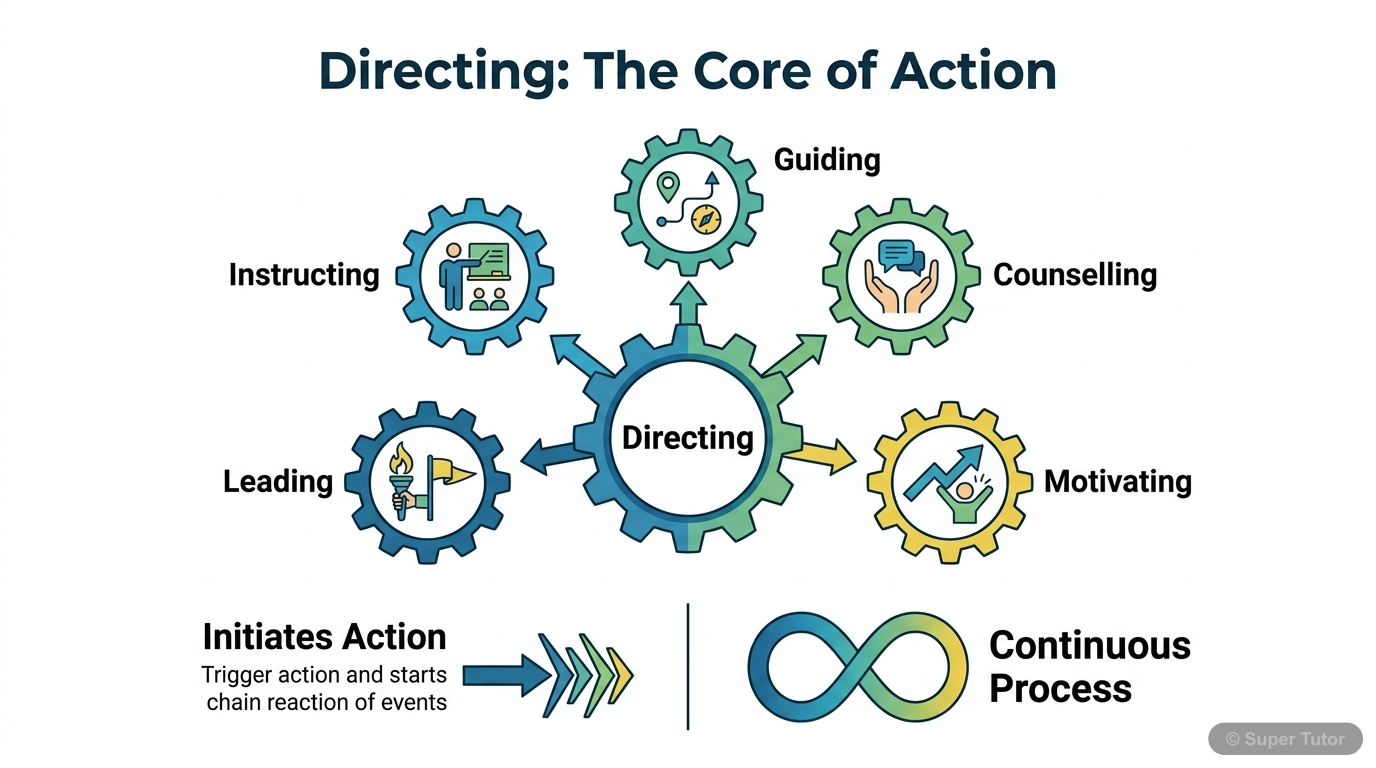
One of 18 illustrations for Directing in Super Tutor — alongside flashcards, concept maps and practice questions.
The first 7 solutions are open to read. The other 7 are free with a Super Tutor account.
Very Short Answer Type
1What is informal communication?Show solution
Informal Communication:
Informal communication refers to the communication that takes place outside the official or formal channels of an organisation. It is not prescribed by the organisation and arises out of social interactions among employees.
Key features:
- It is unofficial, spontaneous, and unrecorded.
- It spreads very fast and is usually in the form of rumours, whispers, or gossip.
- It does not follow any fixed path or hierarchy.
- It is also known as grapevine communication.
Example: Two employees discussing a management decision informally in the cafeteria.
2Which style of leadership does not believe in use of power unless it is absolutely essential?Show solution
Answer: Democratic (Participative) Leadership Style — However, more precisely, the leadership style that does not believe in the use of power unless absolutely essential is the Laissez-faire (Free-rein) Leadership Style.
Explanation: In the laissez-faire style, the leader gives complete freedom to subordinates to make decisions. The leader avoids using authority or power and interferes only when it is absolutely necessary. Subordinates are trusted to manage their own work with minimal supervision.
3Which element in the communication process involves converting the message into words, symbols, gestures etc.?Show solution
Answer: Encoding
Explanation: Encoding is the element of the communication process in which the sender converts the idea or message into words, symbols, gestures, pictures, or any other form that can be transmitted to the receiver. It is the process of putting thoughts into a communicable format.
Example: A manager writing a memo or using sign language to convey a message is performing the act of encoding.
4The workers always try to show their inability when any new work is given to them. They are always unwilling to take up any kind of work. Due to sudden rise in demand a firm wants to meet excess orders. The supervisor is finding it difficult to cope up with the situation. State the element of directing that can help the supervisor in handling the problem.Show solution
Answer: Motivation
Explanation:
- Given: Workers are unwilling to work, show inability when given new tasks, and the supervisor is struggling to meet excess orders due to sudden rise in demand.
- Element of Directing: Motivation is the element that can help the supervisor handle this problem.
Reason: Motivation is the process of stimulating people to action to accomplish desired goals. Since the workers are unwilling and show inability, the supervisor needs to motivate them by offering appropriate financial incentives (such as bonus, overtime pay) or non-financial incentives (such as recognition, praise, job enrichment) to encourage them to work harder and meet the excess orders.
Motivation will stimulate the internal drive of workers, change their attitude from unwillingness to willingness, and help the organisation meet its targets.
Short Answer Type
1What are semantic barriers of communication?Show solution
Semantic Barriers of Communication:
Semantic barriers arise from the use of language and relate to the meaning of words, symbols, and gestures used in communication. These barriers occur when the sender and receiver interpret the same message differently.
Main types of Semantic Barriers:
- Badly expressed message: When the message is poorly worded, uses jargon, or is ambiguous, it leads to misunderstanding. For example, using technical terms that the receiver does not understand.
- Symbols with different meanings: A single word may have multiple meanings. For example, the word 'value' can mean price, importance, or moral principles. If the sender and receiver interpret it differently, communication fails.
- Faulty translation: When a message is translated from one language to another, the original meaning may be lost or distorted.
- Unclarified assumptions: Sometimes the sender assumes that the receiver understands certain background information, which may not be the case, leading to confusion.
- Technical jargon: Use of highly technical or specialised language that the receiver is not familiar with creates a barrier.
Conclusion: Semantic barriers can be overcome by using simple, clear, and precise language and by ensuring that the message is understood in the intended sense.
2Explain the process of motivation with the help of a diagram.Show solution
Process of Motivation:
Motivation is the process of stimulating people to action to accomplish desired goals. It is based on the needs of individuals.
Steps in the Process of Motivation:
Step 1 – Unsatisfied Need: Every individual has certain needs that are unsatisfied. These unsatisfied needs create a state of tension or discomfort in the individual.
Step 2 – Tension: The unsatisfied need creates internal tension (physical or psychological) in the individual.
Step 3 – Drive: The tension leads to a drive or urge within the individual to take some action to satisfy the need.
Step 4 – Search Behaviour: The individual searches for ways and means to satisfy the need and reduce the tension.
Step 5 – Satisfied Need: The individual takes action and the need gets satisfied.
Step 6 – Reduction of Tension: Once the need is satisfied, the tension is reduced and the individual returns to a state of equilibrium.
Diagram:
This cycle repeats as new needs arise, making motivation a continuous and dynamic process.
Conclusion: The process of motivation is cyclical in nature. As one need is satisfied, another need emerges, and the process begins again.
3State the different networks of grapevine communications.Show solution
Networks of Grapevine Communication:
Grapevine (informal) communication does not follow a fixed path. It spreads through various networks. The main networks are:
- Single Strand Network: In this network, each person communicates with the next person in a sequence, i.e., A tells B, B tells C, C tells D, and so on. The information passes through a chain of individuals one by one.
- Gossip Network: In this network, one person communicates with all others directly. A single individual acts as the central source and spreads the information to everyone else. It is like a wheel with one person at the hub.
- Probability Network: In this network, the individual communicates randomly with other individuals. The sender passes the message to anyone they meet by chance, and those people further pass it randomly.
- Cluster Network: In this network, one person tells a selected group of people (a cluster), and then some members of that group tell another selected group, and so on. This is the most common form of grapevine communication.
Conclusion: Among all the networks, the Cluster Network is the most popular and widely observed in organisations.
Free with a Super Tutor account
Free with a Super Tutor account
Free with a Super Tutor account
Long Answer Type
Free with a Super Tutor account
Free with a Super Tutor account
Free with a Super Tutor account
Free with a Super Tutor account
7 more solved questions in Directing
They are free with a Super Tutor account, along with practice quizzes and flashcards for this chapter. Free to start, no card needed.
Frequently Asked Questions
What are the important topics in Directing for Madhya Pradesh Board Class 12 Business Studies?
Are these NCERT Solutions for Directing free?
How should I revise Directing for the Madhya Pradesh Board Class 12 board exam?
Sources & Official References
Content is aligned to the official syllabus. Refer to the board website for the latest curriculum.
More resources for Directing
Practice Quiz
Test yourself with a quick quiz
Important Questions
Exam-style questions with answers
Revision Notes
Key points for last-minute revision
Chapter Summary
Understand the chapter at a glance
Concept Maps
See how topics connect
Study Plan
Step-by-step plan for this chapter
Flashcards
Quick-fire cards for active recall
Syllabus
What topics to cover
For serious students
Get the full Directing chapter — start free.
Quizzes, flashcards, an AI doubt solver and a study plan for Madhya Pradesh Board Class 12 Business Studies. Free to start, no card needed.