Financial Management — NCERT Solutions
Madhya Pradesh Board · Class 12 · Business Studies
NCERT Solutions for Financial Management, Madhya Pradesh Board Class 12 Business Studies: 18 textbook questions solved step by step.
Interactive on Super Tutor
Studying Financial Management? Get the full interactive chapter.
Quizzes, flashcards, AI doubt-solver and a step-by-step study plan — built for NCERT solutions and more.
Free trial, no card needed.
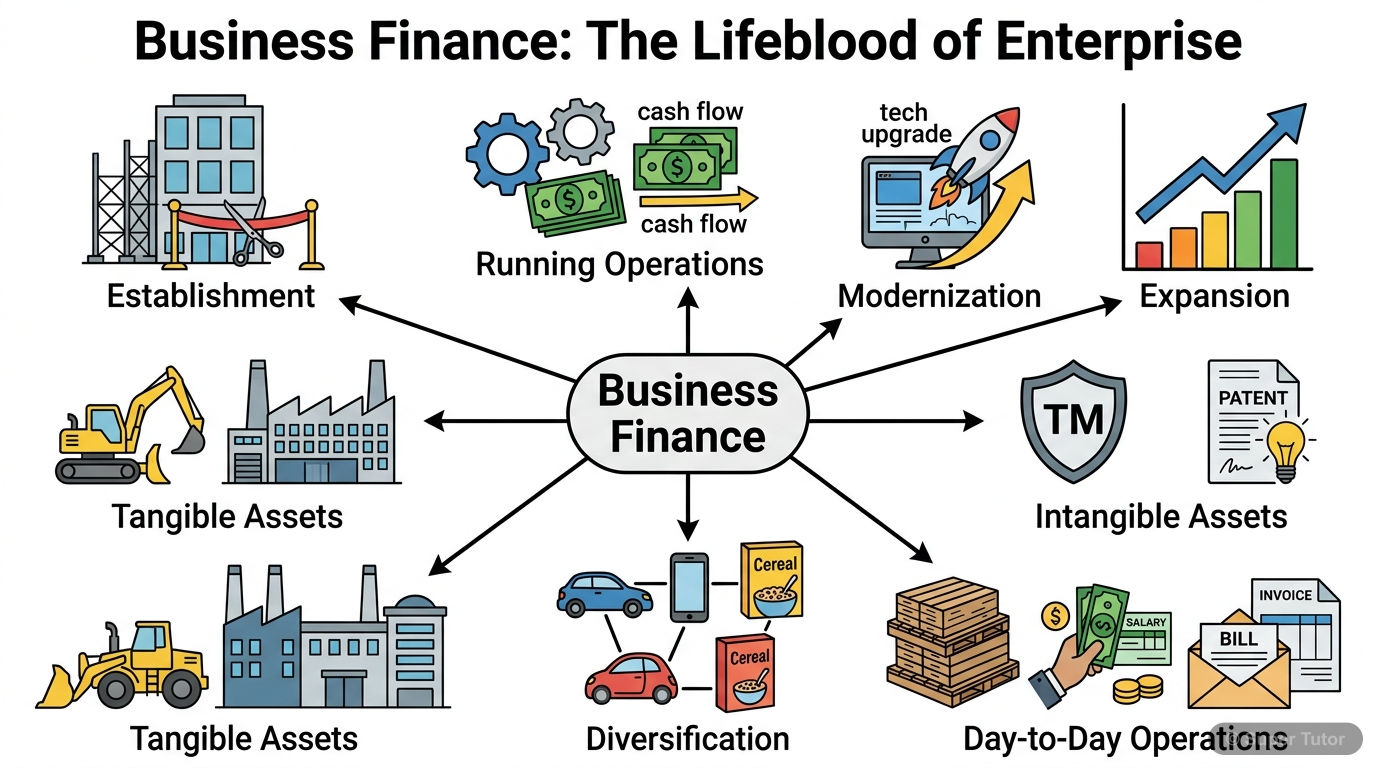
One of 13 illustrations for Financial Management in Super Tutor — alongside flashcards, concept maps and practice questions.
The first 9 solutions are open to read. The other 9 are free with a Super Tutor account.
EXERCISES — Very Short Answer Type
1What is meant by capital structure?Show solution
Given/Concept: Capital structure is a term used in financial management referring to the composition of funds used by a firm.
Answer:
Capital structure refers to the mix or proportion of owners' funds (equity) and borrowed funds (debt) used by a firm to finance its assets and operations.
- Owners' funds include equity share capital, preference share capital, and retained earnings.
- Borrowed funds include debentures, long-term loans, bonds, etc.
The capital structure decision involves determining the relative proportion of these two broad categories of funds so as to minimise the cost of capital and maximise the value of the firm.
Example: If a company raises ₹60 lakh through equity and ₹40 lakh through debt, its capital structure is 60:40 (equity : debt).
2State the two objectives of financial planning.Show solution
Given/Concept: Financial planning is the preparation of a financial blueprint of an organisation's future operations.
The two main objectives of financial planning are:
- To ensure availability of funds whenever required: Financial planning estimates the funds needed at various points of time so that the business does not face a shortage of funds and can carry out its operations smoothly.
- To ensure that the firm does not raise resources unnecessarily: Excess funding leads to unnecessary costs (e.g., interest on idle borrowed funds). Financial planning ensures that funds are raised only to the extent needed, avoiding wastage and over-capitalisation.
In short, financial planning aims at neither a shortage nor a surplus of funds.
3Name the concept of financial management which increases the return to equity shareholders due to the presence of fixed financial charges.Show solution
Answer: The concept is Trading on Equity (also called Financial Leverage).
Explanation: When a company uses borrowed funds (which carry fixed interest charges) along with equity, and if the rate of return on investment (ROI) is higher than the cost of debt, the surplus return (after paying fixed interest) goes to the equity shareholders. This increases the Earnings Per Share (EPS) and hence the return to equity shareholders.
For example, if ROI = 15% and cost of debt = 10%, the extra 5% benefit accrues to equity shareholders, thereby increasing their returns.
4Amrit is running a 'transport service' and earning good returns by providing this service to industries. Giving reason, state whether the working capital requirement of the firm will be 'less' or 'more'.Show solution
Given: Amrit runs a transport service business.
Answer: The working capital requirement of the firm will be LESS.
Reason:
- A transport service is a service sector business. It does not deal in physical goods, so there is no need to maintain inventories (raw materials, work-in-progress, or finished goods).
- Service businesses generally have quick cash realisations as services are rendered and payment is received promptly.
- Since the major investment is in fixed assets (vehicles, equipment) rather than current assets, the working capital requirement is relatively low compared to manufacturing businesses.
5Ramnath is into the business of assembling and selling of televisions. Recently he has adopted a new policy of purchasing the components on three months credit and selling the complete product in cash. Will it affect the requirement of working capital? Give reason in support of your answer.Show solution
Given:
- Purchases components on 3 months credit (Credit Availed = 3 months).
- Sells the complete product in cash (Credit Allowed = 0).
Answer: Yes, this new policy will reduce the working capital requirement significantly.
Reason:
- Credit Availed (Creditors): By purchasing on 3 months credit, Ramnath does not need to pay immediately for raw materials/components. This means his creditors act as a source of short-term finance, reducing the funds he needs to block in current assets.
- Cash Sales (No Debtors): By selling in cash, there are no debtors or receivables. The firm receives money immediately upon sale, so no funds are tied up in debtors.
Conclusion: The combination of buying on credit and selling for cash reduces the operating cycle and hence lowers the working capital requirement of the business.
EXERCISES — Short Answer Type
1What is financial risk? Why does it arise?Show solution
Financial Risk:
Financial risk refers to the risk of a company being unable to meet its fixed financial obligations (such as interest payments on debt, preference dividends, or repayment of principal) out of its earnings. It is the risk of insolvency or financial distress arising from the use of debt (borrowed funds) in the capital structure.
Why does it arise?
Financial risk arises due to the following reasons:
- Use of Debt/Borrowed Funds: When a company uses debt in its capital structure, it is obligated to pay fixed interest charges regardless of whether it earns profits or not. If earnings are insufficient to cover these charges, the firm faces financial risk.
- Fixed Financial Charges: Preference dividends and loan repayments are fixed obligations. Failure to meet them can lead to legal action by creditors.
- Variability in EBIT: If the company's Earnings Before Interest and Tax (EBIT) fluctuates, there is a risk that it may fall below the level required to service debt.
In summary: Financial risk arises because of the presence of fixed-cost financing (debt) in the capital structure. Higher the proportion of debt, higher is the financial risk.
2Define current assets? Give four examples of such assets.Show solution
Definition of Current Assets:
Current assets are those assets which are held for a short period (generally up to one year or one operating cycle, whichever is longer) and can be converted into cash quickly in the normal course of business operations. They are also called short-term assets or liquid assets.
They are used to support the day-to-day operations of the business.
Four Examples of Current Assets:
| S.No. | Current Asset |
|---|---|
| 1. | Cash and Cash Equivalents (cash in hand, cash at bank) |
| 2. | Debtors / Accounts Receivable (amounts owed by customers) |
| 3. | Inventories / Stock (raw materials, work-in-progress, finished goods) |
| 4. | Marketable Securities / Short-term Investments (treasury bills, short-term bonds) |
Other examples include prepaid expenses and bills receivable.
3What are the main objectives of financial management? Briefly explain.Show solution
Main Objectives of Financial Management:
The primary objective of financial management is:
Wealth Maximisation (Shareholders' Wealth Maximisation)
The main aim is to maximise the market value of equity shares (i.e., the wealth of shareholders). This is considered superior to profit maximisation because:
- It considers the time value of money.
- It accounts for risk associated with future cash flows.
- It focuses on long-term value creation rather than short-term profits.
The market price of shares reflects the three key financial decisions:
- Investment Decision (Capital Budgeting): Deciding where to invest funds in long-term assets to generate maximum returns. It involves evaluating projects using techniques like NPV, IRR, etc.
- Financing Decision (Capital Structure): Deciding the optimal mix of debt and equity to minimise the cost of capital and maximise the value of the firm.
- Dividend Decision: Deciding how much of the profit should be distributed to shareholders as dividends and how much should be retained for reinvestment (retained earnings).
Conclusion: All three decisions together aim at maximising shareholders' wealth, which is the ultimate objective of financial management.
4Financial management is based on three broad financial decisions. What are these?Show solution
The Three Broad Financial Decisions in Financial Management:
1. Investment Decision (Capital Budgeting Decision)
- This decision relates to how the firm's funds are invested in different assets.
- It involves evaluating and selecting long-term investment proposals (fixed assets like plant, machinery, land) as well as short-term investments (working capital management).
- The key criterion is that the investment should generate returns greater than the minimum acceptable return (hurdle rate).
- Tools used: Net Present Value (NPV), Internal Rate of Return (IRR), Payback Period.
2. Financing Decision (Capital Structure Decision)
- This decision relates to how the firm raises funds to finance its investments.
- It involves determining the optimal mix of debt (borrowed funds) and equity (owners' funds).
- The goal is to minimise the cost of capital and maximise the value of the firm.
- Key consideration: Use of debt increases financial risk but can enhance returns to equity shareholders (Trading on Equity).
3. Dividend Decision
- This decision relates to how much of the net profit is distributed to shareholders as dividends and how much is retained in the business as retained earnings.
- Factors considered: Earnings stability, growth opportunities, shareholders' preferences, legal constraints, and cash flow position.
- A higher dividend may satisfy shareholders but reduces funds available for reinvestment.
All three decisions are interrelated and together determine the market value of the firm's shares and hence the wealth of shareholders.
Free with a Super Tutor account
Free with a Super Tutor account
a. Identify the financial concept discussed in the above paragraph. Also, state the objectives to be achieved by the use of financial concept so identified.
b. 'There is no restriction on payment of dividend by a company'. Comment.
Free with a Super Tutor account
EXERCISES — Long Answer Type
Free with a Super Tutor account
Free with a Super Tutor account
Free with a Super Tutor account
Free with a Super Tutor account
Free with a Super Tutor account
a. Describe the role and objectives of financial management for this company.
b. Explain the importance of having a financial plan for this company. Give an imaginary plan to support your answer.
c. What are the factors which will affect the capital structure of this company?
d. Keeping in mind that it is a highly capital-intensive sector, what factors will affect the fixed and working capital. Give reasons in support of your answer.
Free with a Super Tutor account
9 more solved questions in Financial Management
They are free with a Super Tutor account, along with practice quizzes and flashcards for this chapter. Free to start, no card needed.
Frequently Asked Questions
What are the important topics in Financial Management for Madhya Pradesh Board Class 12 Business Studies?
Are these NCERT Solutions for Financial Management free?
How should I revise Financial Management for the Madhya Pradesh Board Class 12 board exam?
Sources & Official References
Content is aligned to the official syllabus. Refer to the board website for the latest curriculum.
More resources for Financial Management
Practice Quiz
Test yourself with a quick quiz
Important Questions
Exam-style questions with answers
Revision Notes
Key points for last-minute revision
Formula Sheet
The chapter's formulas in one place
Chapter Summary
Understand the chapter at a glance
Concept Maps
See how topics connect
Study Plan
Step-by-step plan for this chapter
Flashcards
Quick-fire cards for active recall
Syllabus
What topics to cover
For serious students
Get the full Financial Management chapter — start free.
Quizzes, flashcards, an AI doubt solver and a study plan for Madhya Pradesh Board Class 12 Business Studies. Free to start, no card needed.