Organizing — NCERT Solutions
Madhya Pradesh Board · Class 12 · Business Studies
NCERT Solutions for Organizing, Madhya Pradesh Board Class 12 Business Studies: 20 textbook questions solved step by step.
Interactive on Super Tutor
Studying Organizing? Get the full interactive chapter.
Quizzes, flashcards, AI doubt-solver and a step-by-step study plan — built for NCERT solutions and more.
Free trial, no card needed.
One of 8 illustrations for Organizing in Super Tutor — alongside flashcards, concept maps and practice questions.
The first 10 solutions are open to read. The other 10 are free with a Super Tutor account.
Very Short Answer Type
1Identify the network of social relationships which arises spontaneously due to interaction at work.Show solution
The network of social relationships which arises spontaneously due to interaction at work is called Informal Organisation.
It emerges naturally from the social interactions among employees and is not deliberately created by management. It exists within the formal organisation and is based on personal relationships, common interests, and friendships.
2What does the term 'Span of management' refer to?Show solution
Span of Management (also called Span of Control) refers to the number of subordinates that a manager or superior can effectively supervise and manage at a given point of time.
- A wider span means more subordinates under one manager, leading to a flat organisational structure.
- A narrower span means fewer subordinates under one manager, leading to a tall organisational structure.
The span of management determines the levels of management in an organisation.
3State any two circumstances under which the functional structure will prove to be an appropriate choice.Show solution
Functional structure is an appropriate choice under the following two circumstances:
- When the organisation is large in size and has a single product line or limited range of products: Since activities can be grouped by functions (e.g., Production, Marketing, Finance, HR), it ensures specialisation and efficiency.
- When the organisation requires a high degree of specialisation: Functional structure groups similar activities together, allowing employees to develop expertise in their respective functional areas, which is beneficial when technical specialisation is critical to the organisation's success.
4Draw a diagram depicting a functional structure.Show solution
A functional organisational structure groups activities on the basis of functions performed. The diagram is as follows:
Description: At the top is the Managing Director. Below the MD, the organisation is divided into functional departments — Production, Marketing, Finance, and Human Resources. Each department is headed by a functional manager who supervises the staff within that function.
5A company has its registered office in Delhi, manufacturing unit at Gurgaon and marketing and sales department at Faridabad. The company manufactures consumer products. Which type of organisational structure should it adopt to achieve its target?Show solution
Given: The company has operations spread across different locations — registered office in Delhi, manufacturing at Gurgaon, and marketing/sales at Faridabad. It manufactures consumer products.
Recommended Structure: Functional Organisational Structure
Reasons:
- The company is dealing in a single line of consumer products, which makes functional grouping of activities (Production, Marketing, Finance, etc.) appropriate.
- Since the company has distinct functional activities — manufacturing and marketing/sales — a functional structure allows each department to specialise in its area.
- It ensures better coordination among the different functional departments spread across locations.
- It promotes managerial efficiency as each functional head is an expert in their domain.
Thus, a Functional Structure is the most suitable choice for this company.
Short Answer Type
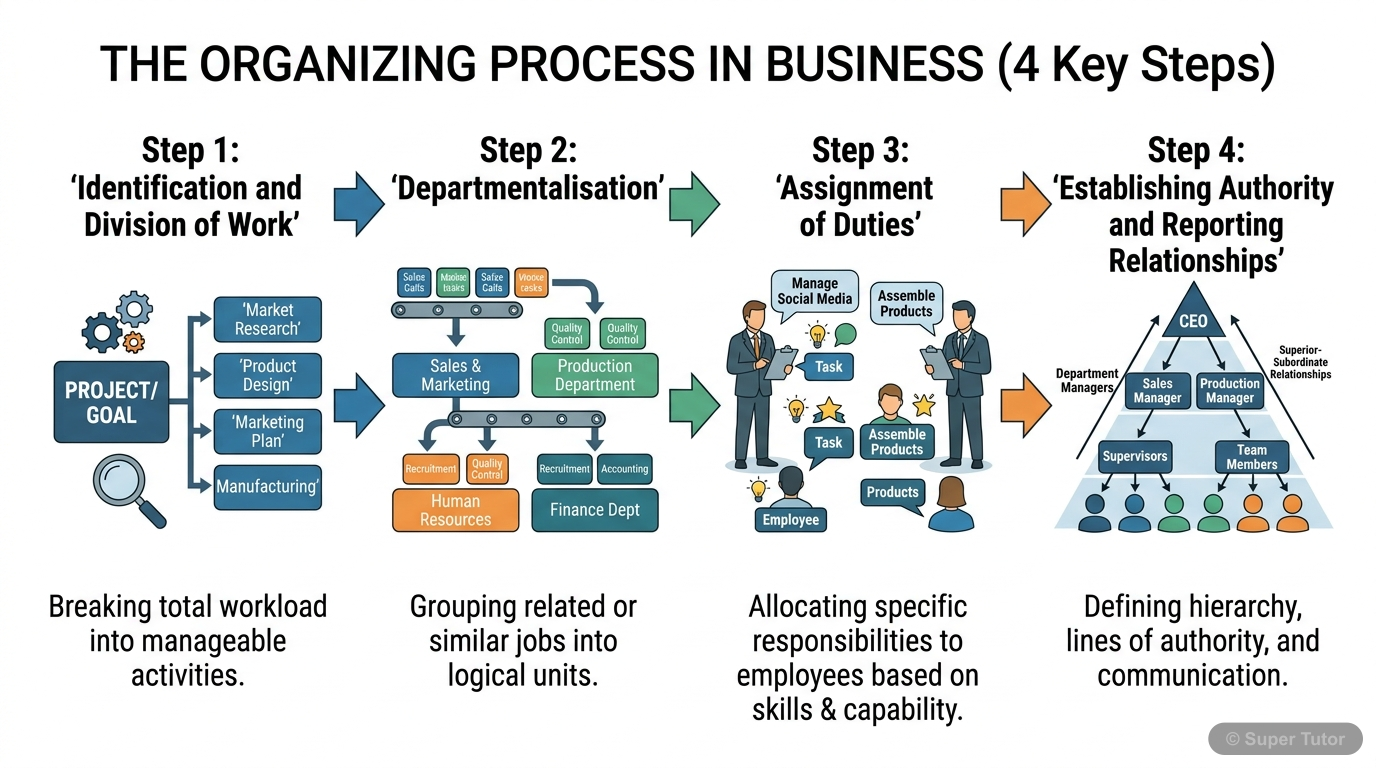
1What are the steps in the process of organising?Show solution
Organising is the process of defining and grouping activities and establishing authority relationships among them. The steps in the process of organising are:
Step 1: Identification and Division of Work
- The total work to be done is divided into specific jobs and tasks.
- This avoids duplication of effort and ensures that all activities necessary to achieve goals are assigned.
Step 2: Departmentalisation
- Similar and related activities are grouped together into departments or units.
- This grouping can be done on the basis of functions, products, territory, customers, etc.
- Example: All marketing activities are grouped under the Marketing Department.
Step 3: Assignment of Duties
- Once departments are formed, each department is placed under the charge of an individual (manager).
- Jobs are assigned to individuals based on their skills, qualifications, and competencies.
- This ensures that the right person is doing the right job.
Step 4: Establishing Reporting Relationships
- After assigning duties, authority and responsibility are defined.
- A clear chain of command is established so that every individual knows who they report to and who reports to them.
- This creates a hierarchy and ensures coordination among departments.
These four steps together complete the process of organising and help in achieving organisational goals effectively.
2Discuss the elements of delegation.Show solution
Delegation is the process by which a manager transfers some of his/her authority and responsibility to subordinates for the accomplishment of specific tasks. It has three interrelated elements:
1. Authority
- Authority refers to the right of an individual to command subordinates and to take decisions within the scope of his/her position.
- It flows downward from superior to subordinate.
- Without authority, a subordinate cannot perform the assigned task effectively.
- Example: A production manager has the authority to direct workers and requisition materials.
2. Responsibility
- Responsibility is the obligation of a subordinate to perform the assigned duty to the best of his/her ability.
- It flows upward — the subordinate is responsible to the superior for the completion of the task.
- Responsibility cannot be fully delegated; the superior remains ultimately responsible.
- Example: The foreman is responsible for achieving the production target assigned by the manager.
3. Accountability
- Accountability means being answerable for the final outcome of the assigned task.
- It flows upward — the subordinate is accountable to the superior for the use of authority and performance of responsibility.
- Unlike authority, accountability cannot be delegated at all.
- Example: If the foreman fails to meet the target, he is accountable to the production manager.
Relationship among the three elements:
All three elements must be balanced — authority should be commensurate with responsibility.
3How does informal organisation support the formal organisation?Show solution
Informal organisation arises spontaneously out of social interactions among employees at the workplace. It supports the formal organisation in the following ways:
- Faster Communication: Informal channels (grapevine) spread information quickly, which supplements the slow formal channels and helps in faster decision-making.
- Fulfillment of Social Needs: Informal organisation satisfies the social and psychological needs of employees (need for belonging, recognition, friendship), which increases their morale and job satisfaction, thereby improving productivity.
- Fills Gaps in Formal Structure: Formal organisation cannot anticipate every situation. Informal organisation fills the gaps and inadequacies of the formal structure by providing flexibility and adaptability.
- Feedback to Management: Informal groups provide managers with useful feedback about employee feelings, attitudes, and concerns, which helps management take corrective action.
- Promotes Cooperation: Informal relationships foster a spirit of teamwork and cooperation among employees, which supports the achievement of formal organisational goals.
Thus, informal organisation acts as a complement to the formal organisation and makes it more effective.
4Can a large sized organisation be totally centralised or decentralised? Give your opinion.Show solution
No, a large-sized organisation cannot be totally centralised or totally decentralised. Both extremes are impractical and undesirable.
Why Total Centralisation is Not Possible:
- In a large organisation, the top management cannot handle all decisions alone due to the sheer volume and complexity of work.
- It would lead to delays in decision-making, overburdening of top management, and inability to respond quickly to local/operational problems.
- Lower-level managers and employees would feel demotivated as they have no authority.
Why Total Decentralisation is Not Possible:
- If all authority is delegated to lower levels, there would be no coordination and the organisation would lose its unity of direction.
- Top management would lose control over operations, leading to chaos and conflicting decisions.
- Strategic decisions require centralised authority to maintain consistency and alignment with organisational goals.
Opinion:
A large organisation should maintain a balance between centralisation and decentralisation. Routine and operational decisions should be decentralised to lower levels for speed and efficiency, while strategic and policy decisions should remain centralised with top management. This ensures both control and flexibility, which is essential for the effective functioning of a large organisation.
5Decentralisation is extending delegation to the lowest level. Comment.Show solution
Yes, the given statement is largely correct. Decentralisation is indeed an extension of delegation throughout the organisation, including to the lowest levels.
Delegation vs. Decentralisation:
| Basis | Delegation | Decentralisation |
|---|---|---|
| Meaning | Transfer of authority from one superior to one subordinate | Systematic dispersal of authority throughout the organisation |
| Scope | Limited — between two individuals | Wide — throughout the organisation |
| Purpose | To reduce workload of manager | To increase role of lower-level managers |
| Nature | A process | A philosophy/policy |
Explanation:
- Delegation is the process by which a manager assigns some of his/her authority to a subordinate. It is a one-to-one transfer.
- Decentralisation is the result of systematically delegating authority at all levels of the organisation — from top management to middle management to lower management and even to the operational level.
- When delegation is extended throughout the organisation and becomes a policy rather than an individual act, it becomes decentralisation.
Conclusion:
Decentralisation is not merely delegation — it is delegation extended to the lowest level of the organisation as a deliberate policy. It represents a philosophy of management where decision-making authority is spread across all levels, enabling faster decisions, greater motivation, and better utilisation of managerial talent at all levels.
Free with a Super Tutor account
Free with a Super Tutor account
Long Answer Type
Free with a Super Tutor account
Free with a Super Tutor account
Free with a Super Tutor account
Free with a Super Tutor account
Free with a Super Tutor account
Free with a Super Tutor account
Free with a Super Tutor account
Free with a Super Tutor account
10 more solved questions in Organizing
They are free with a Super Tutor account, along with practice quizzes and flashcards for this chapter. Free to start, no card needed.
Frequently Asked Questions
What are the important topics in Organizing for Madhya Pradesh Board Class 12 Business Studies?
Are these NCERT Solutions for Organizing free?
How should I revise Organizing for the Madhya Pradesh Board Class 12 board exam?
Sources & Official References
Content is aligned to the official syllabus. Refer to the board website for the latest curriculum.
More resources for Organizing
Practice Quiz
Test yourself with a quick quiz
Important Questions
Exam-style questions with answers
Revision Notes
Key points for last-minute revision
Chapter Summary
Understand the chapter at a glance
Concept Maps
See how topics connect
Study Plan
Step-by-step plan for this chapter
Flashcards
Quick-fire cards for active recall
Syllabus
What topics to cover
For serious students
Get the full Organizing chapter — start free.
Quizzes, flashcards, an AI doubt solver and a study plan for Madhya Pradesh Board Class 12 Business Studies. Free to start, no card needed.