Controlling — NCERT Solutions
Madhya Pradesh Board · Class 12 · Business Studies
NCERT Solutions for Controlling, Madhya Pradesh Board Class 12 Business Studies: 15 textbook questions solved step by step.
Interactive on Super Tutor
Studying Controlling? Get the full interactive chapter.
Quizzes, flashcards, AI doubt-solver and a step-by-step study plan — built for NCERT solutions and more.
Free trial, no card needed.
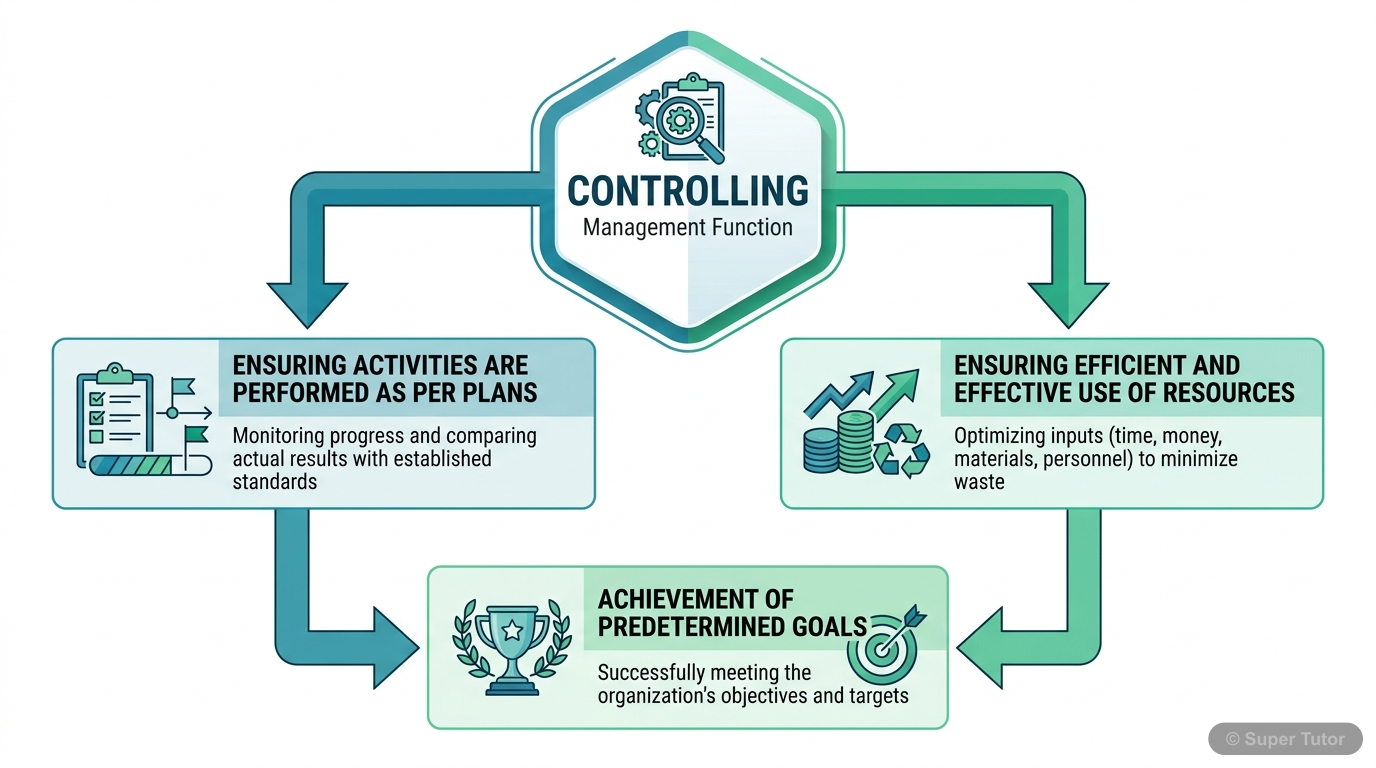
One of 10 illustrations for Controlling in Super Tutor — alongside flashcards, concept maps and practice questions.
The first 8 solutions are open to read. The other 7 are free with a Super Tutor account.
Very Short Answer Type
1State the meaning of controlling.Show solution
Meaning of Controlling:
Controlling is the managerial process of ensuring that actual activities conform to planned activities. It involves measuring actual performance, comparing it with the set standards, identifying deviations, and taking corrective action to ensure that organisational goals are achieved.
In simple words, controlling means making things happen the way they were planned to happen. It is the last function of management that closes the loop between planning and execution.
2Name the principle that a manager should consider while dealing with deviations effectively.Show solution
Principle: Management by Exception (MBE)
A manager should follow the principle of Management by Exception while dealing with deviations effectively.
Explanation: According to this principle, a manager should not try to control each and every deviation. Only significant deviations — those that exceed the acceptable range — should be brought to the manager's attention and corrective action should be taken. Minor or insignificant deviations should be ignored or handled at lower levels.
This allows managers to focus their time and energy on matters that truly require their attention, making the control process more efficient.
3State any one situation in which an organisation's control system loses its effectiveness.Show solution
Situation where control system loses effectiveness:
An organisation's control system loses its effectiveness when it is not possible for management to set quantitative standards of performance.
For example, in areas such as employee morale, job satisfaction, or human relations, it is difficult to set measurable numerical standards. In the absence of clear quantitative benchmarks, the comparison of actual performance with standards becomes subjective and unreliable, thereby reducing the effectiveness of the control system.
(Other valid situations: resistance from employees, high cost of control in small organisations, or inability to control external factors.)
4Give any two standards that can be used by a company to evaluate the performance of its Finance & Accounting department.Show solution
Two standards to evaluate the Finance & Accounting Department:
- Cost Standards: The budgeted cost of performing various financial activities (e.g., cost per transaction, administrative expenses as a percentage of revenue) can be set as a standard. Actual costs are then compared with these budgeted figures.
- Return on Investment (ROI): The expected rate of return on the capital invested can be set as a standard. The actual ROI achieved is compared with the target ROI to evaluate the financial performance of the department.
(Other valid standards: ratio analysis benchmarks such as current ratio, debt-equity ratio; timely submission of financial reports, etc.)
5Which term is used to indicate the difference between standard performance and actual performance?Show solution
The term used to indicate the difference between standard performance and actual performance is 'Deviation'.
If actual performance is less than the standard, it is called an unfavourable or negative deviation, and corrective action needs to be taken. If actual performance exceeds the standard, it is a favourable or positive deviation.
Short Answer Type
1'Planning is looking ahead and controlling is looking back.' Comment.Show solution
Comment on the Statement:
The statement 'Planning is looking ahead and controlling is looking back' is only partially correct.
Why Planning is 'looking ahead':
Planning is a future-oriented function. It involves deciding in advance what is to be done, how it is to be done, when it is to be done, and by whom. It sets goals and charts the course of action for the future. In this sense, planning does look ahead.
Why Controlling is said to be 'looking back':
Controlling involves measuring actual performance and comparing it with the standards set during planning. Since it reviews what has already happened (past performance), it appears to be backward-looking.
However, the statement is only partially true:
Controlling is not merely backward-looking. While it does review past performance, its ultimate purpose is forward-looking — to take corrective action so that future performance conforms to plans. Without corrective action, control would have no value.
Conclusion:
Planning and controlling are inseparable twins of management. Planning initiates the management process and controlling completes it. Plans provide the basis for control, and control ensures that plans are actually implemented. Together, they form a continuous cycle — plans guide action, and control ensures the action stays on track.
2'An effort to control everything may end up in controlling nothing.' Explain.Show solution
Explanation:
The statement 'An effort to control everything may end up in controlling nothing' highlights the principle of Management by Exception and the concept of Critical Point Control.
Meaning: If a manager tries to monitor and control each and every activity and every minor deviation in an organisation, they will:
- Waste valuable time and energy on trivial matters.
- Be unable to give adequate attention to significant problems.
- Overload themselves with information, leading to confusion and inefficiency.
- Ultimately fail to control even the important deviations effectively.
What should be done instead:
Managers should practise Management by Exception — they should focus only on significant deviations that exceed the acceptable range and require managerial attention. Minor deviations can be handled at lower levels or ignored.
Additionally, Critical Point Control suggests that managers should identify and focus on key result areas (KRAs) — those critical points where deviations are most likely to cause serious harm to the organisation.
Conclusion:
By trying to control everything, a manager spreads their attention too thin and loses focus on what truly matters. Effective control requires selectivity — concentrating on exceptions and critical points — so that managerial effort is directed where it is most needed.
3Explain how management audit serves as an effective technique of controlling.Show solution
Management Audit as a Technique of Controlling:
Meaning: Management Audit is a systematic and comprehensive appraisal or examination of the overall management of an organisation — its objectives, policies, procedures, personnel, and operations — to evaluate their effectiveness and efficiency.
How it serves as an effective technique of controlling:
- Evaluates Managerial Performance: It assesses how effectively managers at all levels are performing their functions (planning, organising, directing, and controlling), helping identify weaknesses in management.
- Identifies Inefficiencies: It helps detect areas where resources are being wasted or where management practices are not aligned with organisational goals, enabling timely corrective action.
- Ensures Goal Achievement: By reviewing whether management decisions and actions are directed towards achieving organisational objectives, it ensures that the organisation stays on the right path.
- Improves Decision-Making: The findings of a management audit provide valuable feedback to top management, helping them make better-informed decisions.
- Promotes Accountability: It creates a sense of accountability among managers, as they know their performance will be reviewed and evaluated.
- Facilitates Comparison: It allows comparison of the organisation's management practices with best practices in the industry, helping identify areas for improvement.
Conclusion: Management audit is a proactive and comprehensive control tool that goes beyond financial auditing to evaluate the entire management system, making it a highly effective technique of managerial control.
Free with a Super Tutor account
Long Answer Type
Free with a Super Tutor account
Free with a Super Tutor account
Free with a Super Tutor account
Free with a Super Tutor account
a. Identify the benefits the company will derive from a good control system.
b. How can the company relate its planning with control in this line of business to ensure that its plans are actually implemented and targets attained.
c. Give the steps in the control process that the company should follow to remove the problems it is facing.
Free with a Super Tutor account
a. Describe any two features of Controlling highlighted in the above situation.
b. Explain any four points of importance of Controlling.
Free with a Super Tutor account
7 more solved questions in Controlling
They are free with a Super Tutor account, along with practice quizzes and flashcards for this chapter. Free to start, no card needed.
Frequently Asked Questions
What are the important topics in Controlling for Madhya Pradesh Board Class 12 Business Studies?
Are these NCERT Solutions for Controlling free?
How should I revise Controlling for the Madhya Pradesh Board Class 12 board exam?
Sources & Official References
Content is aligned to the official syllabus. Refer to the board website for the latest curriculum.
More resources for Controlling
Practice Quiz
Test yourself with a quick quiz
Important Questions
Exam-style questions with answers
Revision Notes
Key points for last-minute revision
Chapter Summary
Understand the chapter at a glance
Concept Maps
See how topics connect
Study Plan
Step-by-step plan for this chapter
Flashcards
Quick-fire cards for active recall
Syllabus
What topics to cover
For serious students
Get the full Controlling chapter — start free.
Quizzes, flashcards, an AI doubt solver and a study plan for Madhya Pradesh Board Class 12 Business Studies. Free to start, no card needed.