Nature and Significance of Management — NCERT Solutions
Madhya Pradesh Board · Class 12 · Business Studies
NCERT Solutions for Nature and Significance of Management, Madhya Pradesh Board Class 12 Business Studies: 17 textbook questions solved step by step.
Interactive on Super Tutor
Studying Nature and Significance of Management? Get the full interactive chapter.
Quizzes, flashcards, AI doubt-solver and a step-by-step study plan — built for NCERT solutions and more.
Free trial, no card needed.
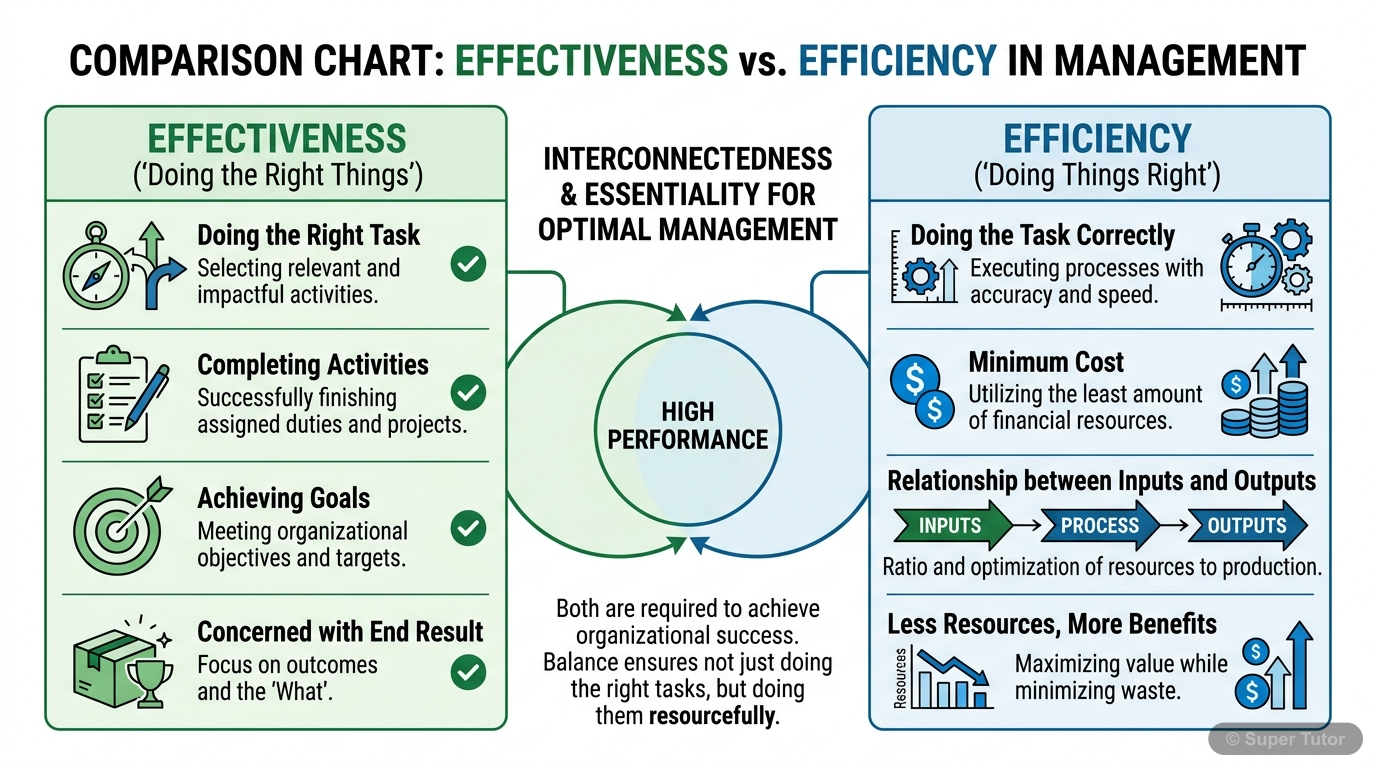
One of 10 illustrations for Nature and Significance of Management in Super Tutor — alongside flashcards, concept maps and practice questions.
The first 9 solutions are open to read. The other 8 are free with a Super Tutor account.
Very Short Answer Type
1What is meant by management?Show solution
Given/Concept: Management is a core concept in Business Studies relating to how organisations function.
Answer:
Management is the process of planning, organising, staffing, directing and controlling the resources of an enterprise (human, physical, financial and informational) efficiently and effectively so as to achieve the goals of the organisation.
- Effectiveness means doing the right task and achieving goals.
- Efficiency means doing the task correctly with minimum cost and resource wastage.
In short, management is the art of getting things done through and with people in formally organised groups.
2Name any two important characteristics of management.Show solution
Given/Concept: Management has several key features that define its nature.
Two important characteristics of management are:
- Goal-Oriented Process: Management is always directed towards achieving organisational, social and personal goals. Every managerial activity is aimed at accomplishing pre-determined objectives.
- All-Pervasive: Management is required in all types of organisations — business or non-business, large or small — and at all levels (top, middle and lower). It is universal in nature.
3Identify and state the force that binds all the other functions of management.Show solution
Given/Concept: Among all the functions of management, one acts as a binding force.
Answer:
The force that binds all other functions of management is Coordination.
Coordination is the process of achieving unity of action among interdependent activities and departments of an organisation. It synchronises the efforts of individuals and departments so that all functions — planning, organising, staffing, directing and controlling — work in harmony towards common goals. That is why coordination is called the 'essence of management'.
4List any two indicators of growth of an organisation.Show solution
Given/Concept: Growth of an organisation can be measured through various indicators.
Two indicators of growth of an organisation are:
- Increase in the number of employees — As an organisation grows, it needs to hire more people to handle expanded operations.
- Increase in sales turnover / market share — A growing organisation typically records higher sales revenue and captures a larger share of the market over time.
(Other valid indicators include increase in product lines, expansion into new markets, increase in profits, etc.)
5Indian Railways has launched a new broad gauge solar power train which is going to be a path breaking leap towards making trains greener and more environment friendly. The solar power DEMU (Diesel Electric Multiple Unit) has 6 trailer coaches and is expected to save about 21,000 liters of diesel and ensure a cost saving of Rs 12,00,000 per year. Name the objectives of management achieved by Indian Railways in the above case.Show solution
Given: Indian Railways launched a solar-powered train that saves 21,000 litres of diesel and Rs 12,00,000 per year, while being environment friendly.
Concept: Management objectives are classified as Organisational, Social and Personal objectives.
Objectives of Management achieved:
- Organisational Objective — Survival and Growth: By saving Rs 12,00,000 per year through reduced diesel consumption, Indian Railways is reducing costs, which contributes to its financial sustainability and growth.
- Social Objective — Environmental Responsibility: By launching a greener, solar-powered train, Indian Railways is contributing to environmental protection and reducing carbon footprint, thereby fulfilling its responsibility towards society.
Conclusion: Indian Railways has achieved both organisational objectives (cost saving/efficiency) and social objectives (environment-friendly operations) through this initiative.
Short Answer Type
1Ritu is the manager of the northern division of a large corporate house. At what level does she work in the organisation? What are her basic functions?Show solution
Given: Ritu is the manager of the northern division of a large corporate house.
Level of Management:
Ritu works at the Middle Level of Management. Middle-level managers are responsible for a specific division or department and act as a link between top management and lower/supervisory management.
Basic Functions of Ritu (Middle-Level Manager):
- Interpreting Policies: She interprets and explains the policies framed by top management to lower-level managers.
- Organising: She organises the activities and resources of her division (northern division) to implement plans.
- Recruiting and Selecting: She is responsible for recruiting and selecting lower-level managers and other staff for her division.
- Motivating: She motivates lower-level managers to achieve better performance.
- Coordinating: She coordinates the activities within her division and with other divisions.
- Reporting to Top Management: She sends important reports and data about the performance of her division to top management.
- Achieving Divisional Goals: She ensures that the goals of the northern division are achieved effectively and efficiently.
2State the basic features of management as a profession.Show solution
Given/Concept: A profession is an occupation backed by specialised knowledge, formal training, and ethical codes. We examine whether management qualifies as a profession.
Basic Features of Management as a Profession:
- Well-Defined Body of Knowledge: Like other professions, management has a systematic body of knowledge based on principles and theories that can be learnt and taught. Numerous books, journals and courses exist on management.
- Restricted Entry: Entry into the management profession is increasingly through formal education (MBA, BBA, etc.), though it is not as strictly restricted as medicine or law.
- Professional Associations: There are professional associations for managers such as the All India Management Association (AIMA) which lays down codes of conduct for members.
- Ethical Code of Conduct: Management associations prescribe a code of conduct that members are expected to follow, ensuring ethical behaviour.
- Service Motive: Although managers work for remuneration, professional management also emphasises service to society, employees and other stakeholders.
Note: Management does not fully satisfy all requirements of a profession (e.g., entry is not strictly restricted by a statutory body), but it is largely professional in character and is moving towards becoming a full-fledged profession.
3Why is management considered to be a multi-dimensional concept?Show solution
Given/Concept: Management is described as multi-dimensional because it covers more than one dimension of activity.
Management is a Multi-Dimensional Concept because it involves three dimensions:
1. Management of Work:
Every organisation exists to perform some work or task (e.g., a factory produces goods, a hospital provides healthcare). Management translates this work into goals and assigns tasks to achieve them. Thus, management is always about managing some specific work.
2. Management of People:
Organisations are made up of people with different personalities, backgrounds and expectations. Managing people means:
- Getting work done through them, and
- Making their strengths effective and their weaknesses irrelevant.
This is the most challenging dimension of management.
3. Management of Operations:
Every organisation has some basic operation or production process — whether it is manufacturing a product or providing a service. Management of operations deals with the process by which inputs (raw materials, labour) are transformed into outputs (finished goods/services). It links management of work with management of people.
Conclusion: Since management simultaneously deals with work, people and operations, it is rightly called a multi-dimensional concept.
4Company X is facing a lot of problems these days. It manufactures white goods like washing machines, microwave ovens, refrigerators and air conditioners. The company's margins are under pressure and the profits and market share are declining. The production department blames marketing for not meeting sales targets and marketing blames production department for producing goods, which are not of good quality meeting customers' expectations. The finance department blames both production and marketing for declining return on investment and bad marketing. State the quality of management that the company is lacking? What quality of management do you think the company is lacking? Explain briefly. What steps should the company management take to bring the company back on track?Show solution
Given: Company X manufactures white goods. Profits and market share are declining. Production, marketing and finance departments are blaming each other instead of working together.
Quality of Management the Company is Lacking:
The company is lacking Coordination.
Coordination is the process of achieving unity of action among interdependent activities and departments. Here, the three departments — production, marketing and finance — are working at cross purposes instead of in a unified direction.
Explanation:
Coordination is the essence of management. It integrates the efforts of all departments towards common organisational goals. In Company X:
- The production department is not producing goods as per customer expectations.
- The marketing department is not meeting sales targets.
- The finance department is concerned about declining returns.
All three are blaming each other, which indicates a complete lack of coordination, communication and unity of purpose.
Steps the Company Should Take to Come Back on Track:
- Establish Clear Common Goals: Top management should set unified organisational goals that all departments understand and work towards together.
- Improve Inter-Departmental Communication: Regular joint meetings between production, marketing and finance departments should be held to share information and resolve conflicts.
- Appoint a Coordination Committee: A cross-functional team or committee can be formed to coordinate activities across departments.
- Market Research: The production department should work closely with marketing to understand customer expectations and produce goods accordingly.
- Performance Review System: A common performance review system should be established so that all departments are evaluated on overall company performance, not just their individual targets.
- Leadership and Motivation: Top management should provide strong leadership to foster a culture of teamwork and shared responsibility rather than blame.
Free with a Super Tutor account
Free with a Super Tutor account
Long Answer Type
Free with a Super Tutor account
Free with a Super Tutor account
Free with a Super Tutor account
Free with a Super Tutor account
Free with a Super Tutor account
Free with a Super Tutor account
8 more solved questions in Nature and Significance of Management
They are free with a Super Tutor account, along with practice quizzes and flashcards for this chapter. Free to start, no card needed.
Frequently Asked Questions
What are the important topics in Nature and Significance of Management for Madhya Pradesh Board Class 12 Business Studies?
Are these NCERT Solutions for Nature and Significance of Management free?
How should I revise Nature and Significance of Management for the Madhya Pradesh Board Class 12 board exam?
Sources & Official References
Content is aligned to the official syllabus. Refer to the board website for the latest curriculum.
More resources for Nature and Significance of Management
Practice Quiz
Test yourself with a quick quiz
Important Questions
Exam-style questions with answers
Revision Notes
Key points for last-minute revision
Chapter Summary
Understand the chapter at a glance
Concept Maps
See how topics connect
Study Plan
Step-by-step plan for this chapter
Flashcards
Quick-fire cards for active recall
Syllabus
What topics to cover
For serious students
Get the full Nature and Significance of Management chapter — start free.
Quizzes, flashcards, an AI doubt solver and a study plan for Madhya Pradesh Board Class 12 Business Studies. Free to start, no card needed.