Consumer Protection — NCERT Solutions
Madhya Pradesh Board · Class 12 · Business Studies
NCERT Solutions for Consumer Protection, Madhya Pradesh Board Class 12 Business Studies: 18 textbook questions solved step by step.
Interactive on Super Tutor
Studying Consumer Protection? Get the full interactive chapter.
Quizzes, flashcards, AI doubt-solver and a step-by-step study plan — built for NCERT solutions and more.
Free trial, no card needed.
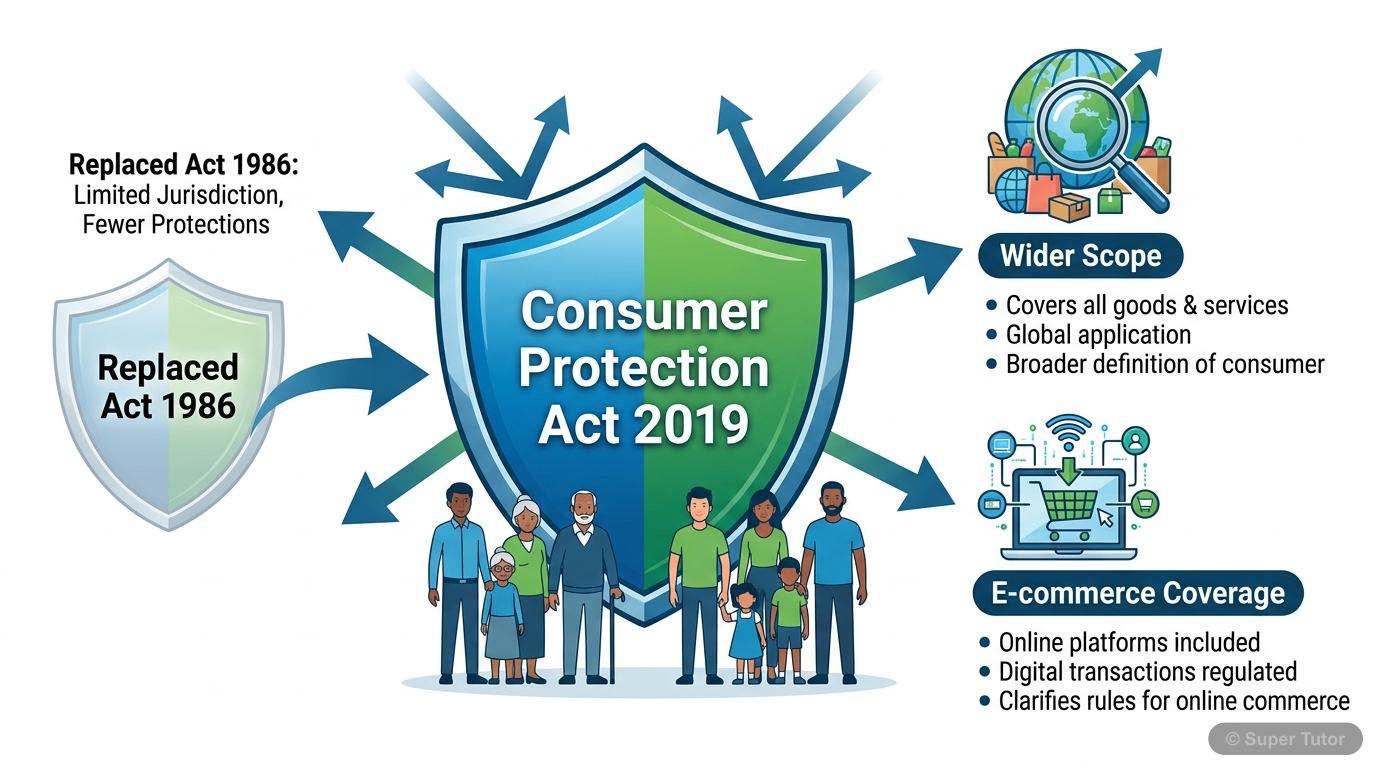
One of 11 illustrations for Consumer Protection in Super Tutor — alongside flashcards, concept maps and practice questions.
The first 9 solutions are open to read. The other 9 are free with a Super Tutor account.
Very Short Answer Type
1Under which consumer right does a business firm set up consumer grievance cell?Show solution
Given: A business firm sets up a consumer grievance cell.
Answer: A business firm sets up a consumer grievance cell under the Right to be Heard (also called Right to Representation).
Explanation: The Right to be Heard ensures that consumers' interests will receive due consideration at appropriate forums. Setting up a consumer grievance cell by a business firm is a practical implementation of this right, as it provides consumers a platform to voice their complaints and grievances and get them addressed.
2Which quality certification mark is used for agricultural products?Show solution
Answer: The quality certification mark used for agricultural products is AGMARK (Agricultural Mark).
Explanation: AGMARK is a certification mark employed on agricultural products in India, assuring that they conform to a set of standards approved by the Directorate of Marketing and Inspection, an agency of the Government of India. It is governed by the Agricultural Produce (Grading and Marking) Act, 1937.
3What is the jurisdiction of cases that can be filed in a State Commission?Show solution
Answer: A State Commission can entertain complaints where the value of goods or services paid as consideration, along with the compensation claimed, exceeds ₹1 crore but does not exceed ₹10 crore.
(Note: These figures are as per the Consumer Protection Act, 2019. Under the earlier 1986 Act, the limit was above ₹20 lakh up to ₹1 crore.)
Additionally, the State Commission also has appellate jurisdiction to hear appeals against orders of the District Commission within the State.
4State any two reliefs available to consumers under CPA.Show solution
Answer: The following are two reliefs available to consumers under the Consumer Protection Act:
- Removal of Defect: The consumer court may direct the opposite party to remove the defect in the goods or deficiency in the services.
- Replacement of Goods: The consumer court may order the replacement of defective goods with new goods of similar description which shall be free from any defect.
(Other reliefs include: refund of price paid, payment of compensation for loss or injury suffered, discontinuation of unfair/restrictive trade practices, etc.)
5Name the component of product mix that helps the consumer to exercise the right to information.Show solution
Answer: Labelling is the component of the product mix that helps the consumer to exercise the Right to Information.
Explanation: A label on a product provides detailed information such as ingredients/contents, date of manufacture, expiry date, price, weight, directions for use, manufacturer's details, etc. This information enables consumers to make informed purchasing decisions, thereby exercising their Right to be Informed.
Short Answer Type
1Enumerate the various Acts passed by the Government of India which help in protection of consumers' interests.Show solution
Given: Various legislative Acts for consumer protection in India.
Answer: The Government of India has passed the following Acts to protect consumers' interests:
- The Consumer Protection Act, 1986 (amended as Consumer Protection Act, 2019): Provides a comprehensive framework for consumer protection including rights, redressal agencies, etc.
- The Indian Contract Act, 1872: Governs the formation and enforcement of contracts, protecting consumers from unfair contract terms.
- The Sale of Goods Act, 1930: Provides implied conditions and warranties in the sale of goods, protecting buyers.
- The Essential Commodities Act, 1955: Controls production, supply, and distribution of essential commodities to prevent hoarding and black marketing.
- The Agricultural Produce (Grading and Marking) Act, 1937: Provides for grading and marking of agricultural produce (AGMARK).
- The Prevention of Food Adulteration Act, 1954: Prevents adulteration of food articles and ensures food safety.
- The Standards of Weights and Measures Act, 1976: Ensures correct weights and measures are used in trade.
- The Trade Marks Act, 1999: Protects consumers from counterfeit goods by regulating trademarks.
- The Competition Act, 2002: Prevents monopolistic and restrictive trade practices that harm consumers.
- The Bureau of Indian Standards Act, 1986: Provides for the ISI mark and BIS hallmark, ensuring quality standards for goods.
2What are the responsibilities of a consumer?Show solution
Given: Responsibilities that a consumer must fulfil while purchasing, using, and consuming goods and services.
Answer: The responsibilities of a consumer are as follows:
- Be Aware: A consumer should be aware of his/her rights and should not be a passive recipient. He/she must gather information about goods and services before purchasing.
- Beware of Advertisements: A consumer should not be misled by false or misleading advertisements and should think critically before making a purchase.
- Buy Standardised Goods: A consumer should look for quality certification marks like ISI, AGMARK, Hallmark, etc., while purchasing goods.
- Assert Yourself: A consumer should be assertive and bold enough to ensure that he/she gets a fair deal. He/she should not hesitate to complain if something is wrong.
- File Complaints for Redressal: A consumer should file a complaint in the appropriate consumer court in case of a genuine grievance, rather than remaining silent.
- Be an Ethical Consumer: A consumer should purchase only legal goods and services and should not encourage black marketing or purchase of spurious goods.
- Insist on Cash Memo/Receipt: A consumer should always ask for a cash memo or receipt as proof of purchase, which is essential for filing a complaint.
- Respect the Environment: A consumer should be conscious of the environmental impact of his/her consumption and avoid wasteful consumption.
3Who can file a complaint in a consumer court?Show solution
Given: Parties eligible to file a complaint in a consumer court under the Consumer Protection Act.
Answer: The following persons/entities can file a complaint in a consumer court:
- A Consumer: Any person who buys goods or hires services for consideration (payment) can file a complaint. This includes the user of such goods/services if done with the buyer's approval.
- Any Recognised Consumer Association: A voluntary consumer organisation registered under the Companies Act or any other law can file a complaint on behalf of consumers.
- The Central Government or State Government: They can file a complaint on behalf of consumers.
- One or More Consumers on Behalf of Numerous Consumers: Where there are numerous consumers having the same interest, one or more of them can file a complaint with the permission of the consumer court.
- A Legal Heir or Representative: In case of death of a consumer, his/her legal heir or representative can file a complaint.
Note: A complaint can be filed against a defective product, deficiency in service, unfair trade practice, or restrictive trade practice adopted by a trader or service provider.
4FSSAI (Food Safety and Standards Authority of India) has made a proposal for hotels and other food outlets to declare the kind of oil/fat used in cooking each of the food items on their menus. Name and explain the Consumer Right being reinforced by this proposal.Show solution
Given: FSSAI's proposal requiring hotels and food outlets to declare the type of oil/fat used in cooking food items on their menus.
Consumer Right Being Reinforced: Right to be Informed
Explanation:
The Right to be Informed means that consumers have the right to be informed about the quality, quantity, potency, purity, standard, and price of goods and services so as to protect themselves against unfair trade practices.
In this case, by requiring hotels and food outlets to declare the kind of oil/fat used in cooking:
- Consumers will be able to make informed choices about the food they consume.
- People with specific health conditions (e.g., heart disease, high cholesterol) or dietary preferences (e.g., vegetarians, those avoiding trans fats) can make healthier and more suitable choices.
- It prevents hotels from using substandard or harmful oils without the consumer's knowledge.
- It empowers consumers to protect their health by being aware of what goes into their food.
Thus, this proposal reinforces the Right to be Informed, which is one of the six consumer rights provided under the Consumer Protection Act.
Free with a Super Tutor account
Long Answer Type
Free with a Super Tutor account
Free with a Super Tutor account
Free with a Super Tutor account
Free with a Super Tutor account
Free with a Super Tutor account
(a) Which right was exercised by Mrs. Mathur at the first instance.
(b) Name and explain the right which helped Mrs. Mathur to avail the compensation.
(c) State which consumer responsibility has been fulfilled by Mrs. Mathur in the above case.
(d) State any other two responsibilities to be assumed by the consumers.
Free with a Super Tutor account
Project Work
Free with a Super Tutor account
Free with a Super Tutor account
9 more solved questions in Consumer Protection
They are free with a Super Tutor account, along with practice quizzes and flashcards for this chapter. Free to start, no card needed.
Frequently Asked Questions
What are the important topics in Consumer Protection for Madhya Pradesh Board Class 12 Business Studies?
Are these NCERT Solutions for Consumer Protection free?
How should I revise Consumer Protection for the Madhya Pradesh Board Class 12 board exam?
Sources & Official References
Content is aligned to the official syllabus. Refer to the board website for the latest curriculum.
More resources for Consumer Protection
Practice Quiz
Test yourself with a quick quiz
Important Questions
Exam-style questions with answers
Revision Notes
Key points for last-minute revision
Chapter Summary
Understand the chapter at a glance
Concept Maps
See how topics connect
Study Plan
Step-by-step plan for this chapter
Flashcards
Quick-fire cards for active recall
Syllabus
What topics to cover
For serious students
Get the full Consumer Protection chapter — start free.
Quizzes, flashcards, an AI doubt solver and a study plan for Madhya Pradesh Board Class 12 Business Studies. Free to start, no card needed.