Marketing — NCERT Solutions
Madhya Pradesh Board · Class 12 · Business Studies
NCERT Solutions for Marketing, Madhya Pradesh Board Class 12 Business Studies: 27 textbook questions solved step by step.
Interactive on Super Tutor
Studying Marketing? Get the full interactive chapter.
Quizzes, flashcards, AI doubt-solver and a step-by-step study plan — built for NCERT solutions and more.
Free trial, no card needed.
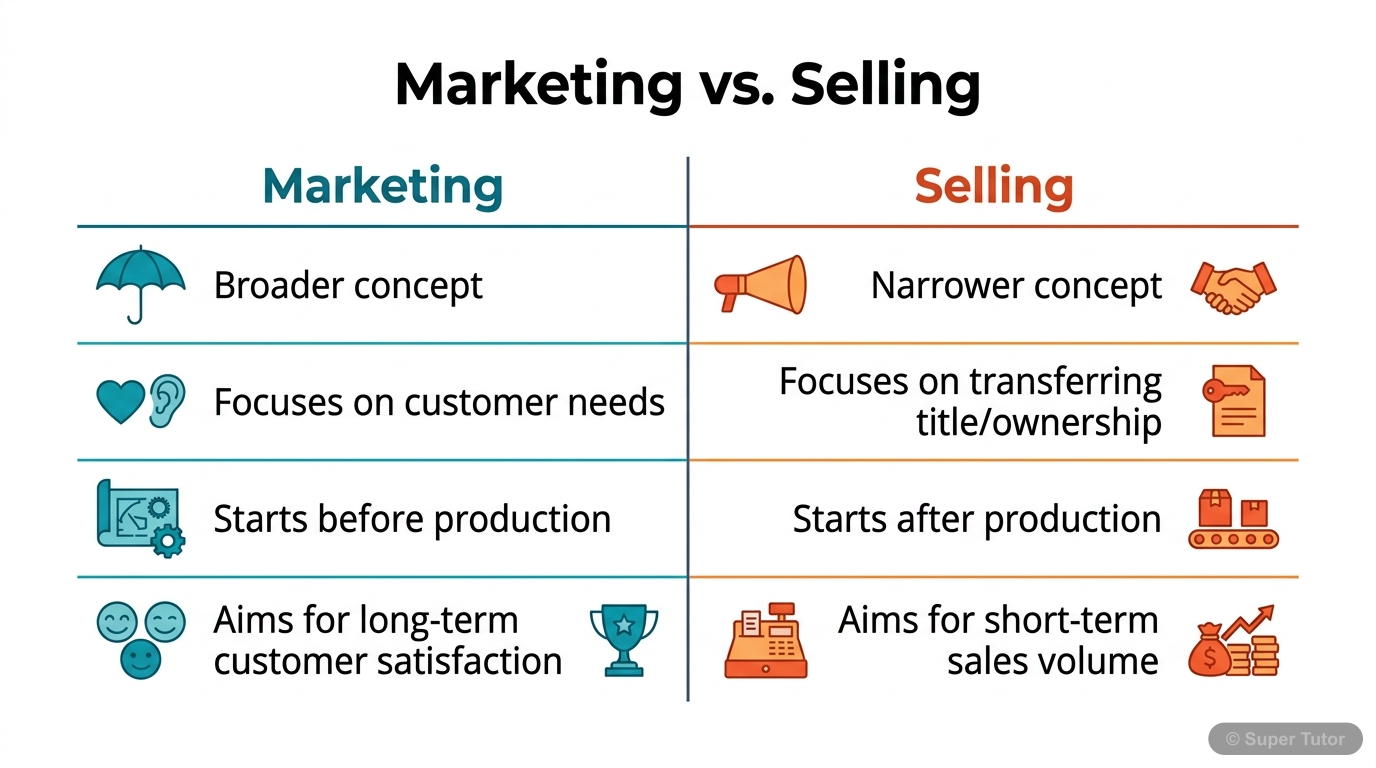
One of 17 illustrations for Marketing in Super Tutor — alongside flashcards, concept maps and practice questions.
The first 14 solutions are open to read. The other 13 are free with a Super Tutor account.
Very Short Answer Type
1State any two advantages of branding to marketers of goods and services.Show solution
Given: We need to identify advantages of branding from the marketer's perspective.
Two advantages of branding to marketers:
(i) Helps in product differentiation: A brand name helps a marketer distinguish his product from competitors' products. For example, 'Surf Excel' is differentiated from other detergents through its brand name, making it easier for consumers to identify and choose it.
(ii) Enables differential pricing: A well-established brand commands a premium price. Marketers can charge higher prices for branded products compared to unbranded ones because consumers associate the brand with quality and reliability. For example, branded medicines are priced higher than generic ones.
Additional advantages include: Helps in advertising and promotion, creates brand loyalty, and facilitates easy introduction of new products under the same brand name.
2How does branding help in differential pricing?Show solution
Given: We need to explain the relationship between branding and differential pricing.
Concept: Differential pricing means charging different prices for similar products.
Explanation:
Branding helps in differential pricing in the following ways:
- A well-known and reputed brand creates a perception of superior quality in the minds of consumers. Consumers are willing to pay a higher price for a trusted brand compared to an unknown or unbranded product.
- Once a brand establishes loyalty among consumers, the marketer can charge a premium price. For example, 'Nike' shoes are priced much higher than unbranded shoes of similar quality because of the brand value.
- Different brands of the same company can be priced differently to target different market segments. For example, a company may sell a premium brand at a high price and a budget brand at a lower price.
Conclusion: Thus, branding creates perceived value differences, enabling marketers to charge different prices for similar products.
3What is the societal concept of marketing?Show solution
Given: We need to define the societal concept of marketing.
Societal Concept of Marketing:
The societal concept of marketing holds that a firm should make good marketing decisions by considering:
- The wants and long-run interests of consumers,
- The requirements of the firm (profits), and
- The long-run interests of society.
In other words, it is not enough for a firm to satisfy individual consumer needs and earn profits; it must also act in the best long-term interest of society as a whole.
Example: A firm manufacturing automobiles should not only satisfy the consumer's desire for a car but also consider the environmental impact (pollution, fuel efficiency) and societal well-being.
Key Idea: Marketing decisions should balance three considerations — company profits, consumer satisfaction, and social welfare. This concept goes beyond the marketing concept by adding the dimension of social responsibility.
4Enlist the advantages of packaging of consumer products.Show solution
Given: We need to list the advantages/functions of packaging of consumer products.
Advantages of Packaging:
(i) Product Identification: Packaging helps in identifying the product easily. The distinctive colour, design, and shape of a package help consumers recognise the product at a glance. For example, the distinctive red colour of Coca-Cola packaging.
(ii) Product Protection: Packaging protects the product from damage, spoilage, leakage, pilferage, and contamination during storage, transportation, and handling.
(iii) Facilitates Use of the Product: Good packaging makes it convenient for consumers to use the product. For example, toothpaste in a tube, shampoo in a pump bottle.
(iv) Promotion of Products: An attractive package acts as a silent salesman. It attracts the attention of customers and promotes the product at the point of purchase.
(v) Convenience in Handling: Packaging makes it easier to handle, store, and transport the product both for the seller and the buyer.
5List five shopping products purchased by you or your family during the last few months.Show solution
Given: We need to list five shopping products.
Concept: Shopping products are those products for which consumers spend considerable time and effort in gathering information and comparing alternatives on the basis of price, quality, style, and suitability before making a purchase decision.
Five Shopping Products:
- Television Set – Consumers compare brands, features, and prices before buying.
- Refrigerator – Requires comparison of capacity, energy rating, brand, and price.
- Mobile Phone – Consumers compare features, camera quality, battery life, and price.
- Washing Machine – Compared on the basis of capacity, brand, and technology.
- Furniture (Sofa Set) – Consumers compare design, material, durability, and price.
Note: These are products where the consumer invests time and effort in the purchase decision, unlike convenience products which are bought frequently with minimum effort.
6A marketer of colour TV having 20% of the current market share of the country aims at enhancing the market share to 50 per cent in next three years. For achieving this objective he specified an action programme. Name the function of marketing being discussed above.Show solution
Given: A marketer has set a goal to increase market share from 20% to 50% in three years and has specified an action programme to achieve it.
Answer: The function of marketing being discussed is Marketing Planning.
Justification: Marketing planning involves setting marketing objectives and determining the strategies and action programmes to achieve those objectives. In this case, the marketer has:
- Set a clear objective (increase market share from 20% to 50%),
- Specified a time frame (3 years), and
- Developed an action programme to achieve the objective.
This is precisely what marketing planning entails — deciding in advance what is to be done, how it is to be done, and who is to do it to achieve the marketing goals of the organisation.
Short Answer Type
1What is marketing? What functions does it perform in the process of exchange of goods and services? Explain.Show solution
What is Marketing?
Marketing has been described as the performance of business activities that direct the flow of goods and services from producers to consumers. In modern terms, marketing is a social and managerial process by which individuals and groups obtain what they need and want through creating, offering, and exchanging products of value with others.
Marketing is not merely a post-production activity. It includes activities performed before goods are produced (like market research) and continues even after goods are sold (like after-sales service).
Functions of Marketing:
(i) Gathering and Analysing Market Information: Identifying the needs and wants of consumers through market research to make informed decisions.
(ii) Marketing Planning: Developing plans to achieve marketing objectives, including strategies for product, price, place, and promotion.
(iii) Product Designing and Development: Designing products that satisfy consumer needs better than competitors.
(iv) Standardisation and Grading: Standardisation ensures that products conform to predetermined specifications. Grading involves classifying products into different groups based on quality.
(v) Packaging and Labelling: Designing the container/wrapper and attaching labels to protect and identify the product.
(vi) Branding: Giving a distinctive name/symbol to a product to differentiate it from competitors.
(vii) Customer Support Services: Providing after-sales services, handling complaints, and maintaining customer relationships.
(viii) Pricing of Products: Determining the price at which the product will be sold, considering costs, competition, and demand.
(ix) Promotion: Informing and persuading potential customers through advertising, personal selling, sales promotion, and publicity.
(x) Physical Distribution: Managing the movement of goods from producer to consumer through transportation and warehousing.
(xi) Transportation: Moving goods from the place of production to the place of consumption.
(xii) Storage/Warehousing: Storing goods to bridge the time gap between production and consumption.
Conclusion: These functions collectively ensure the smooth flow of goods and services from producers to consumers, creating time, place, and possession utilities.
2Distinguish between the product concept and production concept of marketing.Show solution
Distinction between Product Concept and Production Concept of Marketing:
| Basis | Production Concept | Product Concept |
|---|---|---|
| Focus | Focuses on production efficiency and wide availability of products at low cost. | Focuses on quality, performance, and innovative features of the product. |
| Assumption | Consumers prefer products that are widely available and affordable. | Consumers prefer products that offer the most quality, performance, and features. |
| Managerial Orientation | Management focuses on improving production and distribution efficiency. | Management focuses on making superior products and improving them over time. |
| Consumer Needs | Assumes consumers are primarily interested in product availability and low prices. | Assumes consumers will favour products with the best quality regardless of price. |
| Risk | May lead to marketing myopia by ignoring consumer needs. | May also lead to marketing myopia — over-focus on product quality while ignoring actual consumer needs. |
| Example | A firm producing low-cost goods in large quantities. | A firm investing heavily in R&D to produce the best quality product. |
Conclusion: Both concepts have limitations as they do not fully consider consumer needs and market dynamics. The modern marketing concept overcomes these limitations by focusing on identifying and satisfying consumer needs profitably.
3Product is a bundle of utilities. Explain.Show solution
Given: We need to explain the statement 'Product is a bundle of utilities.'
Meaning of Product:
In marketing, a product is not merely a physical object. It is a mixture of tangible and intangible attributes that are capable of being exchanged for a value, with the ability to satisfy customer needs and wants.
Product as a Bundle of Utilities:
A product provides various types of utilities (satisfactions) to the consumer:
(i) Form Utility: The physical form of the product — its shape, size, colour, and design — provides satisfaction. For example, a stylish mobile phone provides form utility.
(ii) Place Utility: The product being available at the right place provides utility. For example, a cold drink available at a nearby store.
(iii) Time Utility: The product being available at the right time provides utility. For example, an umbrella available during the rainy season.
(iv) Possession Utility: The transfer of ownership of the product to the consumer provides utility.
(v) Information Utility: The product provides information about its use, features, and benefits through labelling and packaging.
(vi) Service Utility: After-sales services, warranties, and guarantees add to the utility of the product.
Example: When a consumer buys a washing machine, they get:
- Physical product (form utility),
- Delivery at home (place utility),
- After-sales service (service utility),
- Warranty (psychological utility).
Conclusion: Thus, a product is not just a physical item but a complete bundle of utilities — tangible and intangible — that together satisfy the needs and wants of the consumer.
4What are industrial products? How are they different from consumer products? Explain.Show solution
What are Industrial Products?
Industrial products are those products which are used as inputs in producing other products or in providing services. They are purchased by business firms for use in their production processes. For example, raw materials, machinery, tools, and lubricants.
Classification of Industrial Products:
- Materials and Parts – Raw materials (cotton, iron ore) and manufactured parts (tyres, engines).
- Capital Items – Installations (factories, heavy machinery) and accessory equipment (computers, tools).
- Supplies and Business Services – Operating supplies (lubricants, stationery) and business services (legal, consulting).
Distinction between Industrial Products and Consumer Products:
| Basis | Industrial Products | Consumer Products |
|---|---|---|
| Meaning | Used as inputs in producing other products or services. | Purchased by ultimate consumers for personal use. |
| Buyers | Business firms, manufacturers, and institutions. | Individual consumers and households. |
| Purpose | Used for further production or business operations. | Used for personal satisfaction and consumption. |
| Number of Buyers | Fewer buyers but purchases are in large quantities. | Large number of buyers but purchases are in small quantities. |
| Nature of Demand | Derived demand (depends on demand for consumer goods). | Direct demand (based on personal needs and desires). |
| Buying Process | Technical and complex; involves multiple decision-makers. | Simple; based on personal preference and habit. |
| Examples | Machinery, raw materials, tools, lubricants. | Bread, clothes, television, shoes. |
Conclusion: The key difference lies in the purpose of purchase — industrial products are used for production while consumer products are used for personal consumption.
5Distinguish between convenience product and shopping product.Show solution
Distinction between Convenience Product and Shopping Product:
| Basis | Convenience Product | Shopping Product |
|---|---|---|
| Meaning | Products that are purchased frequently, immediately, and with minimum shopping effort. | Products for which consumers spend considerable time comparing alternatives before buying. |
| Buying Effort | Minimum effort; bought out of habit or impulse. | Considerable time and effort spent in gathering information and comparing. |
| Price | Generally low-priced. | Relatively higher-priced. |
| Frequency of Purchase | Purchased frequently and regularly. | Purchased less frequently. |
| Comparison | Little or no comparison made. | Extensive comparison on price, quality, style, and suitability. |
| Distribution | Widely available at many outlets. | Available at select retail outlets. |
| Brand Loyalty | High brand loyalty for some products. | Consumer evaluates multiple brands before deciding. |
| Examples | Bread, soap, toothpaste, newspapers, matchboxes. | Television, refrigerator, clothing, furniture, mobile phones. |
Conclusion: Convenience products are low-involvement purchases made routinely, while shopping products involve high involvement and careful evaluation before purchase.
6Describe the functions of labeling in the marketing of products.Show solution
Given: We need to describe the functions of labelling in the marketing of products.
Meaning of Labelling:
A label is the printed information on the package of a product. It may vary from a simple tag attached to the product to complex graphics that are part of the package.
Functions of Labelling:
(i) Describes the Product: The label provides important information about the product such as its name, ingredients/contents, directions for use, date of manufacture, expiry date, and precautions. This helps consumers make informed purchase decisions.
(ii) Identifies the Product or Brand: The label helps consumers identify the product and the brand. The brand name, logo, and distinctive design on the label help consumers recognise the product easily among competing products.
(iii) Grading of Products: Labels help in grading products into different categories based on quality. For example, fruits and vegetables are graded as Grade A, Grade B, etc., based on size and quality.
(iv) Aids in Promotion: An attractive and informative label acts as a promotional tool. It attracts the attention of consumers at the point of purchase and communicates the product's benefits and features.
(v) Provides Legal Information: Labels carry mandatory legal information such as MRP (Maximum Retail Price), net weight, manufacturer's address, and statutory warnings (e.g., 'Smoking is injurious to health' on cigarette packs).
(vi) Facilitates Consumer Protection: Labels help consumers make informed choices and protect them from being misled about the product's contents, quality, or price.
Conclusion: Labelling is a vital marketing function that serves informational, promotional, and legal purposes, benefiting both consumers and marketers.
7Discuss the role of intermediaries in the distribution of consumer non-durable products.Show solution
Given: We need to discuss the role of intermediaries in distributing consumer non-durable products.
Meaning of Intermediaries:
Intermediaries (also called middlemen) are individuals or firms that act as links between producers and consumers in the distribution channel. They include wholesalers, retailers, agents, and distributors.
Consumer Non-Durable Products: These are products that are consumed quickly and purchased frequently, such as food items, soap, toothpaste, and beverages.
Role of Intermediaries in Distribution of Consumer Non-Durable Products:
(i) Wider Market Coverage: Non-durable products need to reach a large number of consumers spread across wide geographic areas. Intermediaries help manufacturers achieve this wide coverage without maintaining their own distribution network.
(ii) Bulk Breaking: Manufacturers produce in large quantities. Wholesalers buy in bulk from manufacturers and sell in smaller quantities to retailers, who then sell in even smaller quantities to consumers. This process of bulk breaking makes products accessible to consumers.
(iii) Storage and Warehousing: Intermediaries store goods and bridge the time gap between production and consumption. This ensures continuous availability of non-durable products.
(iv) Transportation: Intermediaries arrange for the movement of goods from manufacturers to various retail outlets, ensuring timely availability.
(v) Financing: Intermediaries often purchase goods on credit from manufacturers and sell on credit to retailers, thereby providing financial support to the distribution chain.
(vi) Risk Bearing: Intermediaries bear the risk of price fluctuations, damage, and unsold stock, reducing the risk for manufacturers.
(vii) Promotion: Retailers display products attractively and inform consumers about new products, thereby promoting sales.
(viii) Market Information: Intermediaries provide valuable feedback to manufacturers about consumer preferences, complaints, and market trends.
Conclusion: Intermediaries play an indispensable role in ensuring that consumer non-durable products are available at the right place, at the right time, and in the right quantity, making them essential links in the distribution chain.
8Define advertising? What are its main features? Explain.Show solution
Definition of Advertising:
Advertising is an impersonal form of communication which is paid for by the marketers (sponsors) to promote some goods, service, or idea. It is a non-personal presentation and promotion of ideas, goods, or services by an identified sponsor through various media such as television, radio, newspapers, magazines, and the internet.
Main Features of Advertising:
(i) Paid Form: Advertising is a paid form of communication. The sponsor (marketer) pays for the space or time used in the media. This distinguishes it from publicity, which is free.
(ii) Impersonal: Advertising is a non-personal form of communication. There is no direct face-to-face contact between the advertiser and the audience. The message is conveyed through mass media.
(iii) Identified Sponsor: Every advertisement has an identified sponsor — the company or individual who pays for and is responsible for the advertisement. This distinguishes advertising from propaganda.
(iv) Mass Reach: Advertising can reach a large number of people simultaneously across wide geographic areas. It is suitable for mass marketing.
(v) Flexibility: Advertising can be adapted to different media (TV, radio, print, digital) and can be targeted to specific audiences.
(vi) Repetition: Advertising messages can be repeated multiple times to reinforce the message in the minds of consumers.
(vii) Expressiveness: Advertising can use creative visuals, sounds, colours, and language to make the message more appealing and memorable.
(viii) One-Way Communication: Advertising is a one-way communication — from the advertiser to the audience. There is no immediate feedback from the audience.
Conclusion: Advertising is a powerful and widely used tool of promotion that helps in creating awareness, building brand image, and stimulating demand for products and services.
Free with a Super Tutor account
Free with a Super Tutor account
Free with a Super Tutor account
Free with a Super Tutor account
Long Answer Type
Free with a Super Tutor account
Free with a Super Tutor account
Free with a Super Tutor account
Free with a Super Tutor account
Free with a Super Tutor account
Free with a Super Tutor account
Free with a Super Tutor account
Free with a Super Tutor account
Project Work
Free with a Super Tutor account
13 more solved questions in Marketing
They are free with a Super Tutor account, along with practice quizzes and flashcards for this chapter. Free to start, no card needed.
Frequently Asked Questions
What are the important topics in Marketing for Madhya Pradesh Board Class 12 Business Studies?
Are these NCERT Solutions for Marketing free?
How should I revise Marketing for the Madhya Pradesh Board Class 12 board exam?
Sources & Official References
Content is aligned to the official syllabus. Refer to the board website for the latest curriculum.
More resources for Marketing
Practice Quiz
Test yourself with a quick quiz
Important Questions
Exam-style questions with answers
Revision Notes
Key points for last-minute revision
Chapter Summary
Understand the chapter at a glance
Concept Maps
See how topics connect
Study Plan
Step-by-step plan for this chapter
Flashcards
Quick-fire cards for active recall
Syllabus
What topics to cover
For serious students
Get the full Marketing chapter — start free.
Quizzes, flashcards, an AI doubt solver and a study plan for Madhya Pradesh Board Class 12 Business Studies. Free to start, no card needed.