Biomolecules — Chapter Summary
Madhya Pradesh Board · Class 12 · Chemistry
Summary of Biomolecules for Madhya Pradesh Board Class 12 Chemistry. Part of the Madhya Pradesh Board Class 12 Chemistry syllabus.
Interactive on Super Tutor
Studying Biomolecules? Get the full interactive chapter.
Quizzes, flashcards, AI doubt-solver and a step-by-step study plan — built for chapter summary and more.
Free trial, no card needed.
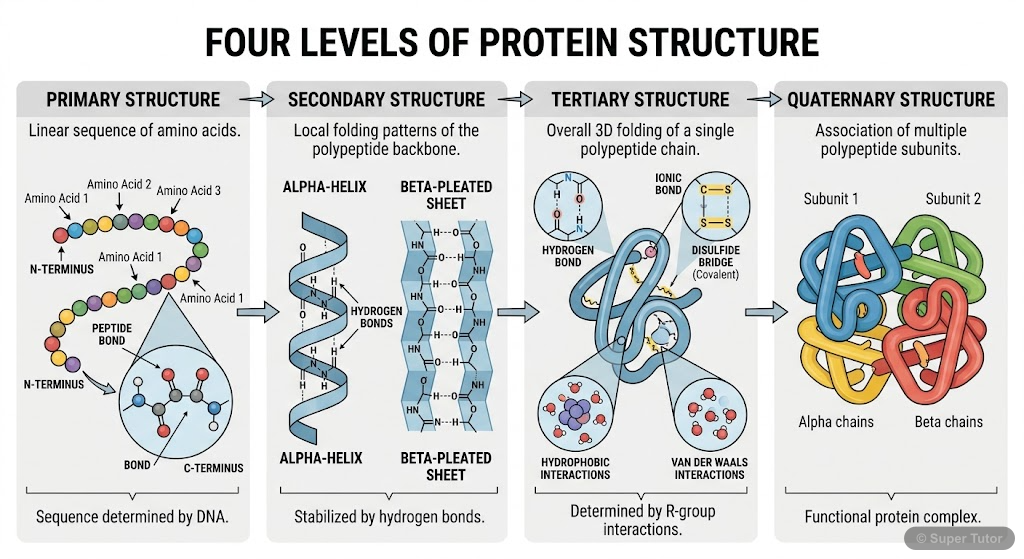
One of 32 illustrations for Biomolecules in Super Tutor — alongside flashcards, concept maps and practice questions.
Overview
Biomolecules form the chemical basis of life. Living systems are built from carbohydrates, proteins, nucleic acids, vitamins, and hormones, and these substances work together to support growth, energy production, heredity, and regulation of body functions. Carbohydrates mainly provide energy and str
Key Concepts
Carbohydrates are optically active polyhydroxy aldehydes
Carbohydrates are optically active polyhydroxy aldehydes or ketones, or compounds that produce such units on hydrolysis. Their general formula is Cx(H
Glucose is an aldohexose with formula
Glucose is an aldohexose with formula C6H12O6. It is the monomer of starch and cellulose and exists in α- and β-anomeric pyranose forms. Its straight-
Fructose is a ketohexose with formula
Fructose is a ketohexose with formula C6H12O6. It is obtained with glucose by hydrolysis of sucrose and forms a five-membered furanose ring. It is D-(
Sucrose
Sucrose, maltose, and lactose are disaccharides formed by glycosidic linkage between monosaccharide units. Sucrose is non-reducing because both reduci
Starch
Starch, cellulose, and glycogen are polysaccharides. Starch is the main storage polysaccharide of plants and contains amylose and amylopectin. Cellulo
Learning Objectives
- Understand the meaning and classification of carbohydrates, proteins, nucleic acids, vitamins, and hormones
- Distinguish between reducing and non-reducing sugars
- Explain the structures of glucose, fructose, sucrose, starch, cellulose, and glycogen
- Describe amino acids, peptide bonds, protein structure, and denaturation
- Compare DNA and RNA in composition, structure, and function
Frequently Asked Questions
What are the important topics in Biomolecules for Madhya Pradesh Board Class 12 Chemistry?
How should I revise Biomolecules for the Madhya Pradesh Board Class 12 board exam?
Sources & Official References
Content is aligned to the official syllabus. Refer to the board website for the latest curriculum.
More resources for Biomolecules
Practice Quiz
Test yourself with a quick quiz
Important Questions
Exam-style questions with answers
Revision Notes
Key points for last-minute revision
Formula Sheet
The chapter's formulas in one place
Concept Maps
See how topics connect
Study Plan
Step-by-step plan for this chapter
Flashcards
Quick-fire cards for active recall
Syllabus
What topics to cover
NCERT Solutions
Every textbook question solved step by step
For serious students
Get the full Biomolecules chapter — start free.
Quizzes, flashcards, an AI doubt solver and a study plan for Madhya Pradesh Board Class 12 Chemistry. Free to start, no card needed.