Coordination Compounds — Chapter Summary
Madhya Pradesh Board · Class 12 · Chemistry
Summary of Coordination Compounds for Madhya Pradesh Board Class 12 Chemistry. Part of the Madhya Pradesh Board Class 12 Chemistry syllabus.
Interactive on Super Tutor
Studying Coordination Compounds? Get the full interactive chapter.
Quizzes, flashcards, AI doubt-solver and a step-by-step study plan — built for chapter summary and more.
Free trial, no card needed.
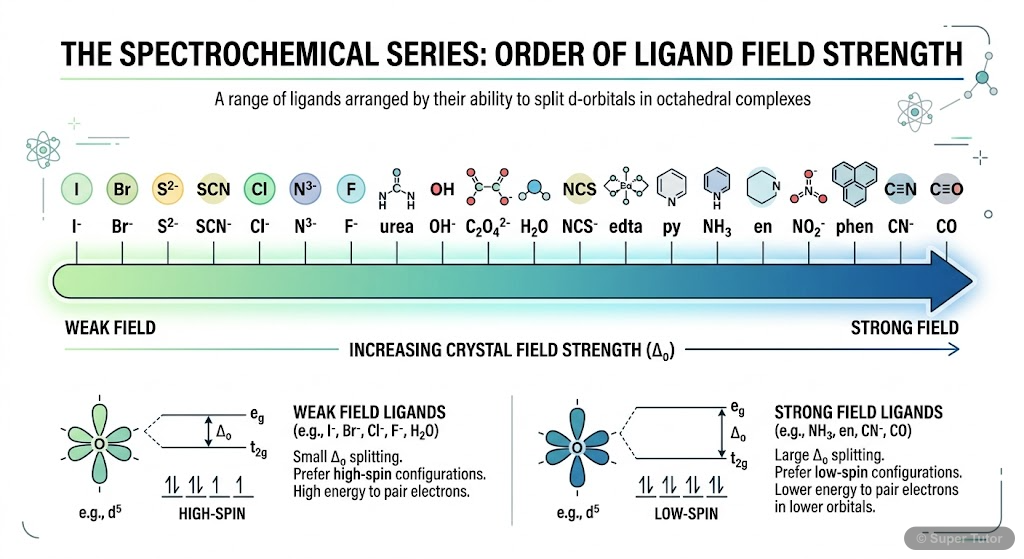
Learn better with visuals Super Tutor pairs illustrations like this with notes and quizzes for Coordination Compounds.
Overview
Coordination compounds are formed when a metal atom or ion is surrounded by ions or neutral molecules called ligands. Their study explains bonding, geometry, colour, magnetic behaviour, isomerism, and many important uses in chemistry, biology, metallurgy, medicine, and industry. Werner’s theory gave
Key Concepts
Werner proposed that metals in coordination
Werner proposed that metals in coordination compounds show primary valence and secondary valence. Primary valence is ionisable and is satisfied by neg
A coordination entity is a central
A coordination entity is a central metal atom or ion bonded to a fixed number of ligands. The species inside square brackets forms the coordination sp
Ligands are ions or molecules attached
Ligands are ions or molecules attached to the central metal atom or ion. They may be unidentate, didentate, polydentate, chelate, or ambidentate. EDTA
Coordination number is the number
Coordination number is the number of ligand donor atoms directly bonded to the metal through sigma bonds. Common coordination polyhedra are octahedral
In naming coordination compounds
In naming coordination compounds, ligands are written before the metal name in alphabetical order, oxidation state is shown in Roman numerals, and ani
Learning Objectives
- Understand Werner’s theory and its postulates
- Define coordination entity, ligand, coordination number, coordination sphere, coordination polyhedron, oxidation number, homoleptic complex, and heteroleptic complex
- Write formulas and names of mononuclear coordination compounds
- Identify and explain different types of isomerism in coordination compounds
- Understand bonding in coordination compounds using Valence Bond Theory and Crystal Field Theory
Frequently Asked Questions
What are the important topics in Coordination Compounds for Madhya Pradesh Board Class 12 Chemistry?
How should I revise Coordination Compounds for the Madhya Pradesh Board Class 12 board exam?
Sources & Official References
Content is aligned to the official syllabus. Refer to the board website for the latest curriculum.
More resources for Coordination Compounds
Practice Quiz
Test yourself with a quick quiz
Important Questions
Exam-style questions with answers
Revision Notes
Key points for last-minute revision
Concept Maps
See how topics connect
Study Plan
Step-by-step plan for this chapter
Flashcards
Quick-fire cards for active recall
Syllabus
What topics to cover
NCERT Solutions
Every textbook question solved step by step
For serious students
Get the full Coordination Compounds chapter — start free.
Quizzes, flashcards, an AI doubt solver and a study plan for Madhya Pradesh Board Class 12 Chemistry. Free to start, no card needed.