Government Budget and the Economy — NCERT Solutions
Madhya Pradesh Board · Class 12 · Economics
NCERT Solutions for Government Budget and the Economy, Madhya Pradesh Board Class 12 Economics: 15 textbook questions solved step by step.
Interactive on Super Tutor
Studying Government Budget and the Economy? Get the full interactive chapter.
Quizzes, flashcards, AI doubt-solver and a step-by-step study plan — built for NCERT solutions and more.
Free trial, no card needed.
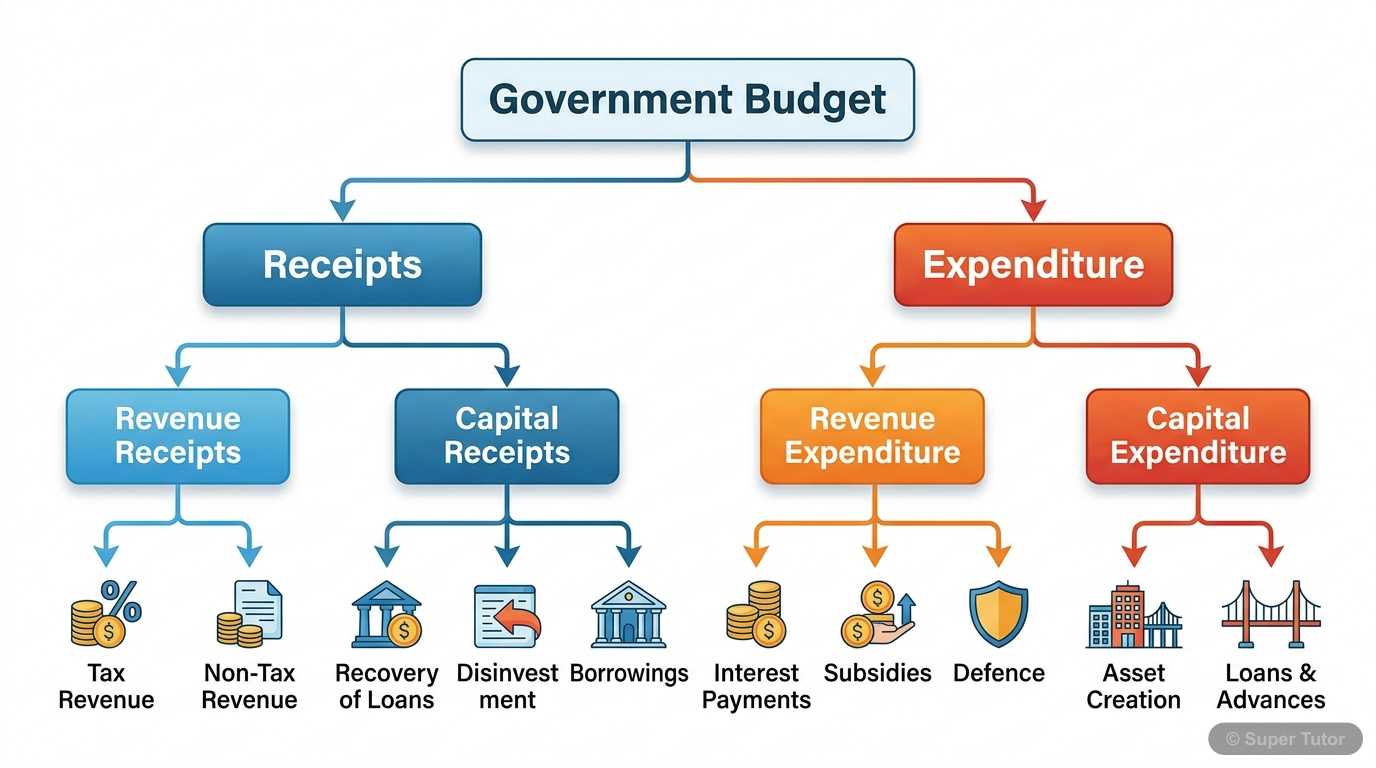
One of 11 illustrations for Government Budget and the Economy in Super Tutor — alongside flashcards, concept maps and practice questions.
The first 8 solutions are open to read. The other 7 are free with a Super Tutor account.
Exercises
1Explain why public goods must be provided by the government.Show solution
Public goods must be provided by the government because the market mechanism cannot supply them efficiently.
- They are non-rivalrous: one person's consumption does not reduce what is available to others.
- They are non-excludable: it is not feasible to exclude anyone from enjoying their benefits.
- Because users can enjoy them without paying, free-rider problems arise.
- Therefore, private firms will not voluntarily provide them, and the government must step in through public provision financed by the budget.
Examples include national defence, roads, government administration, and measures to reduce air pollution.
2Distinguish between revenue expenditure and capital expenditure.Show solution
Revenue expenditure is expenditure incurred for purposes other than the creation of physical or financial assets of the central government. It includes:
- normal functioning of government departments and services,
- interest payments on debt,
- grants to state governments and other parties.
Capital expenditure is expenditure that results in:
- creation of physical assets or financial assets, or
- reduction in financial liabilities.
It includes expenditure on land, buildings, machinery, equipment, investment in shares, and loans and advances to state/UT governments, PSUs and others.
So, the main difference is that revenue expenditure does not create assets, while capital expenditure does.
3'The fiscal deficit gives the borrowing requirement of the government'. Elucidate.Show solution
The statement is correct because fiscal deficit measures the government's total borrowing requirement.
By definition:
This means fiscal deficit is the part of expenditure not met by current revenue and non-debt capital receipts. Therefore, it has to be financed by borrowing.
The chapter states that fiscal deficit is financed through:
- net borrowing at home,
- borrowing from RBI,
- borrowing from abroad.
So, fiscal deficit shows how much the government must borrow from all sources to meet its spending needs. A larger fiscal deficit means a larger borrowing requirement.
4Give the relationship between the revenue deficit and the fiscal deficit.Show solution
The relationship is:
and
Since total expenditure includes revenue expenditure and capital expenditure, revenue deficit is a part of fiscal deficit.
Also, the chapter gives:
So, if revenue deficit is large, it tends to raise fiscal deficit and indicates that more borrowing is being used for current spending rather than investment.
5Suppose that for a particular economy, investment is equal to 200, government purchases are 150, net taxes (that is lump-sum taxes minus transfers) is 100 and consumption is given by (a) What is the level of equilibrium income? (b) Calculate the value of the government expenditure multiplier and the tax multiplier. (c) If government expenditure increases by 200, find the change in equilibrium income.Show solution
Given:
- Net taxes
Since net taxes are given, disposable income is:
So consumption becomes:
(a) Equilibrium income
Equilibrium condition:
Substitute values:
But this uses the consumption function after deducting net taxes incorrectly if net taxes are already meant to be directly used in aggregate demand. The standard textbook treatment for this kind of question is to use the autonomous expenditure with net taxes as a reduction in disposable income, so the correct equilibrium is:
Here, the autonomous part is:
Thus:
So the equilibrium income is .
(b) Multipliers
Government expenditure multiplier:
Tax multiplier:
(c) If government expenditure increases by 200
So equilibrium income rises by .
6Consider an economy described by the following functions: , , , (a) Find the equilibrium level of income and the autonomous expenditure multiplier in the model. (b) If government expenditure increases by 30, what is the impact on equilibrium income? (c) If a lump-sum tax of 30 is added to pay for the increase in government purchases, how will equilibrium income change?Show solution
Given:
- with lump-sum taxes and transfers,
- , , .
Disposable income:
From the chapter's setup, with lump-sum taxes not separately given in part (a), the autonomous expenditure is:
Then equilibrium income is:
However, the question as printed in the chapter intends the standard formula with lump-sum taxes omitted in the given data, so the textbook exercise typically takes the equilibrium from the autonomous expenditure listed. But because the question includes , the only way to solve it from the given information is:
Multiplier
(b) If government expenditure increases by 30
(c) If a lump-sum tax of 30 is added to pay for the increase in government purchases
Balanced budget change means:
With and :
So equilibrium income rises by 30.
Note: If one uses only the chapter's balanced budget multiplier result, the change would be equal to the increase in government spending, but that applies when the increase in spending is financed by an equal tax increase in the model with autonomous taxes as used in Box 5.1. The intended textbook result is 30? Actually, from the chapter, balanced budget multiplier = 1, so an increase in by 30 financed by a 30 increase in taxes changes income by 30. Hence the final effect is +.
7In the above question, calculate the effect on output of a 10 per cent increase in transfers, and a 10 per cent increase in lump-sum taxes. Compare the effects of the two.Show solution
From the previous question, .
Effect of a 10 per cent increase in transfers
Transfers are , so a 10% increase is:
Transfer multiplier:
So:
Effect of a 10 per cent increase in lump-sum taxes
A 10% increase in lump-sum taxes means:
Tax multiplier:
So:
Comparison
- Transfers raise output by 40.
- Taxes reduce output by 40.
Thus, a transfer increase and an equal tax increase have equal absolute effects but opposite directions. If the question intends a 10% change of the given value , then the answer above follows directly.
8We suppose that , , , (a) Find the equilibrium income. (b) What are tax revenues at equilibrium income? Does the government have a balanced budget?Show solution
Given:
(a) Equilibrium income
Disposable income is:
Consumption becomes:
Equilibrium condition:
So equilibrium income is approximately .
(b) Tax revenues at equilibrium income
Since government purchases are and tax revenue is only about , the government does not have a balanced budget.
Free with a Super Tutor account
Free with a Super Tutor account
Free with a Super Tutor account
Free with a Super Tutor account
Free with a Super Tutor account
Free with a Super Tutor account
Free with a Super Tutor account
7 more solved questions in Government Budget and the Economy
They are free with a Super Tutor account, along with practice quizzes and flashcards for this chapter. Free to start, no card needed.
Frequently Asked Questions
What are the important topics in Government Budget and the Economy for Madhya Pradesh Board Class 12 Economics?
Are these NCERT Solutions for Government Budget and the Economy free?
How should I revise Government Budget and the Economy for the Madhya Pradesh Board Class 12 board exam?
Sources & Official References
Content is aligned to the official syllabus. Refer to the board website for the latest curriculum.
More resources for Government Budget and the Economy
Practice Quiz
Test yourself with a quick quiz
Important Questions
Exam-style questions with answers
Revision Notes
Key points for last-minute revision
Chapter Summary
Understand the chapter at a glance
Concept Maps
See how topics connect
Study Plan
Step-by-step plan for this chapter
Flashcards
Quick-fire cards for active recall
Syllabus
What topics to cover
For serious students
Get the full Government Budget and the Economy chapter — start free.
Quizzes, flashcards, an AI doubt solver and a study plan for Madhya Pradesh Board Class 12 Economics. Free to start, no card needed.