Determination of Income and Employment — NCERT Solutions
Madhya Pradesh Board · Class 12 · Economics
NCERT Solutions for Determination of Income and Employment, Madhya Pradesh Board Class 12 Economics: 6 textbook questions solved step by step.
Interactive on Super Tutor
Studying Determination of Income and Employment? Get the full interactive chapter.
Quizzes, flashcards, AI doubt-solver and a step-by-step study plan — built for NCERT solutions and more.
Free trial, no card needed.
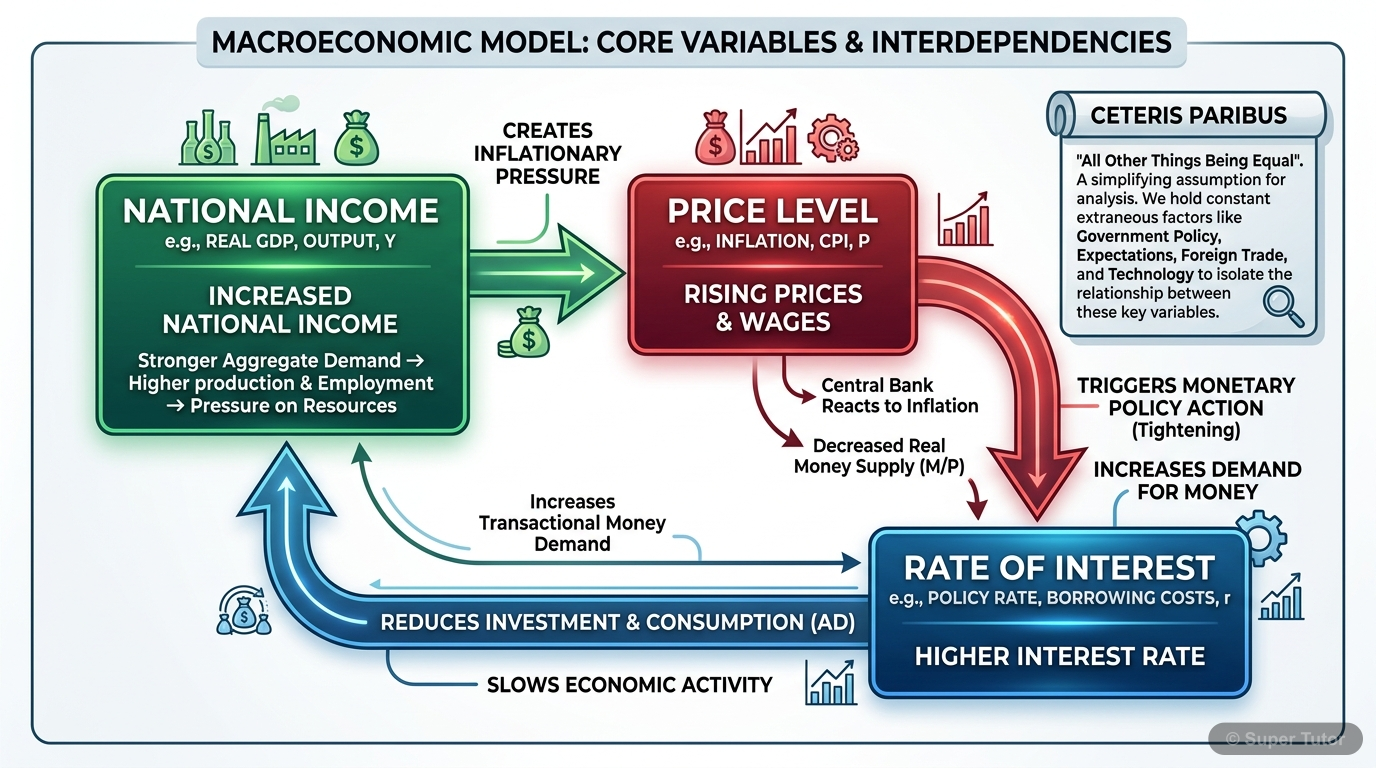
One of 12 illustrations for Determination of Income and Employment in Super Tutor — alongside flashcards, concept maps and practice questions.
The first 3 solutions are open to read. The other 3 are free with a Super Tutor account.
Exercise Questions
1What is marginal propensity to consume? How is it related to marginal propensity to save?Show solution
Given/Concept:
Marginal Propensity to Consume (MPC) measures the responsiveness of consumption to a change in income.
Definition:
Marginal Propensity to Consume (MPC) is defined as the ratio of the change in ex ante consumption () to the change in income (). Mathematically:
It shows how much of every additional rupee of income is spent on consumption. Since consumption increases with income but by less than the increase in income, .
Relationship between MPC and MPS:
We know that income () is either consumed () or saved ():
Taking the change on both sides:
Dividing throughout by :
Conclusion: MPC and MPS are complementary — they always sum to 1. If MPC = 0.8, then MPS = 0.2. A higher MPC implies a lower MPS and vice versa.
2What is the difference between ex ante investment and ex post investment?Show solution
Ex Ante Investment:
- 'Ex ante' means 'planned' or 'intended'.
- Ex ante investment refers to the amount of investment that firms plan or intend to make during a given period at the beginning of that period.
- It is a desired/planned magnitude and may or may not be realised.
- Example: A firm plans to invest Rs 100 crores in new machinery at the start of the year.
Ex Post Investment:
- 'Ex post' means 'actual' or 'realised'.
- Ex post investment refers to the investment that has actually been made during a given period, including both planned investment and unintended changes in inventories.
- It is always realised at the end of the period.
- Mathematically:
Key Difference:
| Basis | Ex Ante Investment | Ex Post Investment |
|---|---|---|
| Nature | Planned/Intended | Actual/Realised |
| Timing | Beginning of period | End of period |
| Includes unintended inventory changes | No | Yes |
Equilibrium Condition: The economy is in equilibrium when ex ante investment equals ex ante saving, i.e., when there are no unintended changes in inventories, so ex ante and ex post investment coincide.
3What do you understand by 'parametric shift of a line'? How does a line shift when its (i) slope decreases, and (ii) its intercept increases?Show solution
Parametric Shift of a Line:
A parametric shift refers to a change in the position or slope of a line caused by a change in one of its parameters (i.e., the constants that define the line — its slope or intercept), while the variable on the horizontal axis remains unchanged.
Consider a general linear equation:
where is the intercept and is the slope. A change in or causes a parametric shift.
(i) When the slope decreases:
- The slope represents the steepness of the line.
- If the slope decreases (i.e., falls), the line becomes flatter — it rotates downward (clockwise) around the intercept point on the Y-axis.
- The intercept remains the same, but for any given value of , the value of is now lower (except at the intercept).
- Example: If MPC falls, the consumption function becomes flatter.
(ii) When the intercept increases:
- The intercept is the value of when .
- If the intercept increases (i.e., rises), the entire line shifts upward in a parallel fashion — the slope remains unchanged but the line moves up.
- Every point on the new line is higher than the corresponding point on the old line by the same amount.
- Example: If autonomous consumption increases, the consumption function shifts upward parallelly.
Summary:
- Decrease in slope → line becomes flatter (rotates clockwise around the Y-intercept).
- Increase in intercept → line shifts upward parallelly (no change in slope).
Free with a Super Tutor account
Free with a Super Tutor account
Free with a Super Tutor account
3 more solved questions in Determination of Income and Employment
They are free with a Super Tutor account, along with practice quizzes and flashcards for this chapter. Free to start, no card needed.
Frequently Asked Questions
What are the important topics in Determination of Income and Employment for Madhya Pradesh Board Class 12 Economics?
Are these NCERT Solutions for Determination of Income and Employment free?
How should I revise Determination of Income and Employment for the Madhya Pradesh Board Class 12 board exam?
Sources & Official References
Content is aligned to the official syllabus. Refer to the board website for the latest curriculum.
More resources for Determination of Income and Employment
Practice Quiz
Test yourself with a quick quiz
Important Questions
Exam-style questions with answers
Revision Notes
Key points for last-minute revision
Formula Sheet
The chapter's formulas in one place
Chapter Summary
Understand the chapter at a glance
Concept Maps
See how topics connect
Study Plan
Step-by-step plan for this chapter
Flashcards
Quick-fire cards for active recall
Syllabus
What topics to cover
For serious students
Get the full Determination of Income and Employment chapter — start free.
Quizzes, flashcards, an AI doubt solver and a study plan for Madhya Pradesh Board Class 12 Economics. Free to start, no card needed.