The Theory of the Firm Under Perfect Competition — NCERT Solutions
Madhya Pradesh Board · Class 12 · Economics
NCERT Solutions for The Theory of the Firm Under Perfect Competition, Madhya Pradesh Board Class 12 Economics: 27 textbook questions solved step by step.
Interactive on Super Tutor
Studying The Theory of the Firm Under Perfect Competition? Get the full interactive chapter.
Quizzes, flashcards, AI doubt-solver and a step-by-step study plan — built for NCERT solutions and more.
Free trial, no card needed.
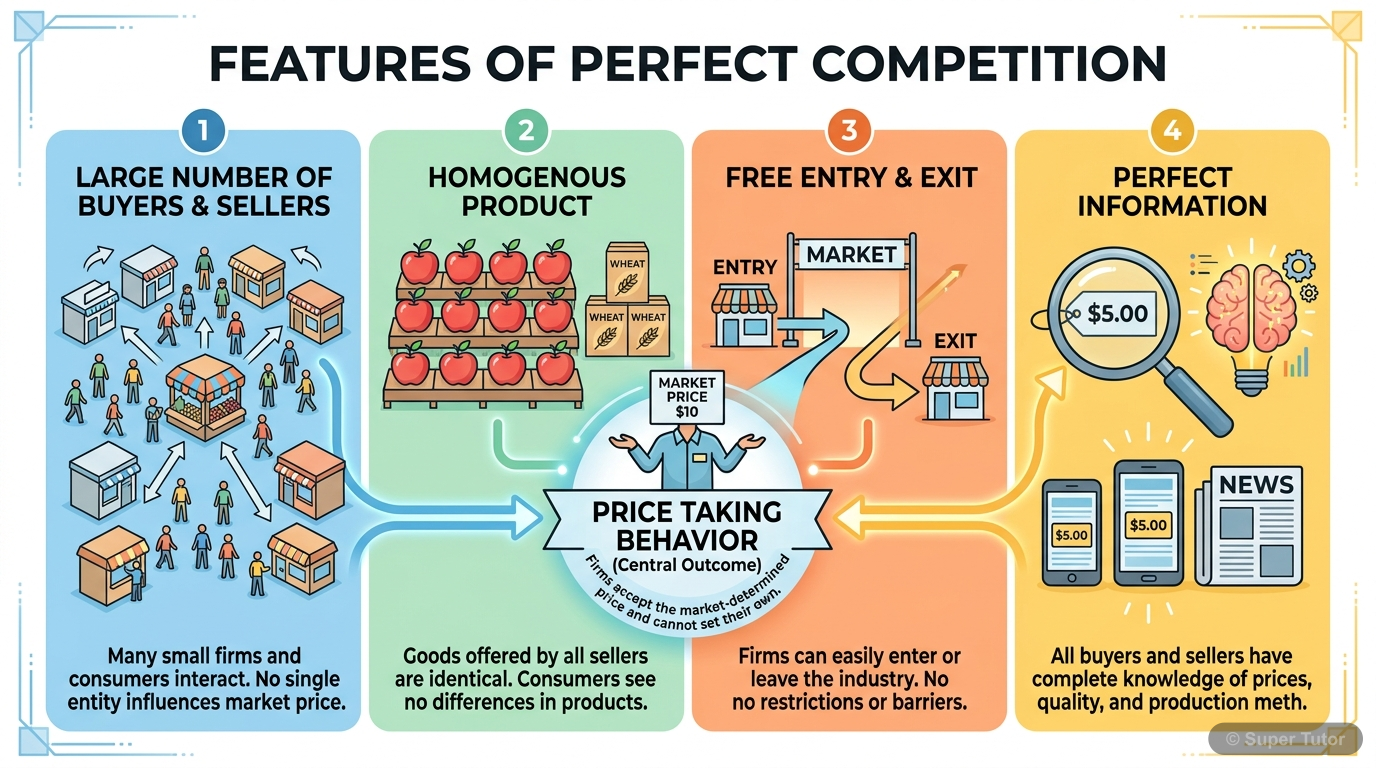
Learn better with visuals Super Tutor pairs illustrations like this with notes and quizzes for The Theory of the Firm Under Perfect Competition.
The first 14 solutions are open to read. The other 13 are free with a Super Tutor account.
Exercises
1What are the characteristics of a perfectly competitive market?Show solution
Given/Concept: A perfectly competitive market is an idealised market structure with specific features.
Characteristics of a Perfectly Competitive Market:
- Large number of buyers and sellers: There are so many buyers and sellers that no single buyer or seller can influence the market price. Each firm is a price-taker.
- Homogeneous product: All firms sell an identical (homogeneous) product, so buyers have no preference for one seller over another.
- Free entry and exit: Firms can freely enter or exit the industry in the long run without any barriers.
- Perfect information: All buyers and sellers have complete and perfect knowledge about prices and market conditions.
- Perfect mobility of factors: Factors of production can move freely between industries.
- No transportation costs: There are no transportation costs, so the price is uniform everywhere.
Conclusion: Because of these features, a single market price prevails and every firm is a price-taker.
2How are the total revenue of a firm, market price, and the quantity sold by the firm related to each other?Show solution
Given: A price-taking firm sells its output at the prevailing market price.
Concept/Formula:
Explanation:
- The market price is determined by the forces of demand and supply in the market. The firm accepts this price as given.
- If the firm sells units at price , its total revenue is simply .
- Since is constant for a price-taking firm, TR increases proportionally with . For every additional unit sold, TR rises by exactly .
Conclusion: Total revenue is directly and proportionally related to the quantity sold, with market price acting as the constant of proportionality: .
3What is the 'price line'?Show solution
Concept: In a perfectly competitive market, a firm is a price-taker — it cannot influence the market price.
Definition: The price line (also called the demand curve faced by a competitive firm) is a horizontal straight line drawn at the level of the prevailing market price .
Explanation:
- Since the firm can sell any quantity it wishes at the fixed market price , the price remains constant regardless of the quantity sold by the firm.
- This horizontal line at represents both the Average Revenue (AR) and the Marginal Revenue (MR) of the firm, because:
Conclusion: The price line is a horizontal line at the market price, indicating that the firm faces a perfectly elastic demand curve.
4Why is the total revenue curve of a price-taking firm an upward-sloping straight line? Why does the curve pass through the origin?Show solution
Given: For a price-taking firm, , where is constant.
Why it is an upward-sloping straight line:
- Since is constant, is a linear function of .
- As increases by 1 unit, increases by a fixed amount equal to .
- Therefore, the TR curve is a straight line with a positive (upward) slope equal to .
Why it passes through the origin:
- When the quantity sold , we get:
- So when output is zero, total revenue is also zero.
- Hence the TR curve passes through the origin (the point where both and ).
Conclusion: The TR curve is an upward-sloping straight line through the origin with slope equal to the market price .
5What is the relation between market price and average revenue of a price-taking firm?Show solution
Given: For a price-taking firm, market price is constant.
Formula:
Explanation:
- Average Revenue is defined as total revenue per unit of output sold.
- Since , dividing both sides by gives .
- This means that for every level of output, the average revenue equals the market price.
Conclusion: For a price-taking firm, Average Revenue (AR) is always equal to the market price () at every level of output.
6What is the relation between market price and marginal revenue of a price-taking firm?Show solution
Given: For a price-taking firm, market price is constant.
Formula:
Derivation:
- at output is .
- at output is .
- Therefore, .
Explanation:
- Since the firm sells each additional unit at the same market price , the addition to total revenue from selling one more unit is always .
- Hence at every level of output.
Conclusion: For a price-taking firm, Marginal Revenue (MR) is always equal to the market price (): .
7What conditions must hold if a profit-maximising firm produces positive output in a competitive market?Show solution
Concept: A profit-maximising firm chooses output to maximise .
Conditions for profit maximisation at a positive output level:
(i) Short Run:
Three conditions must hold simultaneously:
- (Price equals Short-Run Marginal Cost) — the first-order condition.
- is non-decreasing at that output — the second-order (stability) condition.
- (Price must cover Average Variable Cost) — the shut-down condition.
(ii) Long Run:
Three conditions must hold simultaneously:
- (Price equals Long-Run Marginal Cost).
- is non-decreasing at that output.
- (Price must cover Long-Run Average Cost).
Explanation:
- Condition (1) ensures that profit cannot be increased by changing output.
- Condition (2) ensures it is a maximum and not a minimum.
- Condition (3) ensures the firm does not shut down (it at least covers variable/total costs).
Conclusion: All three conditions must hold together for a profit-maximising firm to produce positive output.
8Can there be a positive level of output that a profit-maximising firm produces in a competitive market at which market price is not equal to marginal cost? Give an explanation.Show solution
Answer: No, a profit-maximising firm in a competitive market cannot produce a positive level of output at which market price is not equal to marginal cost (given the other conditions are satisfied).
Explanation:
- Case 1: — If price exceeds marginal cost, the revenue from selling one more unit () is greater than the cost of producing it (). The firm can increase profit by producing more. So this cannot be a profit-maximising position.
- Case 2: — If price is less than marginal cost, the revenue from the last unit is less than its cost. The firm can increase profit by reducing output. So this also cannot be a profit-maximising position.
- Case 3: — Only when price equals marginal cost is there no incentive to change output. Profit cannot be increased by either expanding or contracting output.
Conclusion: Therefore, at the profit-maximising positive output level, it is necessary that . Any deviation from this condition means the firm can do better by adjusting output.
9Will a profit-maximising firm in a competitive market ever produce a positive level of output in the range where the marginal cost is falling? Give an explanation.Show solution
Answer: No, a profit-maximising firm will not produce at a level of output where marginal cost is falling.
Explanation:
- One of the necessary conditions for profit maximisation is that and must be non-decreasing (i.e., the curve must be rising or flat) at the chosen output level.
- Suppose the firm is at an output where but is falling. This means that for the next unit of output, will be even lower than . So the firm can earn more profit by producing that additional unit. This contradicts the assumption that the current output is profit-maximising.
- More formally, when is falling, the point corresponds to a profit minimum, not a profit maximum.
Conclusion: A profit-maximising firm will only produce where is non-decreasing (rising part of the curve). It will never choose to produce in the range where is falling.
10Will a profit-maximising firm in a competitive market produce a positive level of output in the short run if the market price is less than the minimum of AVC? Give an explanation.Show solution
Answer: No, a profit-maximising firm will not produce a positive output in the short run if .
Explanation:
- In the short run, total cost = Total Fixed Cost (TFC) + Total Variable Cost (TVC).
- If the firm shuts down (produces zero output), it still incurs TFC. Its loss = TFC.
- If the firm produces a positive output at price :
- So , which means the firm cannot even cover its variable costs.
- Loss from producing = .
- This loss is greater than the loss from shutting down (which is only TFC).
Conclusion: When , the firm minimises its loss by shutting down and producing zero output. It will not produce any positive output in the short run.
11Will a profit-maximising firm in a competitive market produce a positive level of output in the long run if the market price is less than the minimum of AC? Give an explanation.Show solution
Answer: No, a profit-maximising firm will not produce a positive output in the long run if .
Explanation:
- In the long run, there are no fixed costs — all costs are variable. The firm can exit the industry without any loss.
- If the firm shuts down in the long run, its profit = 0 (no revenue, no cost).
- If at every level of output, then for every positive output level, meaning the firm makes a loss (negative profit) at every positive output.
- Since producing zero gives profit = 0, which is better than a negative profit, the firm will choose to exit the industry.
Conclusion: In the long run, a firm will produce positive output only if . If , the firm will shut down and exit the market, producing zero output.
12What is the supply curve of a firm in the short run?Show solution
Concept: The short-run supply curve shows the quantity a profit-maximising firm is willing to supply at each market price in the short run.
Short-Run Supply Curve:
The short-run supply curve of a firm consists of two parts:
- When : The firm produces at the output where and is rising. So the supply curve is the rising (upward-sloping) portion of the SMC curve at and above the minimum AVC point.
- When : The firm shuts down and supplies zero output.
Formally:
Conclusion: The short-run supply curve is the rising part of the SMC curve from and above the minimum AVC, combined with zero output for all prices below the minimum AVC.
13What is the supply curve of a firm in the long run?Show solution
Concept: The long-run supply curve shows the quantity a profit-maximising firm is willing to supply at each market price in the long run, when all inputs are variable.
Long-Run Supply Curve:
The long-run supply curve of a firm consists of two parts:
- When : The firm produces at the output where and is rising. So the supply curve is the rising (upward-sloping) portion of the LRMC curve at and above the minimum LRAC point.
- When : The firm exits the industry and supplies zero output.
Formally:
Conclusion: The long-run supply curve is the rising part of the LRMC curve from and above the minimum LRAC, combined with zero output for all prices below the minimum LRAC.
14How does technological progress affect the supply curve of a firm?Show solution
Concept: Technological progress means the firm can produce the same output using fewer inputs, or more output using the same inputs — i.e., it reduces the cost of production.
Effect on Supply Curve:
- Technological progress reduces the marginal cost (MC) of production at every level of output.
- Since the supply curve of a firm is the rising part of its MC curve (above minimum AVC), a fall in MC shifts the MC curve downward and to the right.
- This means the firm is now willing to supply more output at every given price than before.
Conclusion: Technological progress shifts the supply curve of a firm to the right (rightward shift), indicating an increase in supply at every price level.
Free with a Super Tutor account
Free with a Super Tutor account
Free with a Super Tutor account
Free with a Super Tutor account
Free with a Super Tutor account
Free with a Super Tutor account
Free with a Super Tutor account
Free with a Super Tutor account
Free with a Super Tutor account
Free with a Super Tutor account
Free with a Super Tutor account
Free with a Super Tutor account
Free with a Super Tutor account
13 more solved questions in The Theory of the Firm Under Perfect Competition
They are free with a Super Tutor account, along with practice quizzes and flashcards for this chapter. Free to start, no card needed.
Frequently Asked Questions
What are the important topics in The Theory of the Firm Under Perfect Competition for Madhya Pradesh Board Class 12 Economics?
Are these NCERT Solutions for The Theory of the Firm Under Perfect Competition free?
How should I revise The Theory of the Firm Under Perfect Competition for the Madhya Pradesh Board Class 12 board exam?
Sources & Official References
Content is aligned to the official syllabus. Refer to the board website for the latest curriculum.
More resources for The Theory of the Firm Under Perfect Competition
Practice Quiz
Test yourself with a quick quiz
Important Questions
Exam-style questions with answers
Revision Notes
Key points for last-minute revision
Formula Sheet
The chapter's formulas in one place
Chapter Summary
Understand the chapter at a glance
Concept Maps
See how topics connect
Study Plan
Step-by-step plan for this chapter
Flashcards
Quick-fire cards for active recall
Syllabus
What topics to cover
For serious students
Get the full The Theory of the Firm Under Perfect Competition chapter — start free.
Quizzes, flashcards, an AI doubt solver and a study plan for Madhya Pradesh Board Class 12 Economics. Free to start, no card needed.