Introduction — NCERT Solutions
Madhya Pradesh Board · Class 12 · Economics
NCERT Solutions for Introduction, Madhya Pradesh Board Class 12 Economics: 8 textbook questions solved step by step. Covers Exercises.
Interactive on Super Tutor
Studying Introduction? Get the full interactive chapter.
Quizzes, flashcards, AI doubt-solver and a step-by-step study plan — built for NCERT solutions and more.
Free trial, no card needed.
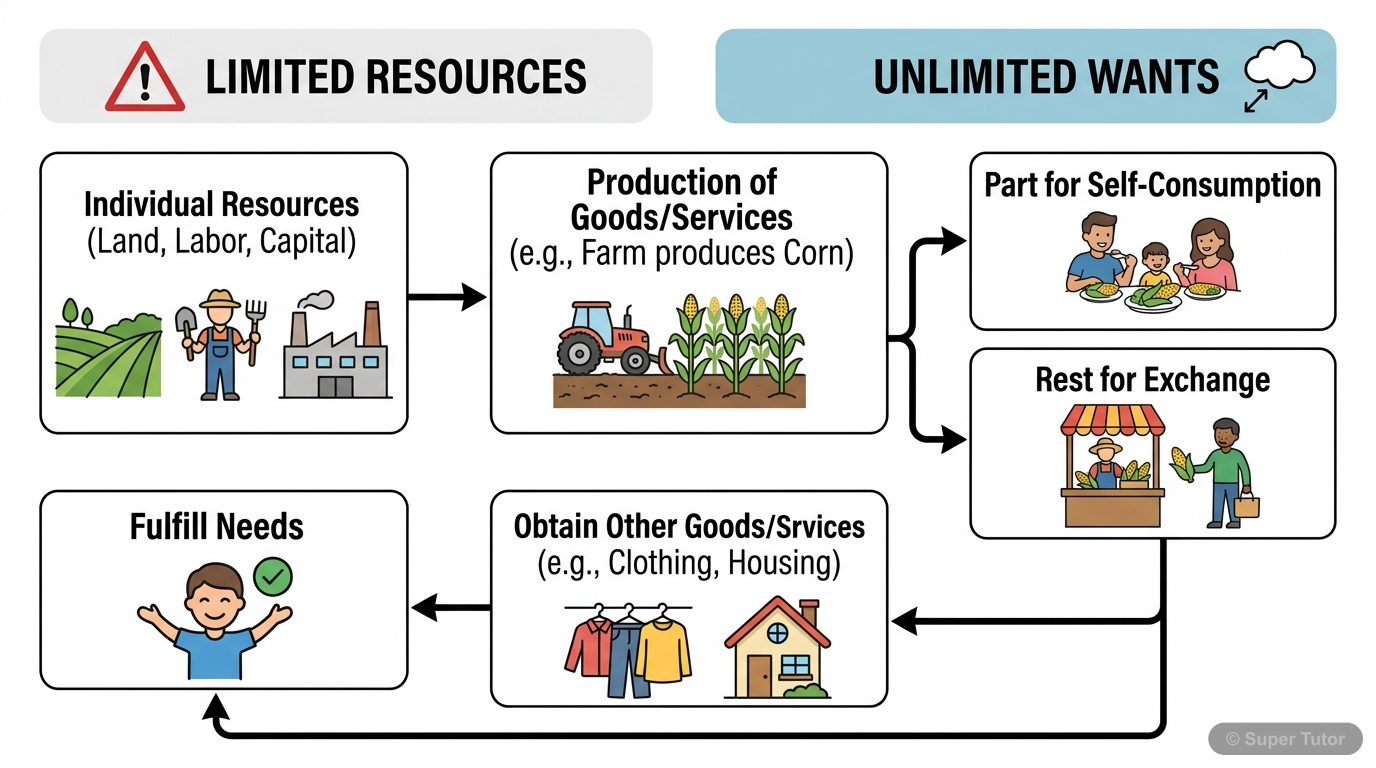
Learn better with visuals Super Tutor pairs illustrations like this with notes and quizzes for Introduction.
The first 4 solutions are open to read. The other 4 are free with a Super Tutor account.
Exercises
1Discuss the central problems of an economy.Show solution
The central problems of an economy arise because resources are scarce and have alternative uses. Since society cannot have everything it wants, it must make choices about how to use its limited resources. The chapter lists three central problems:
- What is produced and in what quantities?
Every society must decide how much of different goods and services—such as food, clothing, housing, education, health services, and luxury goods—should be produced.
- How are these goods produced?
Society must decide which resources and techniques to use in producing goods and services. For example, whether to use more labour or more machines, and which technology to adopt.
- For whom are these goods produced?
Society must decide how the produced goods and services should be distributed among people. It has to decide who gets how much, and whether everyone should get a minimum amount of basic goods and services.
Thus, the central problems of an economy are the allocation of scarce resources among different uses and the distribution of the final output among individuals.
2What do you mean by the production possibilities of an economy?Show solution
The production possibilities of an economy refer to the different combinations of goods and services that the economy can produce with its given resources and existing technology. Since resources are limited and can be used in different ways, the economy can produce one combination of goods or another, depending on how the resources are allocated.
For example, if an economy can produce corn and cotton, it may be able to produce:
- more corn and less cotton,
- less corn and more cotton,
- or some intermediate combination of the two.
The set of all such possible combinations is called the economy’s production possibilities. These possibilities show the choices available to society when its resources are fully or differently used.
3What is a production possibility frontier?Show solution
A production possibility frontier (PPF) is the curve that shows the maximum amount of one good that can be produced for any given amount of another good, when the economy’s resources are fully utilised.
In the chapter’s example of corn and cotton, the PPF shows all combinations of corn and cotton that can be produced with the available resources and technology. Points on the frontier represent efficient use of resources, while points below it represent underutilisation or waste of resources.
So, the PPF is the boundary of feasible output combinations for an economy.
4Discuss the subject matter of economics.Show solution
Economics studies the behaviour of people and society in dealing with the problem of scarcity. Because resources are limited, economics is concerned with how individuals and societies make choices.
Its subject matter includes:
- Production of goods and services,
- Exchange of goods and services,
- Consumption of goods and services,
- The allocation of scarce resources, and
- The distribution of the goods and services produced.
The chapter also explains that economics is traditionally divided into two branches:
- Microeconomics, which studies individual economic units and markets,
- Macroeconomics, which studies the economy as a whole using aggregate measures like total output, employment, and price level.
Thus, economics is the study of how scarce resources are used to satisfy human wants and how economic activities are organised and analysed.
Free with a Super Tutor account
Free with a Super Tutor account
Free with a Super Tutor account
Free with a Super Tutor account
4 more solved questions in Introduction
They are free with a Super Tutor account, along with practice quizzes and flashcards for this chapter. Free to start, no card needed.
Frequently Asked Questions
What are the important topics in Introduction for Madhya Pradesh Board Class 12 Economics?
Are these NCERT Solutions for Introduction free?
How should I revise Introduction for the Madhya Pradesh Board Class 12 board exam?
Sources & Official References
Content is aligned to the official syllabus. Refer to the board website for the latest curriculum.
More resources for Introduction
Practice Quiz
Test yourself with a quick quiz
Important Questions
Exam-style questions with answers
Revision Notes
Key points for last-minute revision
Chapter Summary
Understand the chapter at a glance
Concept Maps
See how topics connect
Study Plan
Step-by-step plan for this chapter
Flashcards
Quick-fire cards for active recall
Syllabus
What topics to cover
For serious students
Get the full Introduction chapter — start free.
Quizzes, flashcards, an AI doubt solver and a study plan for Madhya Pradesh Board Class 12 Economics. Free to start, no card needed.