Indigo (Louis Fischer) — NCERT Solutions
Madhya Pradesh Board · Class 12 · English
NCERT Solutions for Indigo (Louis Fischer), Madhya Pradesh Board Class 12 English: 18 textbook questions solved step by step.
Interactive on Super Tutor
Studying Indigo (Louis Fischer)? Get the full interactive chapter.
Quizzes, flashcards, AI doubt-solver and a step-by-step study plan — built for NCERT solutions and more.
Free trial, no card needed.
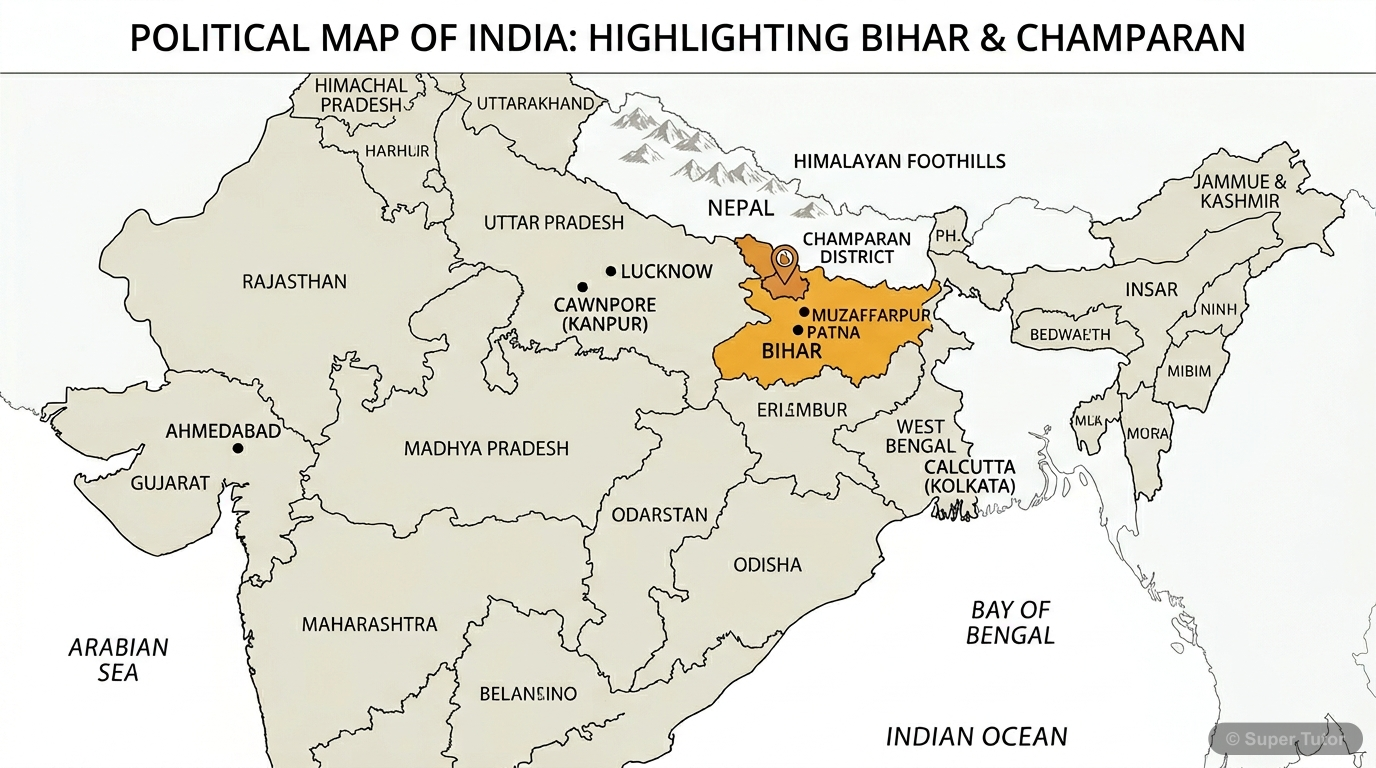
One of 9 illustrations for Indigo (Louis Fischer) in Super Tutor — alongside flashcards, concept maps and practice questions.
The first 9 solutions are open to read. The other 9 are free with a Super Tutor account.
Think as you read (Page 46 — Shukla meets Gandhi)
1Strike out what is not true in the following.
a. Rajkumar Shukla was
(i) a sharecropper.
(ii) a politician.
(iii) delegate.
(iv) a landlord.
b. Rajkumar Shukla was
(i) poor.
(ii) physically strong.
(iii) illiterate.Show solution
a. Rajkumar Shukla was:
Strike out: (ii) a politician and (iv) a landlord.
Rajkumar Shukla was (i) a sharecropper and (iii) a delegate (he came as a delegate to the Congress session to plead the cause of the Champaran peasants). He was neither a politician nor a landlord.
b. Rajkumar Shukla was:
Strike out: (ii) physically strong.
He was (i) poor and (iii) illiterate. The text describes him as an 'unlettered peasant' and a poor yeoman. There is no evidence in the text that he was physically strong.
2Why is Rajkumar Shukla described as being 'resolute'?Show solution
Given: Rajkumar Shukla was a poor, illiterate sharecropper from Champaran.
Answer: Rajkumar Shukla is described as 'resolute' because of his extraordinary determination and single-minded persistence in persuading Gandhi to visit Champaran. He followed Gandhi from the Congress session in Lucknow to Cawnpore, then to other parts of India, and finally to Gandhi's ashram near Ahmedabad. For weeks he never left Gandhi's side. Despite being poor and illiterate, he refused to give up until Gandhi agreed to accompany him to Champaran. This unwavering tenacity and firm resolve in the face of repeated delays and disappointments justifies the description 'resolute'.
3Why do you think the servants thought Gandhi to be another peasant?Show solution
Given: Gandhi accompanied Shukla to Rajendra Prasad's house in Patna.
Answer: The servants at Rajendra Prasad's house thought Gandhi to be another peasant for the following reasons:
- Company he kept: Gandhi arrived in the company of Rajkumar Shukla, whom the servants already knew as a poor yeoman — a simple, low-status peasant who frequently pestered their master.
- Appearance: Gandhi dressed simply, like a common man, without any outward signs of status or distinction.
- Lack of prior information: The servants had no prior knowledge of Gandhi or his stature. To them, any companion of a poor peasant would naturally be assumed to be of a similar background.
This is further confirmed by the fact that Gandhi was not permitted to draw water from the well, lest he be an untouchable — a treatment no distinguished person would receive.
Think as you read (Page 48 — Gandhi arrives in Champaran)
1List the places that Gandhi visited between his first meeting with Shukla and his arrival at Champaran.Show solution
Given: The narrative traces Gandhi's journey from his first meeting with Shukla to Champaran.
List of places visited:
- Lucknow — where Gandhi first met Shukla at the Congress session.
- Cawnpore (Kanpur) — where Gandhi had a prior appointment.
- Other parts of India — Gandhi was committed to visits across India (mentioned generally).
- Ahmedabad (Sabarmati Ashram) — Gandhi returned to his ashram; Shukla followed him here.
- Calcutta (Kolkata) — the appointed meeting point from where both boarded a train.
- Patna (Bihar) — where Shukla led Gandhi to Rajendra Prasad's house.
- Muzzafarpur — Gandhi went here first to gather more complete information about conditions in Champaran.
- Champaran (Motihari) — the final destination.
Thus, the journey covered Lucknow → Cawnpore → various parts of India → Ahmedabad → Calcutta → Patna → Muzzafarpur → Champaran.
2What did the peasants pay the British landlords as rent? What did the British now want instead and why? What would be the impact of synthetic indigo on the prices of natural indigo?Show solution
Given: The text describes the sharecropping arrangement in Champaran.
Part 1 — What the peasants paid as rent:
The peasants were sharecroppers who were compelled to plant indigo on 15 per cent of their land and surrender the entire indigo harvest to the landlords as rent. This was known as the 'tinkathia' system.
Part 2 — What the British now wanted instead and why:
When the landlords learned that Germany had developed synthetic indigo, natural indigo lost its commercial value. The British landlords no longer needed the peasants to grow indigo. They therefore wanted the peasants to pay them monetary compensation in exchange for being released from the 15 per cent arrangement. In other words, they wanted money instead of the indigo crop.
Part 3 — Impact of synthetic indigo on prices of natural indigo:
The development of synthetic indigo by Germany would cause the prices of natural indigo to fall sharply, making its cultivation economically unviable. The landlords, foreseeing this collapse in value, rushed to get money from the peasants before the peasants realised that the indigo they were forced to grow was now worthless. This is why many peasants who had already signed the compensation agreements later wanted their money back when they learned about synthetic indigo.
Think as you read (Page 50 — Civil Disobedience and Gandhi's method)
1The events in this part of the text illustrate Gandhi's method of working. Can you identify some instances of this method and link them to his ideas of satyagraha and non-violence?Show solution
Given: The text describes Gandhi's actions after arriving in Champaran — his defiance of the official notice, his appearance in court, and the lawyers' decision to follow him.
Gandhi's method — instances linked to Satyagraha and Non-violence:
- Refusal to leave Champaran despite official orders: When the British commissioner bullied him and asked him to leave Tirhut, Gandhi did not comply. When served an official notice to quit Champaran, he signed the receipt and wrote that he would disobey the order. This is a direct instance of civil disobedience (Satyagraha) — peacefully but firmly refusing to obey an unjust law.
- Appearing in court willingly: Gandhi received a summons and appeared in court without resistance. He did not flee or use force. This reflects non-violence — accepting legal consequences without aggression.
- Moral courage over legal protection: Gandhi told the court he could not leave Champaran as it was his duty to the peasants. He was willing to go to prison. This shows that truth (Satya) and moral duty were more important to him than personal safety.
- Inspiring the lawyers through example: The lawyers, who had initially planned to go home if Gandhi was arrested, were moved by Gandhi's willingness to go to prison for strangers. They decided to follow him into jail. Gandhi did not command them — he led by example, a core principle of Satyagraha.
- Organised, peaceful inquiry: Rather than inciting the peasants to revolt, Gandhi conducted a systematic, non-violent inquiry — collecting depositions, gathering evidence — to fight injustice through truth and facts, not force.
Conclusion: All these actions embody the Gandhian principles of Satyagraha (truth-force), civil disobedience, and non-violence — achieving justice through moral courage rather than physical confrontation.
Think as you read (Page 52 — Settlement and its impact)
1Why did Gandhi agree to a settlement of 25 per cent refund to the farmers?Show solution
Given: The landlords were ordered to refund money to the sharecroppers. Gandhi agreed to a 25 per cent refund instead of demanding a full 100 per cent.
Answer: Gandhi agreed to a settlement of only 25 per cent refund for the following reasons:
- The amount was less important than the principle: Gandhi explained that the exact percentage mattered less than the fact that the landlords had been made to surrender a portion of the money. The moral victory — compelling the landlords to admit they were wrong and to pay back even a part — was what counted.
- Demonstrating that landlords were not all-powerful: By forcing the landlords to make any refund at all, Gandhi showed the peasants that the British landlords could be challenged. This broke the psychological hold of fear that the landlords had over the peasants.
- Practical wisdom: Demanding 100 per cent might have prolonged the legal battle indefinitely, causing more suffering to the already poor peasants. A 25 per cent settlement gave them immediate, tangible relief.
- Long-term impact over short-term gain: Gandhi's goal was not merely financial compensation but the liberation of the peasants from fear and oppression. Even a partial refund achieved this larger purpose.
2How did the episode change the plight of the peasants?Show solution
Given: The text describes the changes brought about by Gandhi's intervention in Champaran.
The Champaran episode changed the plight of the peasants in the following ways:
- Abolition of the tinkathia system: The sharecropping arrangement that forced peasants to grow indigo on 15 per cent of their land was abolished. The peasants were freed from this exploitative obligation.
- Financial compensation: The landlords were made to refund a portion (25 per cent) of the money they had illegally extracted from the peasants, giving them some economic relief.
- Freedom from fear: Most importantly, the peasants realised that the British landlords were not invincible. Gandhi's courage in defying official orders showed them that injustice could be resisted peacefully. This broke the climate of fear.
- Educational improvement: Gandhi opened primary schools in six villages to educate the children of peasants. Volunteers, including Gandhi's wife Kasturbai, came to teach.
- Health improvement: A doctor volunteered for six months. Basic medicines — castor oil, quinine, and sulphur ointment — were made available to treat common ailments.
- Social improvement: Kasturbai taught the women about personal cleanliness and community sanitation, improving living conditions.
- Self-reliance and dignity: The episode instilled a sense of self-respect and self-reliance in the peasants and the lawyers who worked with Gandhi, teaching them that they could fight their own battles without depending on outside help.
Understanding the Text
1Why do you think Gandhi considered the Champaran episode to be a turning-point in his life?Show solution
Given: Gandhi himself stated, 'What I did was a very ordinary thing. I declared that the British could not order me about in my own country.'
Answer: Gandhi considered the Champaran episode a turning-point in his life for the following reasons:
- First act of civil disobedience in India: Champaran was the first successful experiment with Satyagraha on Indian soil. When Gandhi defied the official notice to quit Champaran and was prepared to go to prison, the Lieutenant-Governor was forced to drop the case. This was the first triumph of civil disobedience in modern India.
- Assertion of dignity and rights: Gandhi declared that the British could not order him about in his own country. This was a powerful statement of Indian self-respect and sovereignty — a turning point from submission to resistance.
- Politics linked to the people's problems: Champaran showed Gandhi that true political work must be rooted in the day-to-day suffering of ordinary people. His politics became intertwined with the practical problems of millions, not abstract ideologies.
- Moulding a new India: Through Champaran, Gandhi began his mission of creating a self-reliant, fearless Indian citizen — one who could stand on his own feet. This became the foundation of the freedom movement.
- Proof of method: The success at Champaran validated the method of Satyagraha — that truth, non-violence, and moral courage could defeat an unjust and powerful authority.
Thus, Champaran was not merely a local victory; it was the beginning of Gandhi's larger national mission.
Free with a Super Tutor account
Free with a Super Tutor account
Free with a Super Tutor account
Talking about the Text
Free with a Super Tutor account
Free with a Super Tutor account
Working with Words
Free with a Super Tutor account
Thinking about Language
Free with a Super Tutor account
(a) When I first visited Gandhi in 1942 at his ashram in Sevagram, he told me what happened in Champaran.
(b) He had not proceeded far when the police superintendent's messenger overtook him.
(c) When the court reconvened, the judge said he would not deliver the judgment for several days.
Free with a Super Tutor account
Things to Do
Free with a Super Tutor account
9 more solved questions in Indigo (Louis Fischer)
They are free with a Super Tutor account, along with practice quizzes and flashcards for this chapter. Free to start, no card needed.
Frequently Asked Questions
What are the important topics in Indigo (Louis Fischer) for Madhya Pradesh Board Class 12 English?
Are these NCERT Solutions for Indigo (Louis Fischer) free?
How should I revise Indigo (Louis Fischer) for the Madhya Pradesh Board Class 12 board exam?
Sources & Official References
Content is aligned to the official syllabus. Refer to the board website for the latest curriculum.
More resources for Indigo (Louis Fischer)
Practice Quiz
Test yourself with a quick quiz
Important Questions
Exam-style questions with answers
Revision Notes
Key points for last-minute revision
Chapter Summary
Understand the chapter at a glance
Concept Maps
See how topics connect
Study Plan
Step-by-step plan for this chapter
Flashcards
Quick-fire cards for active recall
Syllabus
What topics to cover
For serious students
Get the full Indigo (Louis Fischer) chapter — start free.
Quizzes, flashcards, an AI doubt solver and a study plan for Madhya Pradesh Board Class 12 English. Free to start, no card needed.