The Last Lesson (Alphonse Daudet) — NCERT Solutions
Madhya Pradesh Board · Class 12 · English
NCERT Solutions for The Last Lesson (Alphonse Daudet), Madhya Pradesh Board Class 12 English: 22 textbook questions solved step by step.
Interactive on Super Tutor
Studying The Last Lesson (Alphonse Daudet)? Get the full interactive chapter.
Quizzes, flashcards, AI doubt-solver and a step-by-step study plan — built for NCERT solutions and more.
Free trial, no card needed.
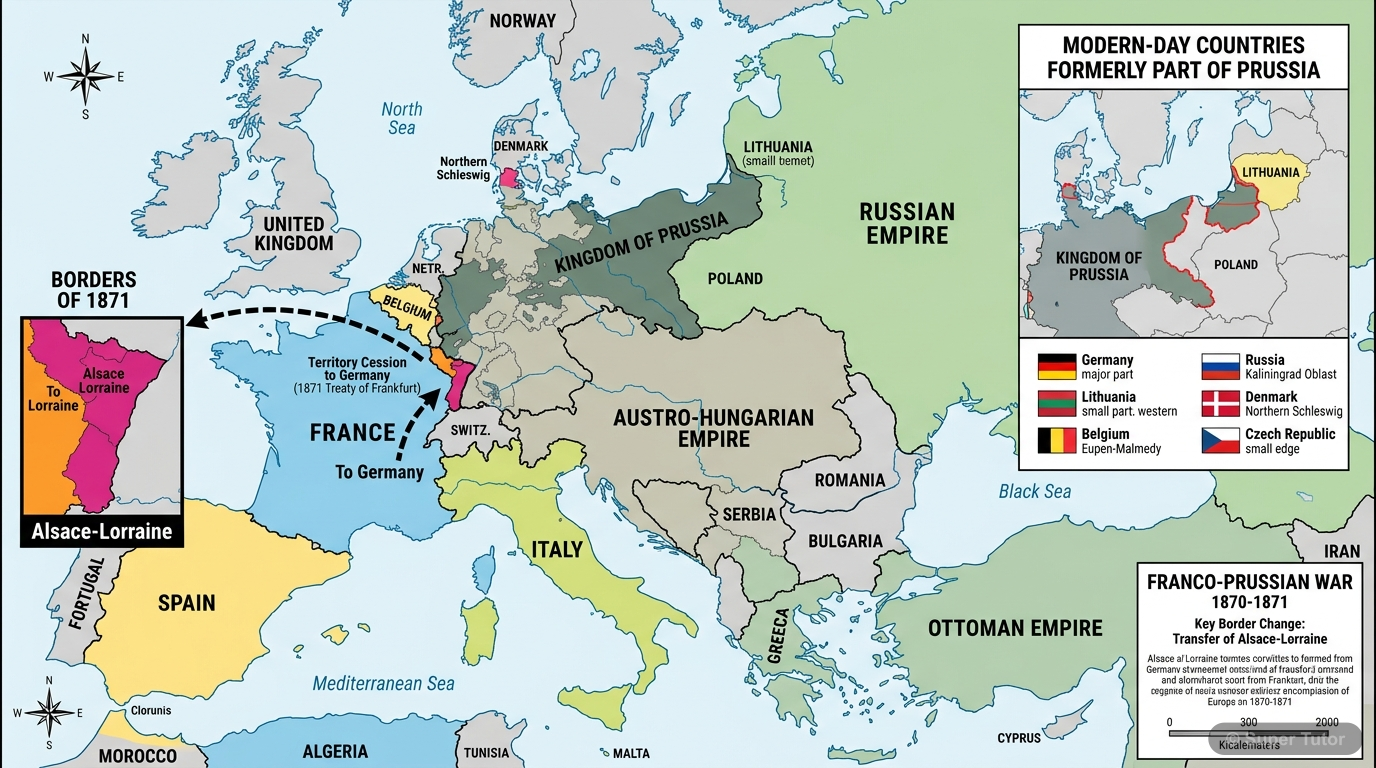
Learn better with visuals Super Tutor pairs illustrations like this with notes and quizzes for The Last Lesson (Alphonse Daudet).
The first 11 solutions are open to read. The other 11 are free with a Super Tutor account.
Think as you read (Section 1)
1What was Franz expected to be prepared with for school that day?Show solution
Given: The story describes Franz's situation on the morning of the last lesson.
Answer: Franz was expected to be prepared with his lesson on participles. M. Hamel had announced that he would question the students on participles that day. Franz had not learned his lesson and was afraid of being scolded by his teacher.
2What did Franz notice that was unusual about the school that day?Show solution
Given: Franz arrives at school and observes several unusual things.
Answer: Franz noticed several unusual things about the school that day:
- The school was unusually quiet, unlike the typical noise of opening and closing desks and lessons repeated in unison.
- M. Hamel was dressed in his fine Sunday clothes — his beautiful green coat, frilled shirt, and the little black silk cap he wore only on inspection and prize days.
- The village people, such as old Hauser, the former mayor, and other villagers, were sitting quietly at the back of the classroom, which was very unusual.
- The whole school had a strange, solemn atmosphere.
3What had been put up on the bulletin-board?Show solution
Given: Franz passes the bulletin-board on his way to school.
Answer: For the last two years, all the bad news — lost battles, the draft, the orders of the commanding officer — had come from the bulletin-board. That day, an order had been put up on the bulletin-board stating that in Alsace and Lorraine only German would be taught in the schools. The new German masters were to come the very next day. This was the order from Berlin that changed everything.
Think as you read (Section 2)
1What changes did the order from Berlin cause in school that day?Show solution
Given: An order from Berlin declared that only German would be taught in the schools of Alsace and Lorraine.
Answer: The order from Berlin brought about the following changes in school that day:
- It was to be the last French lesson. M. Hamel was to leave after that day, and a new German master would arrive the next day.
- M. Hamel wore his finest Sunday clothes as a mark of respect for the occasion.
- The villagers — old Hauser, the former mayor, and others — came and sat quietly at the back of the classroom to attend the last French lesson as a tribute to the language.
- The entire atmosphere of the school was solemn and emotional. M. Hamel taught with great patience and dedication, as if wanting to give all his knowledge before leaving.
- New copybooks with 'France, Alsace' written in a beautiful round hand were distributed, and everyone worked with unusual sincerity and quiet.
2How did Franz's feelings about M. Hamel and school change?Show solution
Given: Franz had earlier been afraid of M. Hamel and disliked school and French lessons.
Answer: Franz's feelings underwent a complete transformation:
- Earlier, he had been afraid of M. Hamel's ruler and scolding, and he used to skip school to play. He found French grammar boring and difficult.
- But on the day of the last lesson, he felt deep regret for having wasted time and neglected his lessons. He realised how precious the French language was.
- He began to feel great admiration and sympathy for M. Hamel. He understood the teacher's pain at having to leave after forty years of devoted service.
- He felt that M. Hamel had never seemed so tall or so dignified as on that last day.
- His books, which had earlier seemed a nuisance, now felt like old friends he could not give up.
- In short, Franz moved from indifference and fear to respect, love, and a sense of loss.
Understanding the text
1The people in this story suddenly realise how precious their language is to them. What shows you this? Why does this happen?Show solution
Given: The story is set in Alsace-Lorraine after the Prussian conquest, when an order from Berlin bans the teaching of French.
Answer:
What shows that people realise the preciousness of their language:
- The villagers — old Hauser, the former mayor, the ex-postmaster — come to attend the last French lesson, showing their love for the language they had perhaps neglected earlier.
- Old Hauser holds his primer with trembling hands and spells out the letters with tears in his eyes.
- M. Hamel teaches with extraordinary patience and dedication, giving his best on the last day.
- Franz, who had earlier dreaded French lessons, suddenly feels deep regret for not having learned his language properly.
- M. Hamel speaks movingly about the French language, calling it the most beautiful, clearest, and most logical language in the world.
- He writes 'Vive La France!' on the blackboard as his final, passionate act.
Why this happens:
This realisation comes because people tend to take things for granted until they are about to lose them. The threat of losing their language — the very medium through which they think, feel, and express their identity — makes them suddenly aware of its immense value. Language is not merely a means of communication; it is the soul of a people's culture and identity. When it is threatened by a conqueror, it becomes a symbol of freedom and resistance.
2Franz thinks, "Will they make them sing in German, even the pigeons?" What could this mean? (There could be more than one answer.)Show solution
Given: Franz hears the pigeons cooing on the roof while everyone is writing silently in the last French lesson.
Answer: This thought of Franz can be interpreted in more than one way:
(i) Irony and Absurdity: Franz is thinking ironically that the Prussian order to replace French with German is so extreme and absurd that even nature — even the pigeons — would be forced to change. It highlights the ridiculousness of trying to suppress a language by force.
(ii) The Universality of Language: The cooing of pigeons is a natural sound, like a language of its own. Franz wonders if even this natural 'language' would be replaced or suppressed. This suggests that language is as natural and instinctive as the sounds of birds — it cannot truly be taken away.
(iii) Deep Emotional Protest: The thought reflects Franz's inner anguish and silent protest against the order. He is expressing, through this image, how unnatural and cruel it is to impose a foreign language on a people.
(iv) Attachment to the Familiar: The pigeons represent the familiar, comforting world of Alsace. Franz's thought shows his fear that everything he knows and loves — even the smallest, most natural things — will be changed by the conquerors.
Talking about the text
1"When a people are enslaved, as long as they hold fast to their language it is as if they had the key to their prison." Can you think of examples in history where a conquered people had their language taken away from them or had a language imposed on them?Show solution
Answer: This statement beautifully captures the relationship between language, identity, and freedom. History offers several examples:
(i) Colonial India: The British imposed English as the medium of education and administration through Macaulay's Minute (1835). Indian languages were marginalised in official and educational spheres, yet people held on to their mother tongues, which became powerful tools of the freedom movement. Leaders like Bal Gangadhar Tilak and Mahatma Gandhi used regional languages to connect with the masses.
(ii) Ireland under British Rule: The British suppressed the Irish language (Gaelic/Irish). The Irish were forced to use English. However, the Irish held on to their language as a symbol of national identity, and after independence, Irish was made an official language of the Republic of Ireland.
(iii) Native Americans: European colonisers in America forced Native American children into boarding schools where they were forbidden to speak their native languages. This caused the loss of many indigenous languages and cultural identities.
(iv) African Nations under Colonial Rule: In many African countries, colonial powers (French, British, Portuguese) imposed their languages, suppressing local languages in education and governance.
(v) Alsace-Lorraine (as in the story): After the Franco-Prussian War (1870–71), Germany imposed German on the people of Alsace-Lorraine, banning French — exactly as depicted in the story.
In all these cases, language became a symbol of resistance and cultural survival.
2What happens to a linguistic minority in a state? How do you think they can keep their language alive? For example: Punjabis in Bangalore, Tamilians in Mumbai, Kannadigas in Delhi, Gujaratis in Kolkata.Show solution
Answer:
What happens to a linguistic minority:
- A linguistic minority refers to a group of people living in a region where their mother tongue is not the dominant or official language of that state.
- They often face difficulties in education, employment, and daily communication because official work is conducted in the majority language.
- Their children may gradually shift to the dominant language, leading to a slow erosion of the mother tongue.
- They may face social and cultural isolation or pressure to assimilate.
- However, the Indian Constitution (Articles 29 and 30) provides certain protections to linguistic minorities, including the right to conserve their language and establish educational institutions.
How they can keep their language alive:
- Community schools and classes: Setting up schools or weekend classes where children are taught their mother tongue (e.g., Gujarati schools in Kolkata, Tamil schools in Mumbai).
- Cultural organisations: Forming cultural associations that celebrate festivals, literature, music, and drama in their language.
- Media: Publishing newspapers, magazines, and running radio/TV programmes in their language.
- Literature and arts: Encouraging writers, poets, and artists to create in their mother tongue.
- Speaking at home: Ensuring that the language is spoken at home so children grow up bilingual.
- Digital platforms: Using social media, YouTube channels, and apps to promote and teach the language.
Thus, a linguistic minority can keep its language alive through conscious community effort, cultural pride, and institutional support.
3Is it possible to carry pride in one's language too far? Do you know what 'linguistic chauvinism' means?Show solution
Answer:
Linguistic Chauvinism:
Linguistic chauvinism refers to an extreme, aggressive pride in one's own language, combined with a belief that it is superior to all other languages, and a hostility towards speakers of other languages. It involves the imposition of one's language on others and the denigration or suppression of other languages.
Can pride in one's language go too far?
Yes, it certainly can. While it is natural and healthy to love and take pride in one's mother tongue, this pride becomes harmful when it:
- Leads to discrimination against speakers of other languages.
- Results in the imposition of one language on linguistic minorities (e.g., the 'Hindi imposition' controversy in South India).
- Creates social divisions and conflicts between communities (e.g., language riots).
- Prevents people from learning other languages, thereby limiting their opportunities and understanding.
- Is used as a political tool to divide people on linguistic lines.
Examples:
- The anti-Hindi agitations in Tamil Nadu (1937, 1965) were partly a reaction to perceived linguistic chauvinism.
- In Sri Lanka, making Sinhala the only official language marginalised Tamil speakers and contributed to decades of ethnic conflict.
Conclusion: Pride in one's language is a positive sentiment that preserves culture and identity. However, when it becomes chauvinism — aggressive, exclusive, and intolerant — it causes division and injustice. A balanced approach values one's own language while respecting all others.
Working with words
1Find out the origins of the following words: tycoon, barbecue, zero, tulip, veranda, ski, logo, robot, trek, bandicoot.Show solution
Answer: The origins of the given words are as follows:
| Word | Language of Origin | Meaning/Note |
|---|---|---|
| tycoon | Japanese (taikun — great lord) | Entered English via American usage |
| barbecue | Spanish (barbacoa), originally from Taíno (Caribbean indigenous language) | A framework for roasting meat |
| zero | Italian (zero), from Arabic (sifr), from Sanskrit (śūnya — empty) | The concept came to Europe through Arabic mathematics |
| tulip | French/Turkish (tülbend — turban), from Persian | Named for its turban-like shape |
| veranda | Portuguese (varanda) or Hindi (varanda) | A roofed platform along the outside of a house |
| ski | Norwegian (ski) | A long narrow piece of wood for gliding over snow |
| logo | Greek (logos — word, reason) | Short for logotype |
| robot | Czech (robota — forced labour/drudgery) | Coined by Karel Čapek in his 1920 play |
| trek | Afrikaans/Dutch (trekken — to pull, travel) | Originally used in South African English |
| bandicoot | Telugu (pandikokku — pig-rat) | An Indian rodent; the name entered English from Telugu |
(a) "What a thunderclap these words were to me!"
The words were
(i) loud and clear.
(ii) startling and unexpected.
(iii) pleasant and welcome.
Free with a Super Tutor account
It is as if they have the key to the prison as long as they
(i) do not lose their language.
(ii) are attached to their language.
(iii) quickly learn the conqueror's language.
Free with a Super Tutor account
You will get to your school
(i) very late.
(ii) too early.
(iii) early enough.
Free with a Super Tutor account
M. Hamel
(a) had grown physically taller
(b) seemed very confident
(c) stood on the chair
Free with a Super Tutor account
Noticing form
Free with a Super Tutor account
Writing
Free with a Super Tutor account
Free with a Super Tutor account
Free with a Super Tutor account
Things to do
Free with a Super Tutor account
Free with a Super Tutor account
Free with a Super Tutor account
11 more solved questions in The Last Lesson (Alphonse Daudet)
They are free with a Super Tutor account, along with practice quizzes and flashcards for this chapter. Free to start, no card needed.
Frequently Asked Questions
What are the important topics in The Last Lesson (Alphonse Daudet) for Madhya Pradesh Board Class 12 English?
Are these NCERT Solutions for The Last Lesson (Alphonse Daudet) free?
How should I revise The Last Lesson (Alphonse Daudet) for the Madhya Pradesh Board Class 12 board exam?
Sources & Official References
Content is aligned to the official syllabus. Refer to the board website for the latest curriculum.
More resources for The Last Lesson (Alphonse Daudet)
Practice Quiz
Test yourself with a quick quiz
Important Questions
Exam-style questions with answers
Revision Notes
Key points for last-minute revision
Chapter Summary
Understand the chapter at a glance
Concept Maps
See how topics connect
Study Plan
Step-by-step plan for this chapter
Flashcards
Quick-fire cards for active recall
Syllabus
What topics to cover
For serious students
Get the full The Last Lesson (Alphonse Daudet) chapter — start free.
Quizzes, flashcards, an AI doubt solver and a study plan for Madhya Pradesh Board Class 12 English. Free to start, no card needed.