Poets and Pancakes (Asokamitran) — NCERT Solutions
Madhya Pradesh Board · Class 12 · English
NCERT Solutions for Poets and Pancakes (Asokamitran), Madhya Pradesh Board Class 12 English: 22 textbook questions solved step by step.
Interactive on Super Tutor
Studying Poets and Pancakes (Asokamitran)? Get the full interactive chapter.
Quizzes, flashcards, AI doubt-solver and a step-by-step study plan — built for NCERT solutions and more.
Free trial, no card needed.
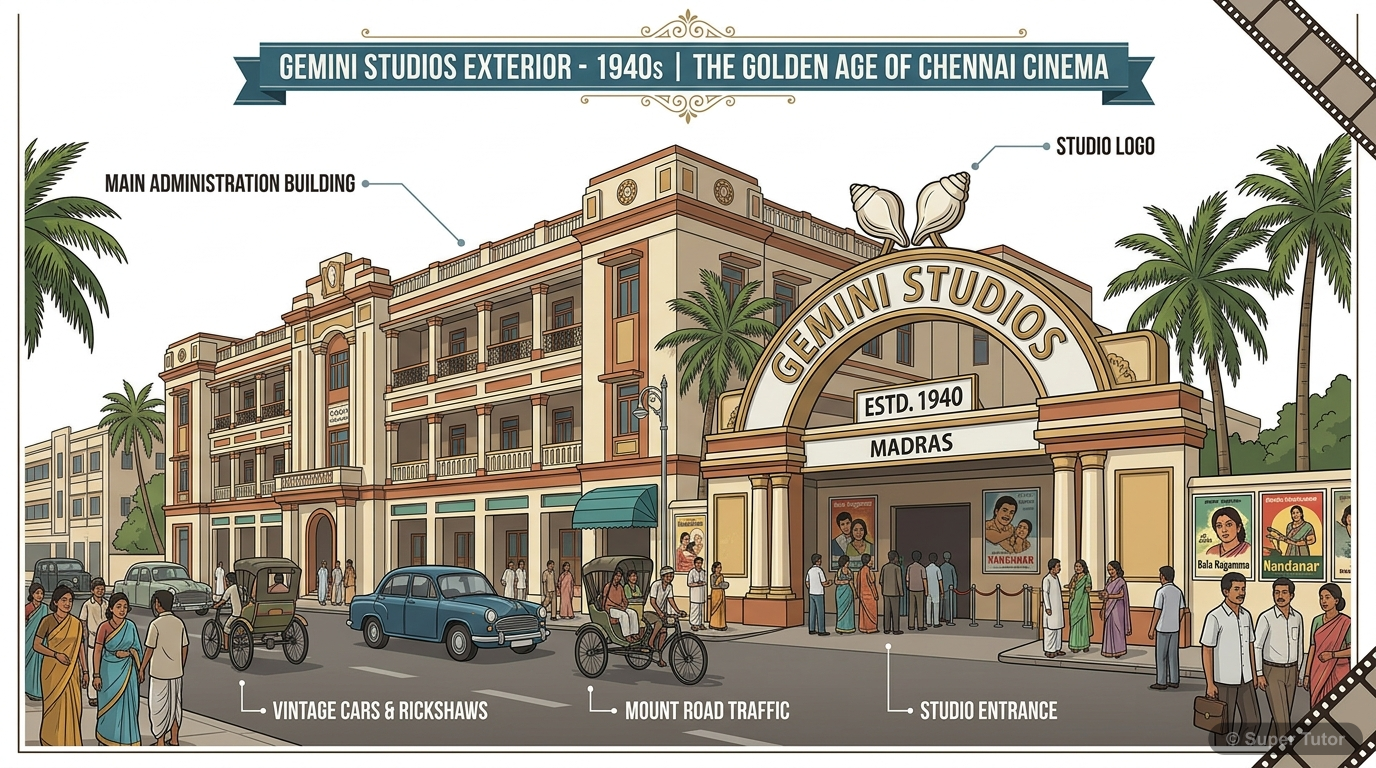
Learn better with visuals Super Tutor pairs illustrations like this with notes and quizzes for Poets and Pancakes (Asokamitran).
The first 11 solutions are open to read. The other 11 are free with a Super Tutor account.
Think as you read (Page 58 – First Set)
1What does the writer mean by 'the fiery misery' of those subjected to make-up?Show solution
Given: The phrase 'the fiery misery' is used in the context of the make-up department at Gemini Studios.
Answer: The writer means the intense discomfort and suffering that the actors and extras had to endure while being subjected to the make-up process. The make-up used in those days (called 'pancake') was applied in large quantities under very hot studio lights. The heat generated by the lights, combined with the thick layers of make-up, caused tremendous physical discomfort — a kind of 'fiery misery' — to those who had to sit through the process. The author uses this phrase with gentle irony to highlight the harsh working conditions in the early days of Indian cinema.
2What is the example of national integration that the author refers to?Show solution
Given: The author works in Gemini Studios, which employed people from all over India.
Answer: The author refers to the make-up department of Gemini Studios as an example of national integration. The make-up department employed people from all parts of India. The department had a hierarchy — the chief make-up man was a Maharashtrian, his assistant was a Dharwar Kannadiga, the other assistants came from Andhra Pradesh, and the office boy was from Udupi. People of different linguistic and regional backgrounds worked together under one roof, making the department a microcosm of India's diversity. The author humorously calls this a 'mini-India' or an example of national integration.
3What work did the 'office boy' do in the Gemini Studios? Why did he join the studios? Why was he disappointed?Show solution
Given: The 'office boy' worked in the make-up department of Gemini Studios.
Work: The office boy's job was to apply make-up — specifically, he was in charge of applying the make-up called 'pancake' to the crowd actors (extras) using a brush.
Why he joined: He had joined Gemini Studios with the hope and ambition of becoming an actor or a director. He was a man of literary talent and creative aspirations, and he believed the film industry would give him an opportunity to showcase his abilities.
Why he was disappointed: He was deeply disappointed because, despite his literary talent and creative ambitions, he was made to do the menial job of applying make-up to crowd extras. He felt his talent was being wasted in a department 'fit only for barbers and perverts.' He had expected a more creative and significant role in the studio but ended up doing a job he considered beneath his abilities.
4Why did the author appear to be doing nothing at the studios?Show solution
Given: The author worked in a cubicle with French windows at Gemini Studios.
Answer: The author's job at Gemini Studios was to cut newspaper clippings related to various topics and maintain a file of these clippings. He would sit at his desk and tear up newspapers day in and day out. Since this activity — tearing and cutting newspapers — did not look like any recognisable or productive form of work to an outside observer, most people, including possibly the Boss (S.S. Vasan), thought he was doing nothing or next to nothing. The nature of his work was such that it appeared idle and purposeless to onlookers, even though it was his assigned duty. This is why the author appeared to be doing nothing at the studios.
Think as you read (Page 59 – Second Set)
1Why was the office boy frustrated? Who did he show his anger on?Show solution
Given: The office boy worked in the make-up department of Gemini Studios.
Why frustrated: The office boy was frustrated because he had joined Gemini Studios with the ambition of becoming an actor or a director, hoping to use his literary and creative talent. Instead, he was reduced to applying make-up (pancake) to crowd extras — a job he considered demeaning and unworthy of his abilities. He felt his talent was being wasted.
On whom he showed his anger: He directed all his anger, frustration, and resentment towards Kothamangalam Subbu, who was the No. 2 at Gemini Studios. The office boy was convinced that all his woes, ignominy, and neglect were due to Subbu. He believed that Subbu was responsible for his lack of recognition and advancement in the studio.
2Who was Subbu's principal?Show solution
Given: Subbu (Kothamangalam Subbu) was the No. 2 at Gemini Studios.
Answer: Subbu's principal was S.S. Vasan, the Boss of Gemini Studios. Subbu's sense of loyalty made him identify himself completely with his principal (the Boss), and he turned his entire creativity to his principal's advantage. He was totally devoted to the Boss and worked wholeheartedly for the success of the Boss's ventures and films.
3Subbu is described as a many-sided genius. List four of his special abilities.Show solution
Given: Kothamangalam Subbu was the No. 2 at Gemini Studios and is described as a many-sided genius.
Four special abilities of Subbu:
- Ability to stay cheerful: He had the remarkable ability to look cheerful at all times, even after having been part of a flop film. His optimism was infectious and unwavering.
- Creative problem-solving: He could find creative solutions to seemingly impossible cinematic problems. When the producer was stuck on a difficult scene, Subbu could immediately suggest multiple ways to handle it — he was inspired even when commanded.
- Loyalty and dedication: He had an extraordinary sense of loyalty to his principal (the Boss). He identified himself completely with the Boss and directed all his creativity towards the Boss's benefit.
- Poetic and literary talent: Subbu was a poet of some merit. He had the ability to compose verse and had a natural flair for the literary arts, which he combined with his film-making skills.
- (Additional ability) Ability to generate work and ideas: He always had work for somebody and could generate ideas and keep people engaged, even though he could never do things entirely on his own.
4Why was the legal adviser referred to as the opposite by others?Show solution
Given: The legal adviser was also a member of the Story Department at Gemini Studios.
Answer: The legal adviser was referred to as the opposite (i.e., the opposite of a poet or a creative person) by others because he was a man of cold logic and rational thinking in a crowd of dreamers, poets, and creative individuals. While every other member of the Story Department wore khadi dhoti and a white khadi shirt (the uniform of Gandhiites and idealists), the legal adviser wore pants, a tie, and sometimes a coat — making him stand out as a practical, worldly man. He represented cold reason and legal precision in an environment filled with artistic imagination and poetic sensibility, making him the very 'opposite' of the poets and writers around him.
5What made the lawyer stand out from the others at Gemini Studios?Show solution
Given: The legal adviser worked in the Story Department at Gemini Studios.
Answer: The legal adviser stood out from the others at Gemini Studios in the following ways:
- Dress: While every other member of the Story Department wore khadi dhoti with a white khadi shirt (reflecting their Gandhian ideology), the legal adviser wore pants, a tie, and sometimes a coat that looked like a coat of mail. His Western attire made him visually distinct from the rest.
- Temperament: He was a man of cold logic and rational thinking, whereas the others were dreamers, poets, and idealists. He was a neutral man in an assembly of Gandhiites and khadiites.
- Professional background: He was a lawyer by training — a practical, logical professional — working among creative writers and poets, which made him an anomaly.
These differences made him appear alone and helpless in that environment, a misfit among the artistic crowd of Gemini Studios.
Think as you read (Page 62 – Third Set)
1Did the people at Gemini Studios have any particular political affiliations?Show solution
Given: The chapter describes the atmosphere and people at Gemini Studios.
Answer: The people at Gemini Studios did not have any strong or well-defined political affiliations. Most of them wore khadi and worshipped Gandhiji, which gave them a superficial association with the Congress ideology. However, beyond that, they had not the faintest appreciation for political thought of any kind. They were largely apolitical and were averse to the term 'Communism.' Their political awareness was limited to a vague Gandhian sentiment expressed through their dress and lifestyle, but they had no deep understanding of or commitment to any political ideology.
2Why was the Moral Rearmament Army welcomed at the Studios?Show solution
Given: The Moral Rearmament Army (MRA) visited Gemini Studios.
Answer: The Moral Rearmament Army was welcomed at Gemini Studios primarily because it was seen as a counter-force to Communism. The people at Gemini Studios were deeply averse to Communism, and the MRA, with its strong anti-Communist stance, was therefore viewed favourably. Additionally, the MRA brought with it a large group of people from different countries, which was an impressive and novel sight. Their plays and performances were also of high quality and made a strong impression on the people at the Studios. The Boss (S.S. Vasan) welcomed them warmly, and the entire Studios was caught up in the excitement of their visit.
Free with a Super Tutor account
Free with a Super Tutor account
Free with a Super Tutor account
Free with a Super Tutor account
Think as you read (Page 63 – Fourth Set)
Free with a Super Tutor account
Free with a Super Tutor account
Free with a Super Tutor account
Understanding the Text
Free with a Super Tutor account
Free with a Super Tutor account
Free with a Super Tutor account
Free with a Super Tutor account
11 more solved questions in Poets and Pancakes (Asokamitran)
They are free with a Super Tutor account, along with practice quizzes and flashcards for this chapter. Free to start, no card needed.
Frequently Asked Questions
What are the important topics in Poets and Pancakes (Asokamitran) for Madhya Pradesh Board Class 12 English?
Are these NCERT Solutions for Poets and Pancakes (Asokamitran) free?
How should I revise Poets and Pancakes (Asokamitran) for the Madhya Pradesh Board Class 12 board exam?
Sources & Official References
Content is aligned to the official syllabus. Refer to the board website for the latest curriculum.
More resources for Poets and Pancakes (Asokamitran)
Practice Quiz
Test yourself with a quick quiz
Important Questions
Exam-style questions with answers
Revision Notes
Key points for last-minute revision
Chapter Summary
Understand the chapter at a glance
Concept Maps
See how topics connect
Study Plan
Step-by-step plan for this chapter
Flashcards
Quick-fire cards for active recall
Syllabus
What topics to cover
For serious students
Get the full Poets and Pancakes (Asokamitran) chapter — start free.
Quizzes, flashcards, an AI doubt solver and a study plan for Madhya Pradesh Board Class 12 English. Free to start, no card needed.