Journey to the end of the Earth (Tishani Doshi) — NCERT Solutions
Madhya Pradesh Board · Class 12 · English
NCERT Solutions for Journey to the end of the Earth (Tishani Doshi), Madhya Pradesh Board Class 12 English: 4 textbook questions solved step by step.
Interactive on Super Tutor
Studying Journey to the end of the Earth (Tishani Doshi)? Get the full interactive chapter.
Quizzes, flashcards, AI doubt-solver and a step-by-step study plan — built for NCERT solutions and more.
Free trial, no card needed.
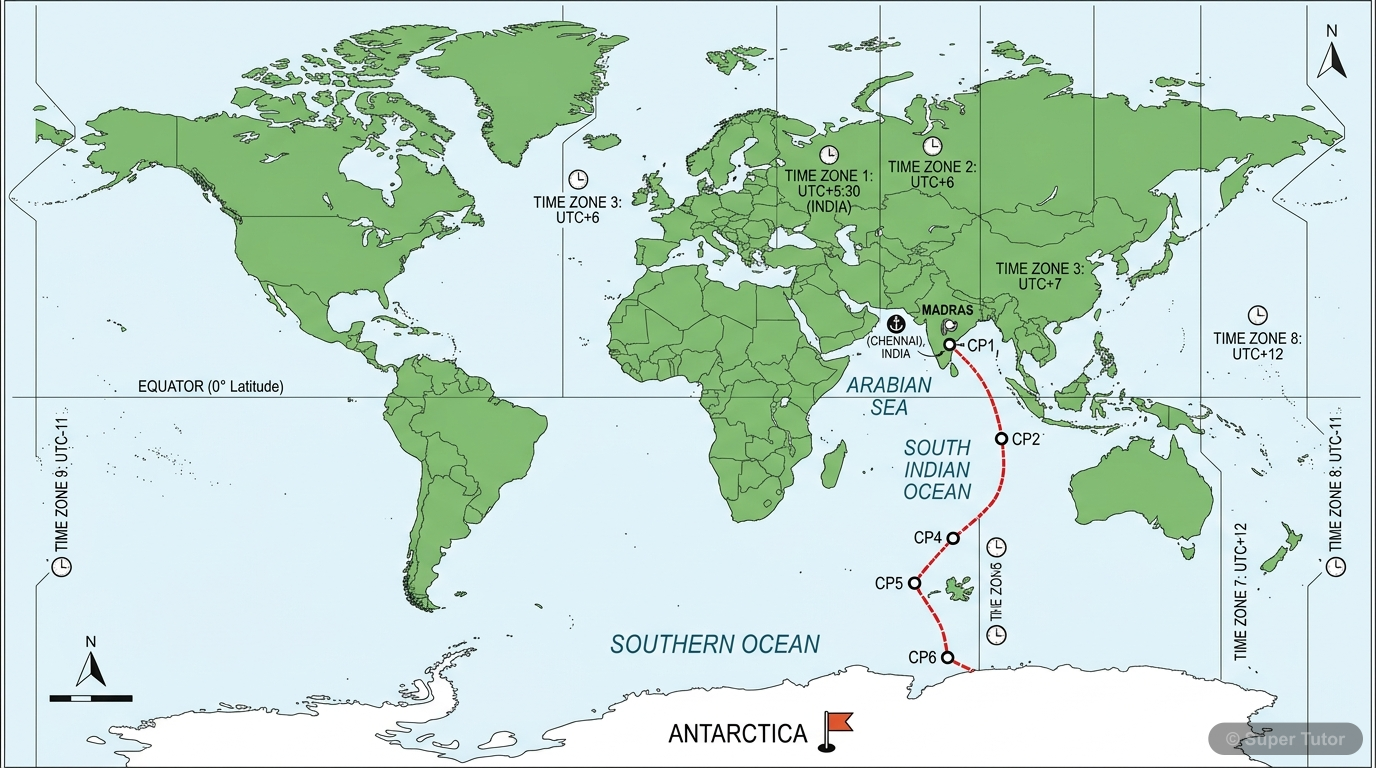
Learn better with visuals Super Tutor pairs illustrations like this with notes and quizzes for Journey to the end of the Earth (Tishani Doshi).
The first 2 solutions are open to read. The other 2 are free with a Super Tutor account.
Reading with Insight — Journey to the End of the Earth
1'The world's geological history is trapped in Antarctica.' How is the study of this region useful to us?Show solution
Given / Context:
The passage describes Antarctica as a pristine, untouched continent that has never sustained a human population and holds half-million-year-old carbon records trapped in its ice-cores.
Concept / Key Idea:
Antarctica serves as a natural archive of the Earth's geological, climatic, and biological history. Studying it helps scientists understand the past, analyse the present, and predict the future of our planet.
Detailed Answer:
- Geological Record: Antarctica's ice-cores contain carbon records going back half a million years. These layers of ice trap gases, dust, and other particles from different eras, giving scientists a detailed timeline of the Earth's atmospheric and climatic changes.
- Understanding Climate Change: By studying these ice-cores, scientists can track how carbon dioxide levels have changed over millennia. This is crucial for understanding the current climate crisis — the unmitigated burning of fossil fuels and the resulting rise in global temperatures.
- Studying Evolution and Extinction: Antarctica was once part of the supercontinent Gondwana. Its geological formations — Cordilleran folds, pre-Cambrian granite shields — help us understand how continents drifted, how species evolved, and why some became extinct (like the dinosaurs).
- Predicting the Future: Questions such as whether the West Antarctic ice sheet will melt entirely, whether the Gulf Stream will be disrupted, and what the consequences of rising temperatures will be, can all be better answered by studying Antarctica.
- Pristine Environment: Because it has never had a permanent human population, Antarctica remains relatively unpolluted, making it an ideal baseline for environmental studies.
Conclusion:
In short, Antarctica is the Earth's memory. Its study is useful because it allows us to place human civilisation in the context of geological time, understand the consequences of our actions, and hopefully make better decisions for the planet's future.
2What are Geoff Green's reasons for including high school students in the Students on Ice expedition?Show solution
Given / Context:
Geoff Green is the Canadian founder of the 'Students on Ice' programme, which takes high school students to Antarctica aboard the Shokalskiy. He had previously been taking celebrities and other adults on similar trips.
Concept / Key Idea:
Green believes that young people, rather than celebrities or adults set in their ways, are the most appropriate audience for the lessons Antarctica has to teach — because they are the ones who will shape the future.
Detailed Answer:
- Disillusionment with Celebrities: Geoff Green grew tired of taking celebrities and VIPs to Antarctica. He felt that such trips were not producing any meaningful change in attitudes or policies. He wanted to invest in an audience that could actually make a difference.
- Young People as Future Decision-Makers: High school students are the next generation of scientists, politicians, entrepreneurs, and citizens. By exposing them to Antarctica at an impressionable age, Green hopes to instil in them a deep respect and understanding for the planet that will guide their future decisions.
- Inspiring Educational Opportunities: The programme aims to provide students with first-hand, experiential learning that no classroom can replicate. Witnessing the scale of Antarctica — its ice, its silence, its wildlife — creates a profound and lasting impact on young minds.
- Fostering a New Understanding and Respect: The explicit goal of Students on Ice is to help students 'foster a new understanding and respect for our planet.' Young people still possess the idealism needed to want to save the world, and Green wants to channel that idealism productively.
- Hope for the Future: As the narrator observes at the end, after spending two weeks with teenagers who still have the idealism to save the world, there is genuine hope. Green's inclusion of students is essentially an investment in that hope.
Conclusion:
Geoff Green includes high school students because he believes that meaningful change can only come from the next generation. By giving them an inspiring, transformative experience in Antarctica, he hopes to create environmentally conscious future leaders who will take better care of the planet.
Free with a Super Tutor account
Free with a Super Tutor account
2 more solved questions in Journey to the end of the Earth (Tishani Doshi)
They are free with a Super Tutor account, along with practice quizzes and flashcards for this chapter. Free to start, no card needed.
Frequently Asked Questions
What are the important topics in Journey to the end of the Earth (Tishani Doshi) for Madhya Pradesh Board Class 12 English?
Are these NCERT Solutions for Journey to the end of the Earth (Tishani Doshi) free?
How should I revise Journey to the end of the Earth (Tishani Doshi) for the Madhya Pradesh Board Class 12 board exam?
Sources & Official References
Content is aligned to the official syllabus. Refer to the board website for the latest curriculum.
More resources for Journey to the end of the Earth (Tishani Doshi)
Practice Quiz
Test yourself with a quick quiz
Important Questions
Exam-style questions with answers
Revision Notes
Key points for last-minute revision
Chapter Summary
Understand the chapter at a glance
Concept Maps
See how topics connect
Study Plan
Step-by-step plan for this chapter
Flashcards
Quick-fire cards for active recall
Syllabus
What topics to cover
For serious students
Get the full Journey to the end of the Earth (Tishani Doshi) chapter — start free.
Quizzes, flashcards, an AI doubt solver and a study plan for Madhya Pradesh Board Class 12 English. Free to start, no card needed.