Rebels and the Raj: 1857 Revolt and its Representations — NCERT Solutions
Madhya Pradesh Board · Class 12 · History
NCERT Solutions for Rebels and the Raj: 1857 Revolt and its Representations, Madhya Pradesh Board Class 12 History: 12 textbook questions solved step by.
Interactive on Super Tutor
Studying Rebels and the Raj: 1857 Revolt and its Representations? Get the full interactive chapter.
Quizzes, flashcards, AI doubt-solver and a step-by-step study plan — built for NCERT solutions and more.
Free trial, no card needed.
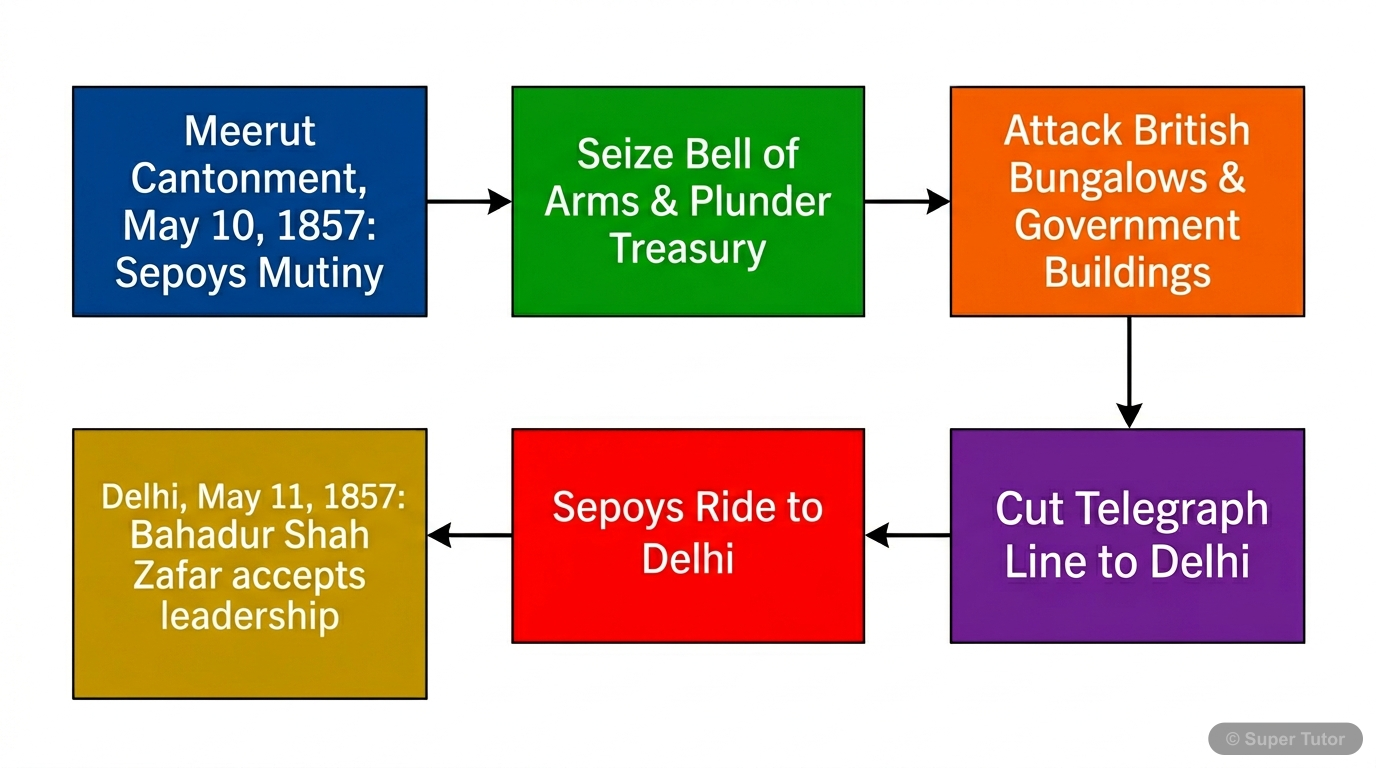
One of 12 illustrations for Rebels and the Raj: 1857 Revolt and its Representations in Super Tutor — alongside flashcards, concept maps and practice questions.
The first 6 solutions are open to read. The other 6 are free with a Super Tutor account.
Answer in 100-150 Words
1Why did the mutinous sepoys in many places turn to erstwhile rulers to provide leadership to the revolt?Show solution
Given/Context: The sepoys who mutinied in 1857 needed symbolic and political leadership to give legitimacy and direction to their uprising.
Answer:
The mutinous sepoys turned to erstwhile rulers for several important reasons:
- Legitimacy and Symbol of Authority: The sepoys needed a recognised figurehead who could give their rebellion political legitimacy. Former rulers like Bahadur Shah Zafar, Begum Hazrat Mahal, and Nana Sahib represented the pre-British order and were respected by the people.
- Lack of Political Vision: The sepoys were skilled fighters but lacked political experience and administrative ability. The erstwhile rulers could provide the organisational framework and political direction the revolt needed.
- Emotional and Cultural Connect: The deposed rulers symbolised everything the rebels were fighting to restore — the Mughal world, regional kingdoms, and the culture of the courts. Bahadur Shah Zafar, for instance, was a unifying symbol for both Hindus and Muslims.
- Shared Grievances: The rulers had their own grievances against the British — annexation of territories, loss of pensions, and disrespect. This made them natural allies.
Thus, the sepoys saw the erstwhile rulers as the most appropriate leaders to restore the pre-British world they cherished.
2Discuss the evidence that indicates planning and coordination on the part of the rebels.Show solution
Given/Context: The revolt of 1857 spread rapidly across a wide geographical area in a remarkably similar pattern, suggesting prior planning and coordination.
Answer:
Several pieces of evidence point to planning and coordination among the rebels:
- Communication between Sepoy Lines: After the 7th Awadh Irregular Cavalry refused the new cartridges, they wrote to the 48th Native Infantry stating they had 'acted for the faith and awaited the 48th's orders.' This shows deliberate communication between cantonments.
- Movement of Emissaries: Sepoys or their emissaries moved from one station to another, spreading the message of revolt and coordinating action.
- The Panchayat System: Charles Ball noted that panchayats were a nightly occurrence in the Kanpur sepoy lines. These collective gatherings of native officers from different regiments were used to take decisions collectively about the course of the rebellion.
- The Sisten–Tahsildar Conversation (Source 2): A Muslim tahsildar from Bijnor, upon meeting someone he believed to be a rebel, spoke confidently about the progress of the revolt, saying 'the direction of the business is in able hands.' This suggests a wider network of communication among rebel sympathisers.
- Chapatti Movement: The mysterious circulation of chapattis from village to village was read by people as an omen of an upheaval, suggesting some form of coded communication.
Thus, the similarity in the pattern of the revolt across different places was not accidental but the result of deliberate planning and coordination.
3Discuss the extent to which religious beliefs shaped the events of 1857.Show solution
Given/Context: Religion played a significant role in triggering and sustaining the revolt of 1857, though it was not the only factor.
Answer:
Religious beliefs shaped the events of 1857 in several important ways:
Role of Religion as a Trigger:
- The immediate cause of the sepoy mutiny was the introduction of the Enfield rifle cartridges, which were rumoured to be greased with the fat of cows and pigs. This was seen as a deliberate attempt to defile the religion of both Hindus and Muslims.
- The rebel arzi (petition) clearly states: 'we have fought for two years in order that our faith and religion may not be polluted.'
Rumours and Religious Fear:
- Rumours spread that the British were mixing bone powder in flour (atta) and distributing it to destroy caste distinctions.
- People feared that the British were bent on converting Indians to Christianity through their educational and social reform policies (abolition of sati, widow remarriage, etc.).
Religion as a Unifying Force:
- The rebel proclamations called upon Hindus and Muslims to unite against the 'infidel' British who were enemies of both religions.
- Pundits and fakirs were specifically urged to join the 'holy war.'
Limitations:
- However, religion alone does not explain the revolt. Economic grievances — dispossession of taluqdars, exploitation of peasants, ruin of artisans — were equally important.
- The revolt was also driven by political factors such as the annexation of Awadh and the doctrine of lapse.
Conclusion: Religion was a powerful mobilising force that gave the revolt an emotional and moral dimension, but it worked alongside economic and political grievances.
4What were the measures taken to ensure unity among the rebels?Show solution
Given/Context: The rebels came from diverse social backgrounds — sepoys, peasants, taluqdars, artisans, religious leaders — and needed mechanisms to maintain unity.
Answer:
Several measures were taken to ensure unity among the rebels:
- Proclamations Addressing All Social Groups: The rebel proclamations (like the one issued in the name of Bahadur Shah Zafar) specifically addressed zamindars, merchants, public servants, artisans, and religious leaders (pundits and fakirs), listing the grievances of each group and urging them to join the fight against British rule.
- Appeal to Common Religion: Both Hindus and Muslims were urged to unite against the British, who were portrayed as enemies of both religions. The fear of religious conversion was used as a common rallying point.
- Panchayat System: Collective decision-making through panchayats composed of native officers from different regiments helped build consensus and shared ownership of the rebellion.
- Symbolic Leadership: Erstwhile rulers like Bahadur Shah Zafar and Begum Hazrat Mahal were placed at the head of the revolt to provide a unifying symbol that transcended caste and community differences.
- Common Enemy: The proclamations consistently identified the British (firangi raj) as the common enemy responsible for the misery of all sections of society, thus creating a shared sense of purpose.
- Administrative Structures: In places like Delhi, Lucknow, and Kanpur, the rebels set up administrative structures, made appointments, and issued orders — creating a sense of an alternative government that could unite different groups.
Thus, unity was maintained through a combination of political, religious, and administrative measures.
5What steps did the British take to quell the uprising?Show solution
Given/Context: The British initially found themselves overwhelmed by the revolt but eventually suppressed it through a combination of legal, military, and psychological measures.
Answer:
The British took the following steps to quell the uprising:
Legal Measures:
- In May and June 1857, the British passed a series of Acts putting the whole of North India under martial law.
- Military officers and even ordinary Britons were given the power to try and punish Indians suspected of rebellion.
- The ordinary processes of law and trial were suspended; rebellion was made punishable by death.
Military Measures:
- Reinforcements were brought in from Britain.
- A two-pronged military attack was launched: one force moved from Calcutta into North India, and another moved from the Punjab (which was largely peaceful) to reconquer Delhi.
- Delhi, recognised as the symbolic centre of the revolt, was specifically targeted and recaptured.
Psychological Measures (Terror):
- Rebels were executed in brutal and public ways — blown from guns or hanged from gallows.
- Images of these executions were widely circulated through popular journals to terrorise the population into submission.
- The British used collective punishment, burning villages and executing large numbers of people suspected of rebellion.
Strategic Use of Loyal Areas:
- The Punjab, Bombay, and Madras presidencies remained largely loyal, providing the British with troops and resources to fight the rebels in North India.
Through these measures, the British gradually suppressed the revolt by the end of 1858.
Write a Short Essay (250-300 Words)
6Why was the revolt particularly widespread in Awadh? What prompted the peasants, taluqdars and zamindars to join the revolt?Show solution
Introduction:
Awadh was one of the most intense and long-lasting centres of the revolt of 1857. The widespread nature of the rebellion there was the result of a chain of grievances that linked princes, taluqdars, peasants, and sepoys.
Annexation of Awadh:
In 1856, the British deposed Nawab Wajid Ali Shah and annexed Awadh on the plea of misgovernance. This was deeply resented by the people. The Nawab was a popular ruler, and his removal was mourned widely. Folk songs lamented: 'The honourable English came and took the country.' The dissolution of the court led to the loss of livelihood for musicians, dancers, poets, artisans, cooks, and administrative officials.
Grievances of Taluqdars:
The British introduced summary revenue settlements in Awadh that dispossessed many taluqdars of their estates. The attitude of the taluqdars was best expressed by Hanwant Singh of Kalakankar, who told a British officer: 'At one blow you took from me lands which from time immemorial had been in my family.' The dispossession of taluqdars meant the breakdown of an entire social order — the ties of loyalty and patronage that had bound peasants to taluqdars were disrupted.
Grievances of Peasants:
Under British rule, peasants were directly exposed to overassessment of revenue and inflexible methods of collection. There was no guarantee of relief in times of hardship or crop failure. The taluqdars, despite being oppressive, had earlier provided loans and support during festivals and famines. The British system was impersonal and alien.
Role of Sepoys:
A vast majority of the Bengal Army sepoys were recruited from the villages of Awadh. The grievances of their families were transmitted to the sepoy lines, and in turn, the fears of the sepoys were communicated back to the villages. When the sepoys mutinied, peasants poured into towns and joined the rebellion.
Conclusion:
In Awadh, the revolt was not merely a sepoy mutiny but a genuine popular uprising. The combination of political dispossession, economic exploitation, and cultural humiliation made Awadh the heartland of the revolt of 1857.
Free with a Super Tutor account
Free with a Super Tutor account
Free with a Super Tutor account
Map Work
Free with a Super Tutor account
Projects
Free with a Super Tutor account
Free with a Super Tutor account
6 more solved questions in Rebels and the Raj: 1857 Revolt and its Representations
They are free with a Super Tutor account, along with practice quizzes and flashcards for this chapter. Free to start, no card needed.
Frequently Asked Questions
What are the important topics in Rebels and the Raj: 1857 Revolt and its Representations for Madhya Pradesh Board Class 12 History?
Are these NCERT Solutions for Rebels and the Raj: 1857 Revolt and its Representations free?
How should I revise Rebels and the Raj: 1857 Revolt and its Representations for the Madhya Pradesh Board Class 12 board exam?
Sources & Official References
Content is aligned to the official syllabus. Refer to the board website for the latest curriculum.
More resources for Rebels and the Raj: 1857 Revolt and its Representations
Practice Quiz
Test yourself with a quick quiz
Important Questions
Exam-style questions with answers
Revision Notes
Key points for last-minute revision
Chapter Summary
Understand the chapter at a glance
Concept Maps
See how topics connect
Study Plan
Step-by-step plan for this chapter
Flashcards
Quick-fire cards for active recall
Syllabus
What topics to cover
For serious students
Get the full Rebels and the Raj: 1857 Revolt and its Representations chapter — start free.
Quizzes, flashcards, an AI doubt solver and a study plan for Madhya Pradesh Board Class 12 History. Free to start, no card needed.