Rebels and the Raj: 1857 Revolt and its Representations — Study Plan
Madhya Pradesh Board · Class 12 · History
A step-by-step study plan for Rebels and the Raj: 1857 Revolt and its Representations, Madhya Pradesh Board Class 12 History: what to learn first, what.
Interactive on Super Tutor
Studying Rebels and the Raj: 1857 Revolt and its Representations? Get the full interactive chapter.
Quizzes, flashcards, AI doubt-solver and a step-by-step study plan — built for study plan and more.
Free trial, no card needed.
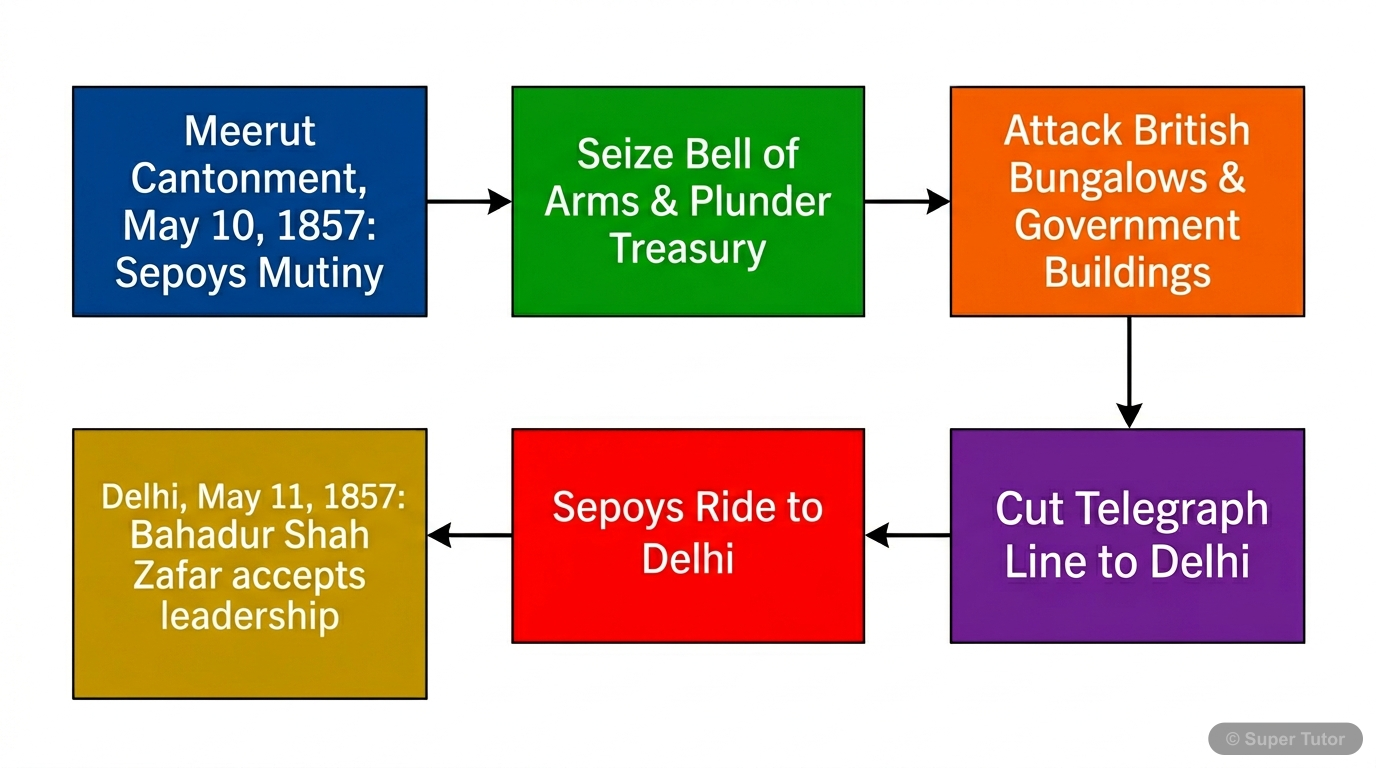
One of 12 illustrations for Rebels and the Raj: 1857 Revolt and its Representations in Super Tutor — alongside flashcards, concept maps and practice questions.
Study Plan
Learn the Theory
Read the textbook chapter carefully. Note down definitions, formulas and key ideas. Focus on: 1. The Beginning of the Revolt and its Spread, 2. Planning, Communication, and Collective Decision-Making, 3. Leaders of the Revolt and Why People Followed Them.
Practise
Solve the textbook exercises and extra practice questions. There are 35 questions available for this chapter.
Revise & Test
Revise key points without looking at your notes. Take a practice quiz and mark weak areas for another pass.
Spaced Revision
Come back to Rebels and the Raj: 1857 Revolt and its Representations after a week. Use flashcards for quick recall and try past exam questions on this chapter.
What to Focus On
- The revolt began with the Meerut mutiny on 10 May 1857.
- Sepoys reached Delhi on 11 May 1857.
- Bahadur Shah became only a nominal leader after pressure from the sepoys.
- Mutiny means sepoy uprising.
- Revolt means civilian uprising.
- The 7th Awadh Irregular Cavalry showed pre-existing coordination.
- Leadership often came from older rulers or local authority figures.
- Popular pressure forced many leaders to take charge.
- Birjis Qadr was a nominal leader in Lucknow, while Begum Hazrat Mahal led resistance.
Common Mistakes to Avoid
The Revolt of 1857 was only a sepoy mutiny, not a wider uprising.
Bahadur Shah eagerly accepted rebel leadership from the beginning.
Nana Sahib, Rani Lakshmi Bai, and Kunwar Singh were all leaders of the same place and same kind of struggle.
Memory Tips
Difference between mutiny and revolt
Early chain of events from Meerut to Delhi
The greased-cartridge rumour
Bahadur Shah’s reluctant leadership
Want a personalised study plan?
Super Tutor builds a day-by-day plan for Madhya Pradesh Board Class 12 History that fits your exam date and pace.
Create My Study PlanFrequently Asked Questions
What are the important topics in Rebels and the Raj: 1857 Revolt and its Representations for Madhya Pradesh Board Class 12 History?
How should I revise Rebels and the Raj: 1857 Revolt and its Representations for the Madhya Pradesh Board Class 12 board exam?
Sources & Official References
Content is aligned to the official syllabus. Refer to the board website for the latest curriculum.
More resources for Rebels and the Raj: 1857 Revolt and its Representations
Practice Quiz
Test yourself with a quick quiz
Important Questions
Exam-style questions with answers
Revision Notes
Key points for last-minute revision
Chapter Summary
Understand the chapter at a glance
Concept Maps
See how topics connect
Flashcards
Quick-fire cards for active recall
Syllabus
What topics to cover
NCERT Solutions
Every textbook question solved step by step
For serious students
Get the full Rebels and the Raj: 1857 Revolt and its Representations chapter — start free.
Quizzes, flashcards, an AI doubt solver and a study plan for Madhya Pradesh Board Class 12 History. Free to start, no card needed.