The End of Bipolarity — Revision Notes
Madhya Pradesh Board · Class 12 · Political Science
The End of Bipolarity revision notes for Madhya Pradesh Board Class 12 Political Science: 4 topics in quick points.
Interactive on Super Tutor
Studying The End of Bipolarity? Get the full interactive chapter.
Quizzes, flashcards, AI doubt-solver and a step-by-step study plan — built for revision notes and more.
Free trial, no card needed.
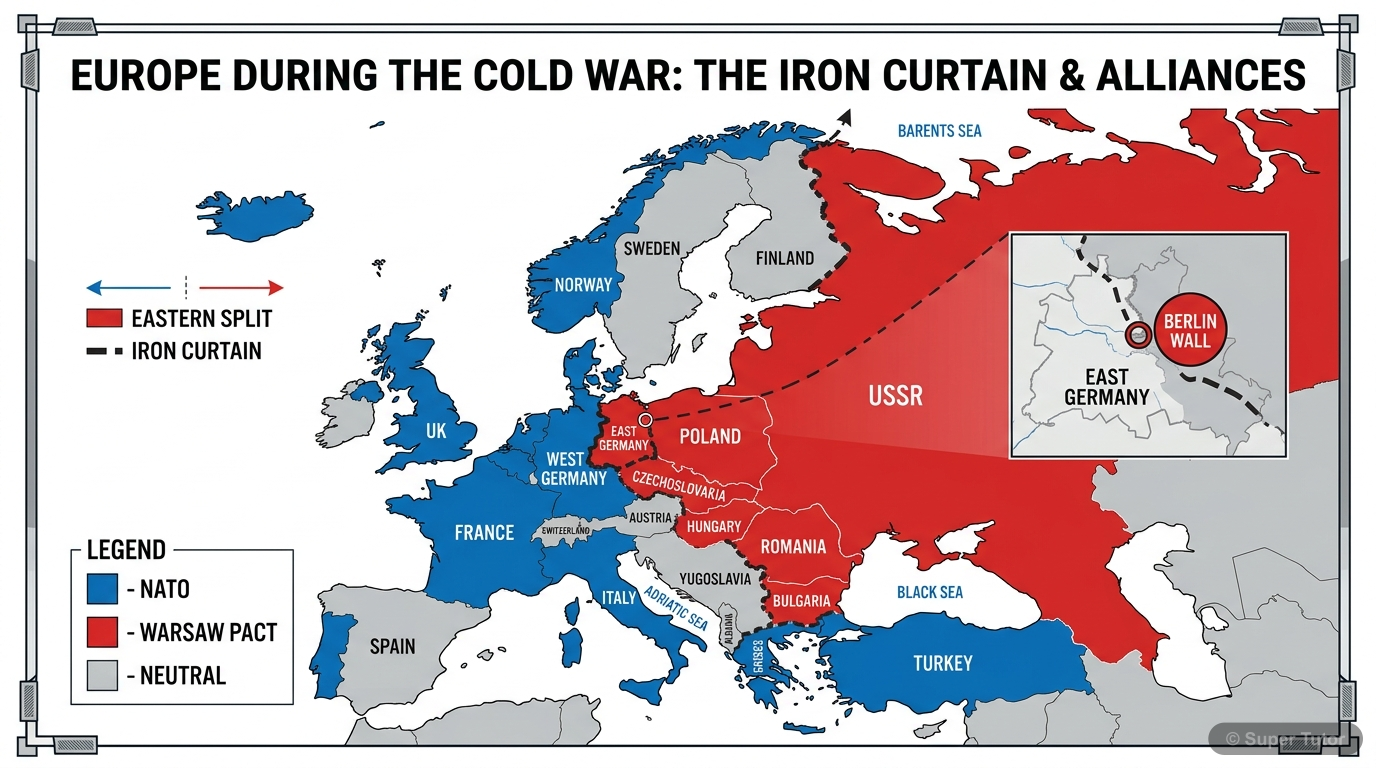
One of 10 illustrations for The End of Bipolarity in Super Tutor — alongside flashcards, concept maps and practice questions.
Key Topics to Revise
1. The Soviet System
- The USSR came into being after the socialist revolution in Russia in 1917.
- The Soviet Union comprised fifteen republics; Russia was only one of them on paper but dominated in reality.
- The political system centred on the Communist Party, and no other political party or opposition was allowed.
2. Leadership and Reform in the Soviet Union
- Vladimir Lenin founded the Bolshevik Communist Party and led the Russian Revolution of 1917.
- Joseph Stalin succeeded Lenin and led consolidation from 1924 to 1953; he began rapid industrialisation and forcible collectivisation of agriculture.
- Nikita Khrushchev led the Soviet Union from 1953 to 1964; he denounced Stalin's leadership style and introduced reforms in 1956.
3. Causes of Disintegration
- Internal weaknesses of Soviet political and economic institutions were a major cause of collapse.
- Economic stagnation led to shortages of consumer goods and reduced faith in the system.
- The Soviet economy carried a huge burden because of the arms race and support to satellite states, especially in Eastern Europe and the Central Asian republics.
4. The Collapse of the USSR and the CIS
- A coup encouraged by Communist Party hardliners took place in 1991.
- Boris Yeltsin emerged as a national hero in opposing the coup.
- In December 1991, Russia, Ukraine, and Belarus declared that the Soviet Union was disbanded.
Get complete notes with diagrams and examples
Full NotesKey Concepts
Frequently Asked Questions
What are the important topics in The End of Bipolarity for Madhya Pradesh Board Class 12 Political Science?
How should I revise The End of Bipolarity for the Madhya Pradesh Board Class 12 board exam?
Sources & Official References
Content is aligned to the official syllabus. Refer to the board website for the latest curriculum.
More resources for The End of Bipolarity
Practice Quiz
Test yourself with a quick quiz
Important Questions
Exam-style questions with answers
Chapter Summary
Understand the chapter at a glance
Concept Maps
See how topics connect
Study Plan
Step-by-step plan for this chapter
Flashcards
Quick-fire cards for active recall
Syllabus
What topics to cover
NCERT Solutions
Every textbook question solved step by step
For serious students
Get the full The End of Bipolarity chapter — start free.
Quizzes, flashcards, an AI doubt solver and a study plan for Madhya Pradesh Board Class 12 Political Science. Free to start, no card needed.