The End of Bipolarity — NCERT Solutions
Madhya Pradesh Board · Class 12 · Political Science
NCERT Solutions for The End of Bipolarity, Madhya Pradesh Board Class 12 Political Science: 10 textbook questions solved step by step.
Interactive on Super Tutor
Studying The End of Bipolarity? Get the full interactive chapter.
Quizzes, flashcards, AI doubt-solver and a step-by-step study plan — built for NCERT solutions and more.
Free trial, no card needed.
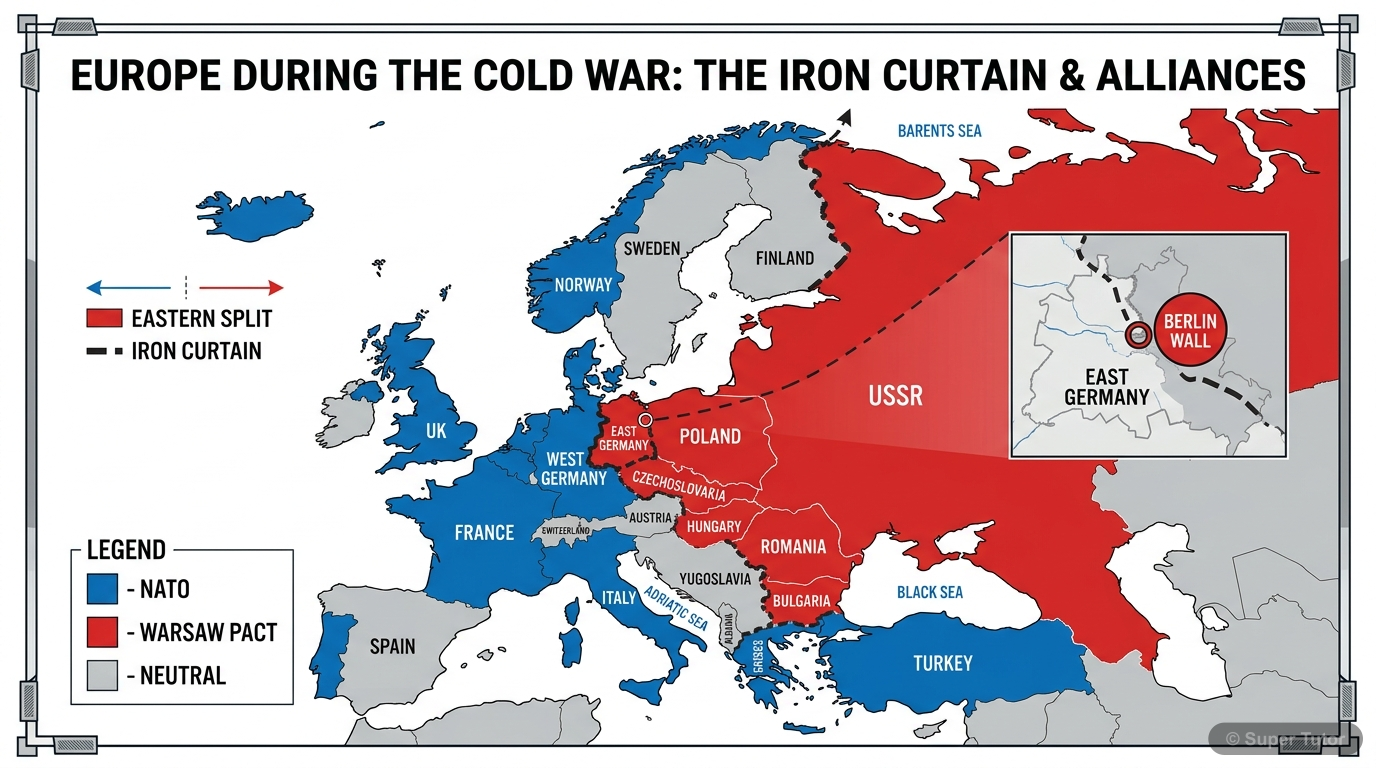
One of 10 illustrations for The End of Bipolarity in Super Tutor — alongside flashcards, concept maps and practice questions.
The first 5 solutions are open to read. The other 5 are free with a Super Tutor account.
Exercise Questions
1Which among the following statements that describe the nature of Soviet economy is wrong?
a. Socialism was the dominant ideology
b. State ownership/control existed over the factors of production
c. People enjoyed economic freedom
d. Every aspect of the economy was planned and controlled by the StateShow solution
Correct Answer: (c) People enjoyed economic freedom
Justification: In the Soviet economy, there was no economic freedom for individuals. The state owned and controlled all factors of production, every aspect of the economy was centrally planned, and socialism was the guiding ideology. Individual economic choices were severely restricted. Therefore, the statement that 'people enjoyed economic freedom' is wrong — it does not correctly describe the Soviet economy.
2Arrange the following in chronological order:
a. Soviet invasion of Afghanistan
b. Fall of the Berlin Wall
c. Disintegration of the Soviet Union
d. Russian RevolutionShow solution
Correct Chronological Order:
| Event | Year |
|---|---|
| d. Russian Revolution | 1917 |
| a. Soviet invasion of Afghanistan | 1979 |
| b. Fall of the Berlin Wall | 1989 |
| c. Disintegration of the Soviet Union | 1991 |
So the correct order is: d → a → b → c
- The Russian Revolution took place in 1917, establishing the Bolshevik (Communist) government.
- The Soviet invasion of Afghanistan began in 1979.
- The Berlin Wall fell on 9 November 1989, symbolising the end of the Cold War.
- The Soviet Union disintegrated on 25 December 1991, when Gorbachev resigned and the USSR formally ceased to exist.
3Which among the following is NOT an outcome of the disintegration of the USSR?
a. End of the ideological war between the US and USSR
b. Birth of CIS
c. Change in the balance of power in the world order
d. Crises in the Middle EastShow solution
Correct Answer: (d) Crises in the Middle East
Justification: The crises in the Middle East were not a direct outcome of the disintegration of the USSR. The other three options — end of the ideological (Cold War) conflict between the US and USSR, birth of the Commonwealth of Independent States (CIS), and a fundamental change in the global balance of power (emergence of a unipolar world with the US as the sole superpower) — were all direct consequences of the Soviet disintegration. Middle East crises have their own historical, religious, and geopolitical roots independent of the USSR's collapse.
4Match the following:
i. Mikhail Gorbachev — a. Successor of USSR
ii. Shock Therapy — b. Military pact
iii. Russia — c. Introduced reforms
iv. Boris Yeltsin — d. Economic model
v. Warsaw — e. President of RussiaShow solution
Correct Matching:
| Column I | Column II |
|---|---|
| i. Mikhail Gorbachev | c. Introduced reforms |
| ii. Shock Therapy | d. Economic model |
| iii. Russia | a. Successor of USSR |
| iv. Boris Yeltsin | e. President of Russia |
| v. Warsaw | b. Military pact |
Explanation:
- Mikhail Gorbachev introduced the landmark reforms of Glasnost (openness) and Perestroika (restructuring) in the USSR in 1985.
- Shock Therapy was the economic model/prescription adopted by former Soviet republics to rapidly transition from a communist planned economy to a capitalist market economy.
- Russia is the principal successor state of the USSR.
- Boris Yeltsin became the first elected President of the Russian Federation.
- Warsaw Pact was the military alliance formed by the USSR and Eastern European socialist states in 1955 as a counter to NATO.
5Fill in the blanks.
a. The Soviet political system was based on __________ ideology.
b. __________ was the military alliance started by the USSR.
c. __________ party dominated the Soviet Union's political system.
d. __________ initiated the reforms in the USSR in 1985.
e. The fall of the __________ symbolised the end of the Cold War.Show solution
Answers:
a. The Soviet political system was based on Marxist-Leninist (Communist/Socialist) ideology.
b. Warsaw Pact was the military alliance started by the USSR. (Formed in 1955)
c. Communist Party (CPSU — Communist Party of the Soviet Union) dominated the Soviet Union's political system.
d. Mikhail Gorbachev initiated the reforms in the USSR in 1985. (He introduced Glasnost and Perestroika)
e. The fall of the Berlin Wall symbolised the end of the Cold War. (The Berlin Wall fell on 9 November 1989)
Free with a Super Tutor account
Free with a Super Tutor account
Free with a Super Tutor account
Free with a Super Tutor account
Free with a Super Tutor account
5 more solved questions in The End of Bipolarity
They are free with a Super Tutor account, along with practice quizzes and flashcards for this chapter. Free to start, no card needed.
Frequently Asked Questions
What are the important topics in The End of Bipolarity for Madhya Pradesh Board Class 12 Political Science?
Are these NCERT Solutions for The End of Bipolarity free?
How should I revise The End of Bipolarity for the Madhya Pradesh Board Class 12 board exam?
Sources & Official References
Content is aligned to the official syllabus. Refer to the board website for the latest curriculum.
More resources for The End of Bipolarity
Practice Quiz
Test yourself with a quick quiz
Important Questions
Exam-style questions with answers
Revision Notes
Key points for last-minute revision
Chapter Summary
Understand the chapter at a glance
Concept Maps
See how topics connect
Study Plan
Step-by-step plan for this chapter
Flashcards
Quick-fire cards for active recall
Syllabus
What topics to cover
For serious students
Get the full The End of Bipolarity chapter — start free.
Quizzes, flashcards, an AI doubt solver and a study plan for Madhya Pradesh Board Class 12 Political Science. Free to start, no card needed.