International Organizations — Syllabus
Madhya Pradesh Board · Class 12 · Political Science
What International Organizations covers in Madhya Pradesh Board Class 12 Political Science: 4 topics, for the 2026-27 session.
Interactive on Super Tutor
Studying International Organizations? Get the full interactive chapter.
Quizzes, flashcards, AI doubt-solver and a step-by-step study plan — built for syllabus and more.
Free trial, no card needed.
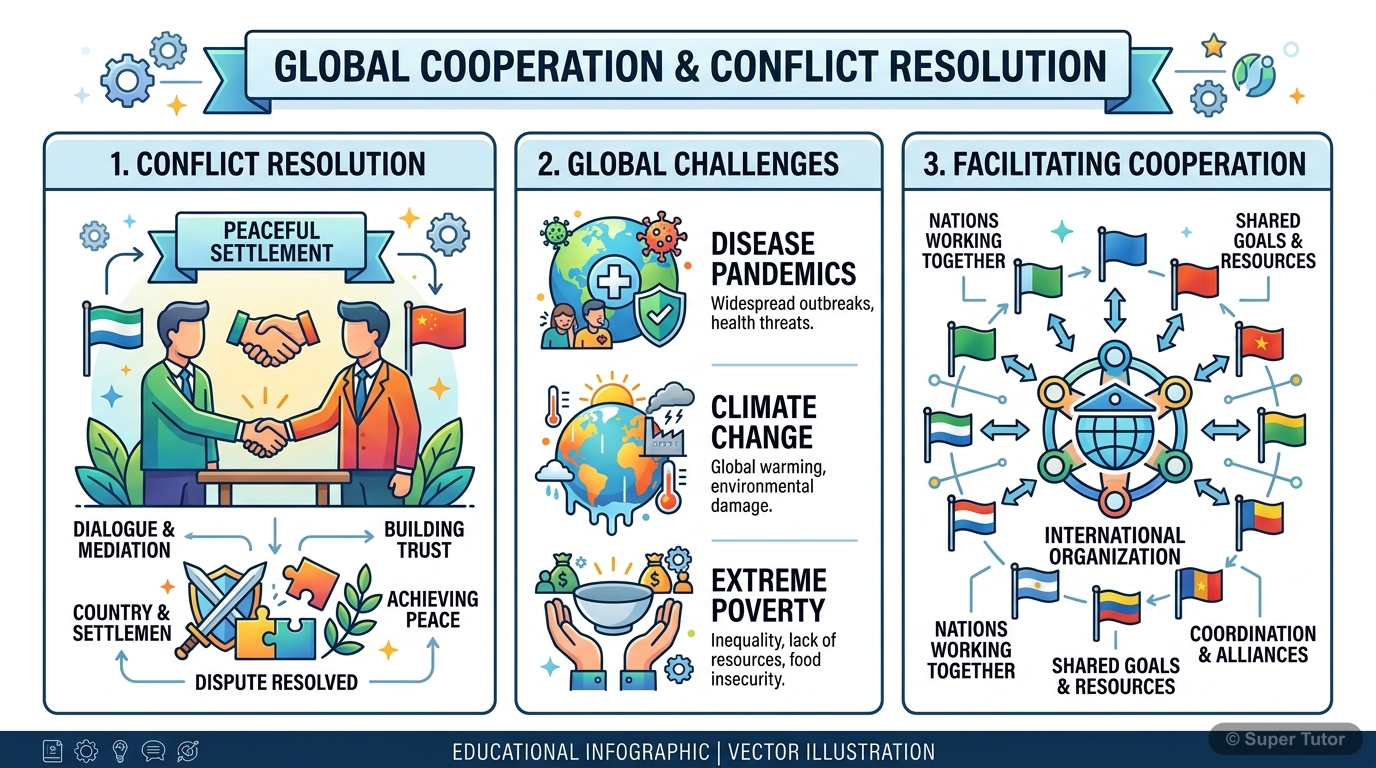
Learn better with visuals Super Tutor pairs illustrations like this with notes and quizzes for International Organizations.
Topics in International Organizations
1. Why International Organisations Matter
- International organisations help states solve problems that no single country can handle alone.
- They provide a forum for dialogue, negotiation, and peaceful settlement of disputes.
- They support cooperation on issues such as disease control, global warming, development, and humanitarian relief.
2. The United Nations: Origin and Purpose
- The UN was founded as a successor to the League of Nations in 1945 immediately after the Second World War.
- The League of Nations failed to prevent the Second World War.
- The UN Charter was signed by 51 nations; Poland signed later on October 15, making 51 original founding members.
3. Principal Organs of the UN
- The UN system has six principal organs: General Assembly, Security Council, International Court of Justice, Secretariat, Economic and Social Council, and Trusteeship Council.
- The General Assembly has representatives of all 193 member states, with one vote each.
- Major decisions in the General Assembly require a two-thirds majority; other decisions need a simple majority.
4. Security Council: Structure, Veto, and Reform
- The Security Council has 15 members: five permanent and ten non-permanent.
- The five permanent members are the United States, Russia, the United Kingdom, France, and China.
- They were selected because they were the most powerful states immediately after the Second World War and were the victors in the War.
Key Concepts
Central concept: International Organizations and the United Nations system in contemporary world politics
Work through every topic in International Organizations with notes and quizzes
Start This ChapterFrequently Asked Questions
What are the important topics in International Organizations for Madhya Pradesh Board Class 12 Political Science?
How should I revise International Organizations for the Madhya Pradesh Board Class 12 board exam?
Sources & Official References
Content is aligned to the official syllabus. Refer to the board website for the latest curriculum.
More resources for International Organizations
Practice Quiz
Test yourself with a quick quiz
Important Questions
Exam-style questions with answers
Revision Notes
Key points for last-minute revision
Chapter Summary
Understand the chapter at a glance
Concept Maps
See how topics connect
Study Plan
Step-by-step plan for this chapter
Flashcards
Quick-fire cards for active recall
NCERT Solutions
Every textbook question solved step by step
For serious students
Get the full International Organizations chapter — start free.
Quizzes, flashcards, an AI doubt solver and a study plan for Madhya Pradesh Board Class 12 Political Science. Free to start, no card needed.