International Organizations — NCERT Solutions
Madhya Pradesh Board · Class 12 · Political Science
NCERT Solutions for International Organizations, Madhya Pradesh Board Class 12 Political Science: 12 textbook questions solved step by step.
Interactive on Super Tutor
Studying International Organizations? Get the full interactive chapter.
Quizzes, flashcards, AI doubt-solver and a step-by-step study plan — built for NCERT solutions and more.
Free trial, no card needed.
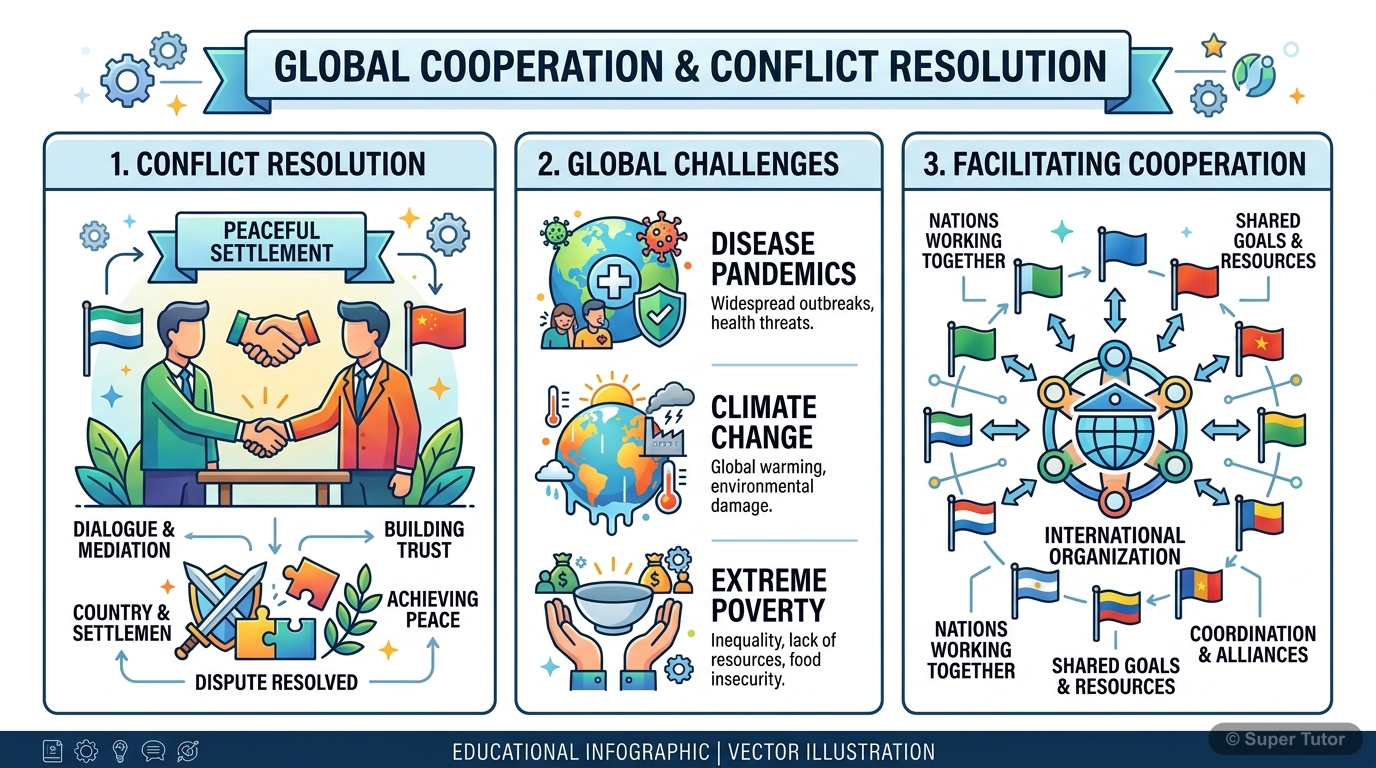
Learn better with visuals Super Tutor pairs illustrations like this with notes and quizzes for International Organizations.
The first 6 solutions are open to read. The other 6 are free with a Super Tutor account.
Exercise Questions — Chapter: International Organizations (Contemporary World Politics, Class 12)
1Mark correct or wrong against each of the following statements about the veto power.
a. Only the permanent members of the Security Council possess the veto power.
b. It's a kind of negative power.
c. The Secretary-General uses this power when not satisfied with any decision.
d. One veto can stall a Security Council resolution.Show solution
Given: Statements about the veto power in the UN Security Council.
Concept: The veto power is the special privilege given to the five permanent members (P5) of the UN Security Council — USA, UK, France, Russia, and China — by which a single 'No' vote from any one of them can block/defeat any substantive resolution.
Answers:
a. Correct — Only the five permanent members (USA, UK, France, Russia, China) possess the veto power. Non-permanent members do not have this power.
b. Correct — It is indeed a kind of negative power because it is used to block or prevent a resolution from being passed, rather than to affirmatively create something.
c. Wrong — The Secretary-General does NOT possess the veto power. The veto is exclusively with the five permanent members of the Security Council. The Secretary-General is the chief administrative officer of the UN.
d. Correct — Even a single veto by one permanent member is sufficient to stall (block) a Security Council resolution, regardless of how many other members vote in favour.
2Mark correct or wrong against each of the following statements about the way the UN functions.
a. All security and peace related issues are dealt with in the Security Council.
b. Humanitarian policies are implemented by the main organs and specialised agencies spread across the globe.
c. Having consensus among the five permanent members on security issues is vital for its implementation.
d. The members of the General Assembly are automatically the members of all other principal organs and specialised agencies of the UN.Show solution
Given: Statements about the functioning of the United Nations.
Concept: The UN functions through its six principal organs — the General Assembly, Security Council, Secretariat, International Court of Justice, Economic and Social Council, and the Trusteeship Council — along with numerous specialised agencies.
Answers:
a. Correct — The Security Council is the primary organ responsible for maintaining international peace and security. All major security and peace-related issues are dealt with in the Security Council.
b. Correct — Humanitarian policies are implemented by the main organs as well as specialised agencies such as UNHCR, UNICEF, WHO, WFP, etc., which are spread across the globe.
c. Correct — Since any one of the five permanent members can veto a resolution, having consensus (or at least no veto) among the P5 is vital for any security-related decision to be implemented.
d. Wrong — Membership of the General Assembly does NOT automatically confer membership of all other principal organs and specialised agencies. Membership of the Security Council, for example, is limited to 15 members (5 permanent + 10 elected non-permanent). Specialised agencies have their own separate membership criteria.
3Which among the following would give more weightage to India's proposal for permanent membership in the Security Council?
a. Nuclear capability
b. It has been a member of the UN since its inception
c. It is located in Asia
d. India's growing economic power and stable political systemShow solution
Correct Answer: (d) India's growing economic power and stable political system
Justification: While all options have some relevance, India's growing economic power (it is one of the fastest-growing major economies and among the largest GDPs in the world) combined with its stable democratic political system provides the strongest and most internationally acceptable argument. These factors demonstrate India's capacity to shoulder global responsibilities. Nuclear capability is not an official criterion (and could be controversial), being a founding member is a historical fact but not a decisive criterion, and geographical location alone is insufficient justification for permanent membership.
4The UN agency concerned with the safety and peaceful use of nuclear technology is:
a. The UN Committee on Disarmament
b. International Atomic Energy Agency
c. UN International Safeguard Committee
d. None of the aboveShow solution
Correct Answer: (b) International Atomic Energy Agency (IAEA)
Justification: The International Atomic Energy Agency (IAEA), established in 1957, is the UN-related intergovernmental organisation responsible for promoting the safe, secure, and peaceful use of nuclear technology. It also implements safeguards to verify that nuclear materials are not diverted for military purposes. The other options — UN Committee on Disarmament and UN International Safeguard Committee — are not the correct agencies for this specific mandate.
5WTO is serving as the successor to which of the following organisations?
a. General Agreement on Trade and Tariffs
b. General Arrangement on Trade and Tariffs
c. World Health Organisation
d. UN Development ProgrammeShow solution
Correct Answer: (a) General Agreement on Trade and Tariffs (GATT)
Justification: The World Trade Organisation (WTO) was established on 1 January 1995 as the successor to the General Agreement on Tariffs and Trade (GATT), which had been in operation since 1948. GATT was a multilateral agreement regulating international trade; the WTO replaced it with a more comprehensive and institutionalised framework. Note: The full form is 'General Agreement on Tariffs and Trade', not 'Tariffs and Tariffs' as in option (a) — the intent of the question is clearly GATT. Option (b) uses the wrong word 'Arrangement', (c) and (d) are entirely different organisations.
6Fill in the blanks.
a. The prime objective of the UN is ___.
b. The highest functionary of the UN is called ___.
c. The UN Security Council has ___ permanent and ___ non-permanent members.
d. ___ is the present UN Secretary-General.Show solution
Given: Blanks related to basic facts about the United Nations.
Answers:
a. The prime objective of the UN is to maintain international peace and security, develop friendly relations among nations, and promote social progress, better living standards, and human rights. (In brief: to maintain international peace and security.)
b. The highest functionary of the UN is called the Secretary-General.
c. The UN Security Council has 5 permanent and 10 non-permanent members. (Total = 15 members)
d. António Guterres is the present UN Secretary-General. (He has been serving since 1 January 2017 and was re-appointed for a second term beginning 1 January 2022. Students should verify the current incumbent at the time of their examination.)
1. Economic and Social Council
2. International Court of Justice
3. International Atomic Energy Agency
4. Security Council
5. UN High Commission for Refugees
6. World Trade Organisation
7. International Monetary Fund
8. General Assembly
9. World Health Organisation
10. Secretariat
a. Oversees the global financial system
b. Preservation of international peace and security
c. Looks into the economic and social welfare of the member countries
d. Safety and peaceful use of nuclear technology
e. Resolves disputes between and among member countries
f. Provides shelter and medical help during emergencies
g. Debates and discusses global issues
h. Administration and coordination of UN affairs
i. Providing good health for all
j. Facilitates free trade among member countries
Free with a Super Tutor account
Free with a Super Tutor account
Free with a Super Tutor account
Free with a Super Tutor account
Free with a Super Tutor account
Free with a Super Tutor account
6 more solved questions in International Organizations
They are free with a Super Tutor account, along with practice quizzes and flashcards for this chapter. Free to start, no card needed.
Frequently Asked Questions
What are the important topics in International Organizations for Madhya Pradesh Board Class 12 Political Science?
Are these NCERT Solutions for International Organizations free?
How should I revise International Organizations for the Madhya Pradesh Board Class 12 board exam?
Sources & Official References
Content is aligned to the official syllabus. Refer to the board website for the latest curriculum.
More resources for International Organizations
Practice Quiz
Test yourself with a quick quiz
Important Questions
Exam-style questions with answers
Revision Notes
Key points for last-minute revision
Chapter Summary
Understand the chapter at a glance
Concept Maps
See how topics connect
Study Plan
Step-by-step plan for this chapter
Flashcards
Quick-fire cards for active recall
Syllabus
What topics to cover
For serious students
Get the full International Organizations chapter — start free.
Quizzes, flashcards, an AI doubt solver and a study plan for Madhya Pradesh Board Class 12 Political Science. Free to start, no card needed.