Era of one-party dominance — Syllabus
Madhya Pradesh Board · Class 12 · Political Science
What Era of one-party dominance covers in Madhya Pradesh Board Class 12 Political Science: 4 topics, for the 2026-27 session.
Interactive on Super Tutor
Studying Era of one-party dominance? Get the full interactive chapter.
Quizzes, flashcards, AI doubt-solver and a step-by-step study plan — built for syllabus and more.
Free trial, no card needed.
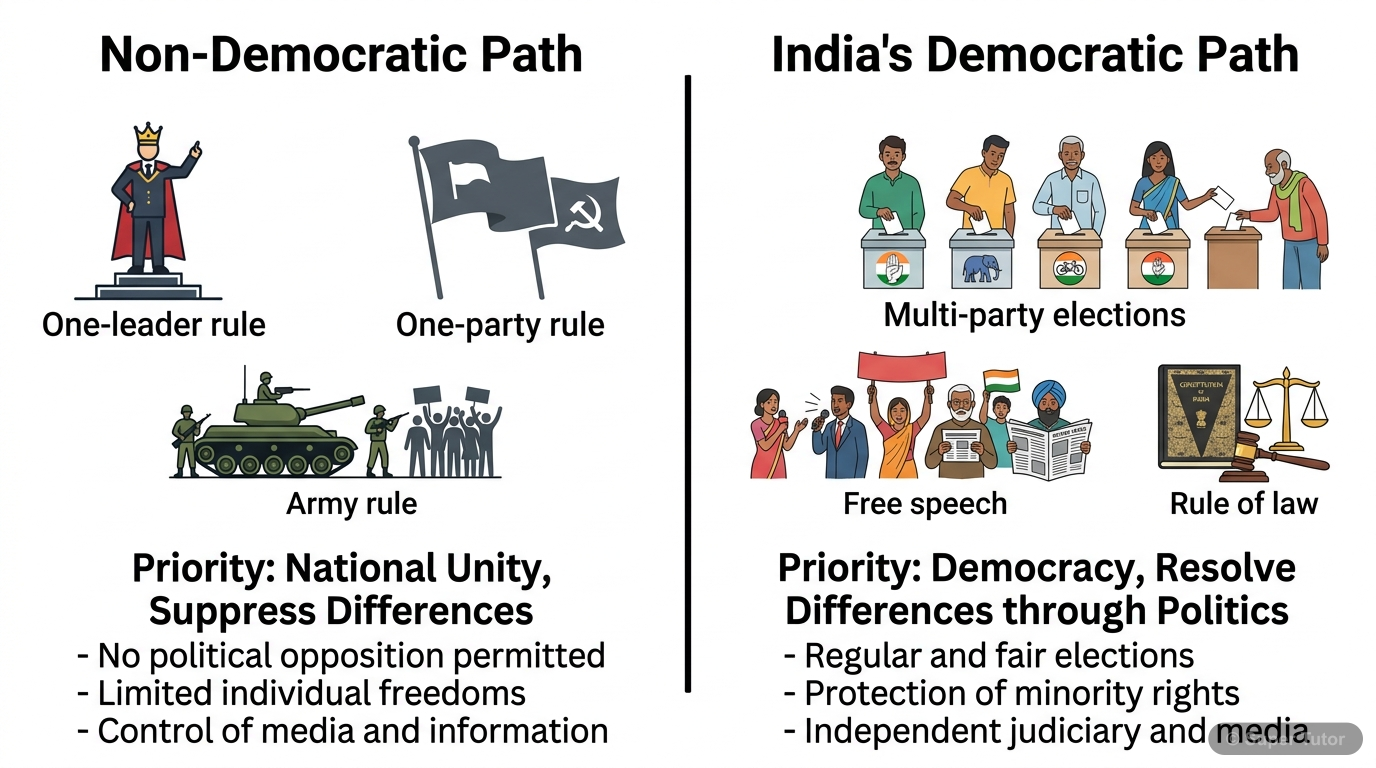
One of 15 illustrations for Era of one-party dominance in Super Tutor — alongside flashcards, concept maps and practice questions.
Topics in Era of one-party dominance
Building democracy after Independence
- The Constitution was adopted on 26 November 1949, signed on 24 January 1950, and came into effect on 26 January 1950.
- The Election Commission of India was set up in January 1950, and Sukumar Sen became the first Chief Election Commissioner.
- Independent India chose democracy even though many countries after colonial rule chose non-democratic paths in the name of unity and stability.
The first general election
- The Election Commission had to handle delimitation and preparation of electoral rolls before voting could begin.
- Nearly 40 lakh women were missing from the first draft electoral rolls and were listed as 'wife of' or 'daughter of'.
- The Election Commission refused to accept such entries and ordered revision or deletion where needed.
Congress dominance in the first three elections
- The Indian National Congress inherited the legacy of the national movement and had an organisation spread across the country.
- Jawaharlal Nehru led the Congress campaign, toured the country, and became Prime Minister after the first general election.
- The Congress won 364 of the 489 seats in the first Lok Sabha.
Nature of Congress dominance
- Congress dominance in India was different from one-party states in countries where democracy was compromised.
- China, Cuba, and Syria permit only a single party to rule by constitutional provision.
- Myanmar, Belarus, Egypt, and Eritrea are effectively one-party states because of legal and military measures.
Key Concepts
Central concept: Congress dominance under democratic conditions and the emergence of opposition parties in early independent India
Work through every topic in Era of one-party dominance with notes and quizzes
Start This ChapterFrequently Asked Questions
What are the important topics in Era of one-party dominance for Madhya Pradesh Board Class 12 Political Science?
How should I revise Era of one-party dominance for the Madhya Pradesh Board Class 12 board exam?
Sources & Official References
Content is aligned to the official syllabus. Refer to the board website for the latest curriculum.
More resources for Era of one-party dominance
Practice Quiz
Test yourself with a quick quiz
Important Questions
Exam-style questions with answers
Revision Notes
Key points for last-minute revision
Chapter Summary
Understand the chapter at a glance
Concept Maps
See how topics connect
Study Plan
Step-by-step plan for this chapter
Flashcards
Quick-fire cards for active recall
NCERT Solutions
Every textbook question solved step by step
For serious students
Get the full Era of one-party dominance chapter — start free.
Quizzes, flashcards, an AI doubt solver and a study plan for Madhya Pradesh Board Class 12 Political Science. Free to start, no card needed.