The Market as a Social Institution — Chapter Summary
Madhya Pradesh Board · Class 12 · Sociology
Summary of The Market as a Social Institution for Madhya Pradesh Board Class 12 Sociology. Part of the Madhya Pradesh Board Class 12 Sociology syllabus.
Interactive on Super Tutor
Studying The Market as a Social Institution? Get the full interactive chapter.
Quizzes, flashcards, AI doubt-solver and a step-by-step study plan — built for chapter summary and more.
Free trial, no card needed.
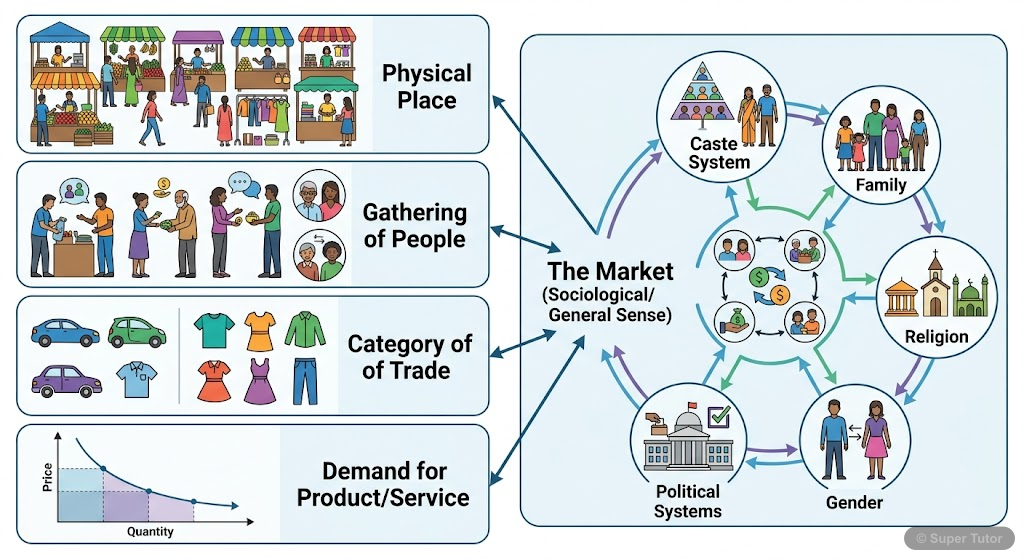
Learn better with visuals Super Tutor pairs illustrations like this with notes and quizzes for The Market as a Social Institution.
Overview
The market is more than a place where buying and selling happen. It also works as a social institution shaped by caste, class, trust, status, culture, and historical change. Markets connect local exchange with wider regional, national, and global networks. Sociology studies these social relations be
Key Concepts
The market is not only
The market is not only an economic space for exchange. It is shaped by social groups, trust, caste, class, and links with other institutions. Economie
Modern economics at its origin
Modern economics at its origin was called political economy. Adam Smith argued that many individual transactions together create an ordered market sys
Marx saw capitalism as commodity production
Marx saw capitalism as commodity production through wage labour. Each mode of production has specific relations of production and a specific class str
Weber showed that goods people buy
Weber showed that goods people buy and use are linked to social status. He coined the term status symbol. Classes and status groups are also marked by
The Nakarattars formed a caste
The Nakarattars formed a caste-based banking system based on trust, kinship, business territory, residence, descent, marriage, and common cult members
Learning Objectives
- Understand the market as both an economic and a social institution.
- Explain Adam Smith’s view of the market economy as an ordered system of individual exchanges.
- Understand Marx’s view of capitalism as a system based on commodity production, labour power, and surplus value.
- Explain Weber’s idea that consumption can express social status through status symbols.
- Describe caste-based trading and banking networks such as the Nakarattars and the role of Vaisyas, Banjaras, and Marwaris.
Frequently Asked Questions
What are the important topics in The Market as a Social Institution for Madhya Pradesh Board Class 12 Sociology?
How should I revise The Market as a Social Institution for the Madhya Pradesh Board Class 12 board exam?
Sources & Official References
Content is aligned to the official syllabus. Refer to the board website for the latest curriculum.
More resources for The Market as a Social Institution
Practice Quiz
Test yourself with a quick quiz
Important Questions
Exam-style questions with answers
Revision Notes
Key points for last-minute revision
Concept Maps
See how topics connect
Study Plan
Step-by-step plan for this chapter
Flashcards
Quick-fire cards for active recall
Syllabus
What topics to cover
NCERT Solutions
Every textbook question solved step by step
For serious students
Get the full The Market as a Social Institution chapter — start free.
Quizzes, flashcards, an AI doubt solver and a study plan for Madhya Pradesh Board Class 12 Sociology. Free to start, no card needed.