The Market as a Social Institution — NCERT Solutions
Madhya Pradesh Board · Class 12 · Sociology
NCERT Solutions for The Market as a Social Institution, Madhya Pradesh Board Class 12 Sociology: 10 textbook questions solved step by step.
Interactive on Super Tutor
Studying The Market as a Social Institution? Get the full interactive chapter.
Quizzes, flashcards, AI doubt-solver and a step-by-step study plan — built for NCERT solutions and more.
Free trial, no card needed.
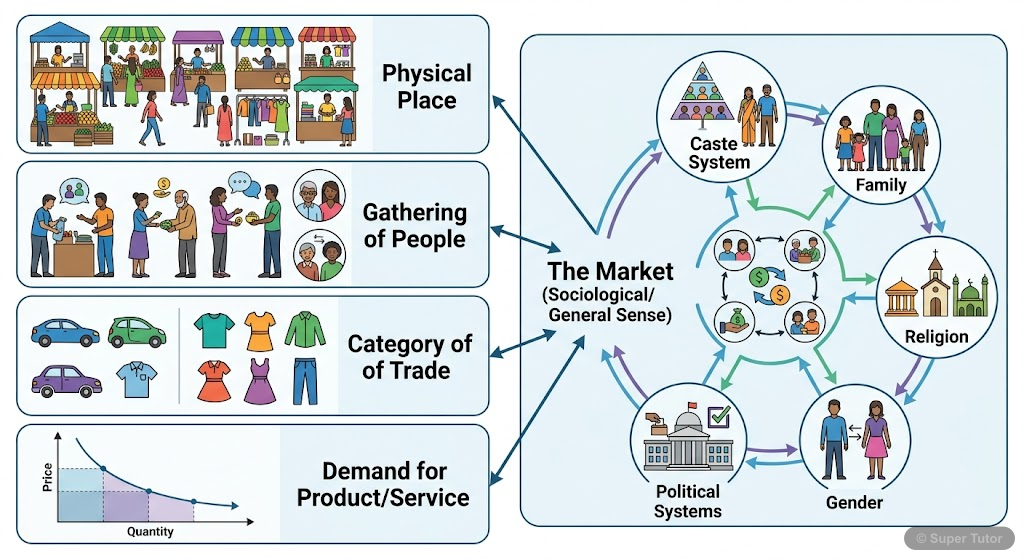
Learn better with visuals Super Tutor pairs illustrations like this with notes and quizzes for The Market as a Social Institution.
The first 5 solutions are open to read. The other 5 are free with a Super Tutor account.
Exercise Questions
1What is meant by the phrase 'invisible hand'?Show solution
Given/Context: The phrase 'invisible hand' is associated with classical economics, particularly with the economist Adam Smith.
Explanation:
The phrase 'invisible hand' refers to the idea that in a free market, individuals pursuing their own self-interest are led, as if by an invisible hand, to promote the good of society as a whole — even without intending to do so.
Key Points:
- Adam Smith used this metaphor to describe the self-regulating nature of a free market economy.
- When individuals make decisions based on their own interests (e.g., buying cheap, selling at profit), the overall outcome — through the mechanism of price, supply, and demand — tends to benefit society by allocating resources efficiently.
- The 'invisible hand' thus implies that no central authority or planning is needed; the market coordinates economic activity automatically.
Example: A farmer grows wheat to earn profit. A baker buys wheat to make bread for customers. Neither is thinking of 'feeding society,' yet society gets fed. The market coordinates their actions without any external direction.
Conclusion: The 'invisible hand' is essentially a metaphor for the self-correcting and self-regulating mechanism of the free market, where individual self-interest collectively produces social benefit.
2How does a sociological perspective on markets differ from an economic one?Show solution
Given/Context: Markets can be studied from both an economic and a sociological perspective. The two approaches differ significantly in their focus and assumptions.
Economic Perspective:
- Economics treats the market as a mechanism for the exchange of goods and services based on the forces of supply and demand.
- It focuses on rational, self-interested individuals (the 'economic man' or homo economicus) who make decisions to maximise profit or utility.
- The market is seen as an impersonal, neutral institution governed by price signals.
- Social and cultural factors are generally treated as external or irrelevant to market functioning.
Sociological Perspective:
- Sociology views the market as a social institution — shaped by social relationships, cultural norms, power structures, and historical processes.
- It emphasises that markets are embedded in society (Karl Polanyi's concept of 'embeddedness') — they cannot be separated from social life.
- Sociologists examine how factors like caste, kinship, gender, religion, and ethnicity influence who participates in markets, on what terms, and with what outcomes.
- Markets are seen as sites of social inequality — not just economic exchange.
- The sociological approach also looks at how markets change over time due to historical forces such as colonialism and globalisation.
Key Difference in Summary:
| Aspect | Economic Perspective | Sociological Perspective |
|---|---|---|
| Focus | Price, supply, demand | Social relations, power, culture |
| View of individual | Rational, self-interested | Socially embedded actor |
| Market | Neutral mechanism | Social institution |
| Social factors | Ignored or secondary | Central to analysis |
Conclusion: While economics asks how markets work, sociology asks why markets work the way they do for different groups of people, and how social structures shape market outcomes.
3In what ways is a market – such as a weekly village market – a social institution?Show solution
Given/Context: A weekly village market (called haat in many parts of India) is a common feature of rural life. It appears to be simply a place for buying and selling, but sociologically it is much more.
A Market as a Social Institution — Explanation:
A social institution is a set of organised social relationships and norms that fulfil important social functions. A weekly village market qualifies as a social institution in the following ways:
- Regular Social Gathering: The weekly market brings together people from surrounding villages on a fixed day. It is a predictable, recurring social event that structures community life.
- Social Interaction Beyond Trade: People do not come only to buy and sell. They meet relatives, exchange news, discuss community matters, and renew social bonds. The market is a space for social communication.
- Governed by Social Norms: The market operates according to unwritten rules — about who sells what, where stalls are located, how disputes are settled, and what prices are fair. These norms are socially enforced.
- Reflects Social Hierarchy: The organisation of the market often reflects caste and gender hierarchies — certain groups occupy certain spaces, certain communities dominate certain trades.
- Cultural and Ritual Significance: In many tribal and rural communities, markets have ritual dimensions. Alfred Gell's study of a tribal market in India showed that the market had symbolic and cosmological significance beyond mere trade.
- Embedded in Kinship and Community Networks: Trust, credit, and trade relationships in village markets are built on kinship and community ties, not just on impersonal economic calculation.
Conclusion: A weekly village market is far more than an economic exchange point. It is a social institution that organises community life, reflects social structures, and is embedded in cultural and historical contexts.
4How do caste and kin networks contribute to the success of a business?Show solution
Given/Context: In India, business communities such as the Marwaris, Nattukottai Chettiars, and Parsis have historically used caste and kinship networks to build successful enterprises.
Ways in which Caste and Kin Networks Contribute to Business Success:
- Trust and Reduced Transaction Costs:
- Business involves risk. Caste and kinship networks provide a built-in system of trust. Members of the same caste or family are more likely to honour agreements, repay loans, and maintain honesty.
- This reduces the need for expensive legal contracts and formal enforcement mechanisms.
- Access to Capital:
- Within caste or kin networks, credit and capital can be mobilised more easily. Community members lend to each other at lower interest rates or without collateral, based on social trust.
- The Nattukottai Chettiars, for example, built a vast banking and trading network across South and Southeast Asia using community-based credit systems.
- Labour and Management:
- Businesses often employ relatives and caste members, ensuring loyalty and reducing the risk of betrayal or theft.
- Family labour is often unpaid or underpaid, reducing costs.
- Information Networks:
- Caste and kin networks serve as information channels — about market conditions, business opportunities, reliable suppliers, and creditworthy customers.
- Training and Skill Transmission:
- Traditional business skills, trade secrets, and knowledge are passed down within families and communities, giving them a competitive advantage.
- Social Capital and Reputation:
- Belonging to a reputed business community (e.g., Marwaris, Banias) itself lends credibility and reputation in the market.
Example: The Marwaris of Calcutta (studied by Anne Hardgrove) used their community networks to dominate trade and finance across India. Their success was built not just on individual talent but on collective community resources.
Conclusion: Caste and kin networks function as social capital — they provide trust, credit, labour, information, and reputation, all of which are crucial resources for business success.
5In what ways did the Indian economy change after the coming of colonialism?Show solution
Given/Context: Before British colonialism, India had a diverse and largely self-sufficient economy. Colonial rule brought fundamental and far-reaching changes.
Changes in the Indian Economy under Colonialism:
- Transformation from Self-Sufficient to Export Economy:
- India's economy was restructured to serve British industrial interests. India became a supplier of raw materials (cotton, indigo, jute, opium) to British industries and a market for British manufactured goods.
- Destruction of Indian Handicrafts and Industries:
- The influx of cheap, machine-made British goods (especially textiles) destroyed traditional Indian handicraft industries. The famous muslin weavers of Dhaka and artisans across India lost their livelihoods.
- Introduction of a Market Economy and Commoditisation:
- The colonial state introduced land revenue systems (like the Permanent Settlement) that forced peasants into the cash economy. Land, labour, and goods that were previously outside the market became commodities.
- This process of commoditisation meant that things previously exchanged through social/ritual obligations were now bought and sold for money.
- New Infrastructure for Colonial Trade:
- Railways, roads, telegraph, and ports were built — but primarily to facilitate the extraction of resources and movement of goods for British benefit, not for Indian development.
- Drain of Wealth:
- Colonial policies led to a systematic drain of wealth from India to Britain through trade imbalances, taxation, and the 'Home Charges' (payments India had to make to Britain).
- Rise of New Social Classes:
- Colonialism created new social groups: a class of Indian merchants and compradors who collaborated with the British, a new professional middle class, and a large class of landless labourers.
- Disruption of Traditional Trade Networks:
- Pre-colonial India had vibrant internal and external trade networks (e.g., the Indian Ocean trade). Colonial rule disrupted these and reoriented trade towards Britain.
Conclusion: Colonialism fundamentally restructured the Indian economy — from a relatively self-sufficient, diversified economy to a dependent, export-oriented one that served British imperial interests, causing widespread deindustrialisation and impoverishment.
Free with a Super Tutor account
Free with a Super Tutor account
Free with a Super Tutor account
Free with a Super Tutor account
Free with a Super Tutor account
5 more solved questions in The Market as a Social Institution
They are free with a Super Tutor account, along with practice quizzes and flashcards for this chapter. Free to start, no card needed.
Frequently Asked Questions
What are the important topics in The Market as a Social Institution for Madhya Pradesh Board Class 12 Sociology?
Are these NCERT Solutions for The Market as a Social Institution free?
How should I revise The Market as a Social Institution for the Madhya Pradesh Board Class 12 board exam?
Sources & Official References
Content is aligned to the official syllabus. Refer to the board website for the latest curriculum.
More resources for The Market as a Social Institution
Practice Quiz
Test yourself with a quick quiz
Important Questions
Exam-style questions with answers
Revision Notes
Key points for last-minute revision
Chapter Summary
Understand the chapter at a glance
Concept Maps
See how topics connect
Study Plan
Step-by-step plan for this chapter
Flashcards
Quick-fire cards for active recall
Syllabus
What topics to cover
For serious students
Get the full The Market as a Social Institution chapter — start free.
Quizzes, flashcards, an AI doubt solver and a study plan for Madhya Pradesh Board Class 12 Sociology. Free to start, no card needed.