Lines And Angles — Chapter Summary
NIOS · Class 10 · Maths
Summary of Lines And Angles for NIOS Class 10 Maths. Key concepts: A point is represented by, An angle is a figure and Two angles with sum 90°.
Interactive on Super Tutor
Studying Lines And Angles? Get the full interactive chapter.
Quizzes, flashcards, AI doubt-solver and a step-by-step study plan — built for chapter summary and more.
Free trial, no card needed.
One of 17 illustrations for Lines And Angles in Super Tutor — alongside flashcards, concept maps and practice questions.
Overview
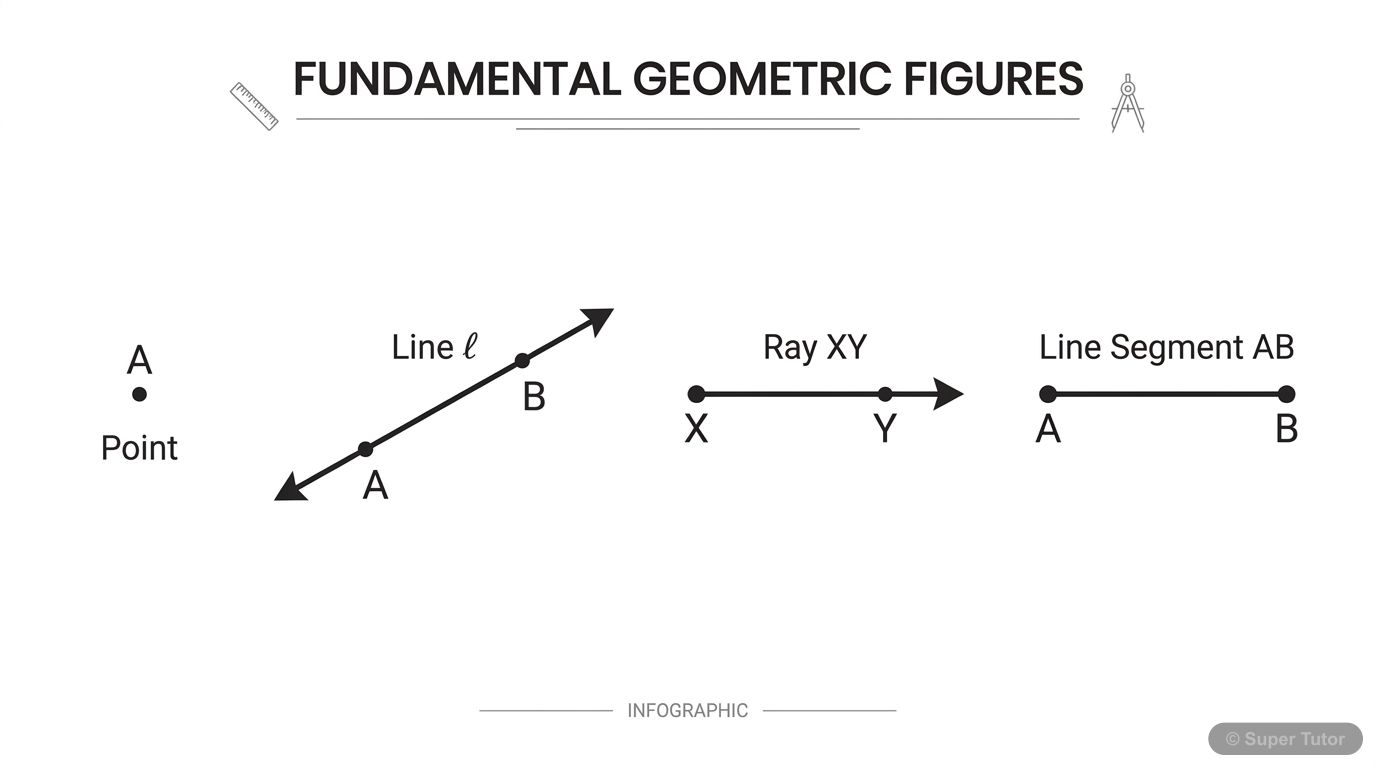
Lines and angles form the basic language of geometry. A point shows a location, a line extends infinitely in both directions, a ray extends in one direction, and a plane extends infinitely in length and breadth. Angles are formed by two rays with a common starting point. The chapter also studies how
Key Concepts
A point is represented by capital
A point is represented by capital letters such as A, B, and C. A line is formed by joining two points and extending infinitely on both sides. A ray st
An angle is a figure consisting
An angle is a figure consisting of two rays starting from a common point. Important types include right angle, straight angle, acute angle, and obtuse
Two angles with sum 90°
Two angles with sum 90° are complementary. Two angles with sum 180° are supplementary. If a ray stands on a line, the two adjacent angles formed make
When two lines intersect
When two lines intersect, the opposite angles are equal. If the intersecting lines form angles AOC and DOB, then ∠AOC = ∠DOB, and ∠AOD = ∠BOC.
A transversal is a line
A transversal is a line that intersects two or more lines at distinct points. When it cuts two lines, eight angles are formed. Important pairs are cor
Learning Objectives
- Understand the meanings of point, line, ray, plane, and angle
- Identify different types of angles and line relationships
- Use angle properties for intersecting lines and transversal lines
- Apply the angle sum property and exterior angle theorem of triangles
- Find unknown angles using linear pair, vertically opposite angles, and parallel line rules
Frequently Asked Questions
What are the important topics in Lines And Angles for NIOS Class 10 Maths?
How should I revise Lines And Angles for the NIOS Class 10 board exam?
Sources & Official References
Content is aligned to the official syllabus. Refer to the board website for the latest curriculum.
More resources for Lines And Angles
Practice Quiz
Test yourself with a quick quiz
Important Questions
Exam-style questions with answers
Revision Notes
Key points for last-minute revision
Formula Sheet
The chapter's formulas in one place
Concept Maps
See how topics connect
Study Plan
Step-by-step plan for this chapter
Flashcards
Quick-fire cards for active recall
Syllabus
What topics to cover
For serious students
Get the full Lines And Angles chapter — start free.
Quizzes, flashcards, an AI doubt solver and a study plan for NIOS Class 10 Maths. Free to start, no card needed.