Chemical Bonding — Concept Maps
NIOS · Class 10 · Science & Tech
4 concept maps of Chemical Bonding for NIOS Class 10 Science & Tech, each also written out as a text outline. Maps: Chemical Bonding Overview and Chemical.
Interactive on Super Tutor
Studying Chemical Bonding? Get the full interactive chapter.
Quizzes, flashcards, AI doubt-solver and a step-by-step study plan — built for concept maps and more.
Free trial, no card needed.
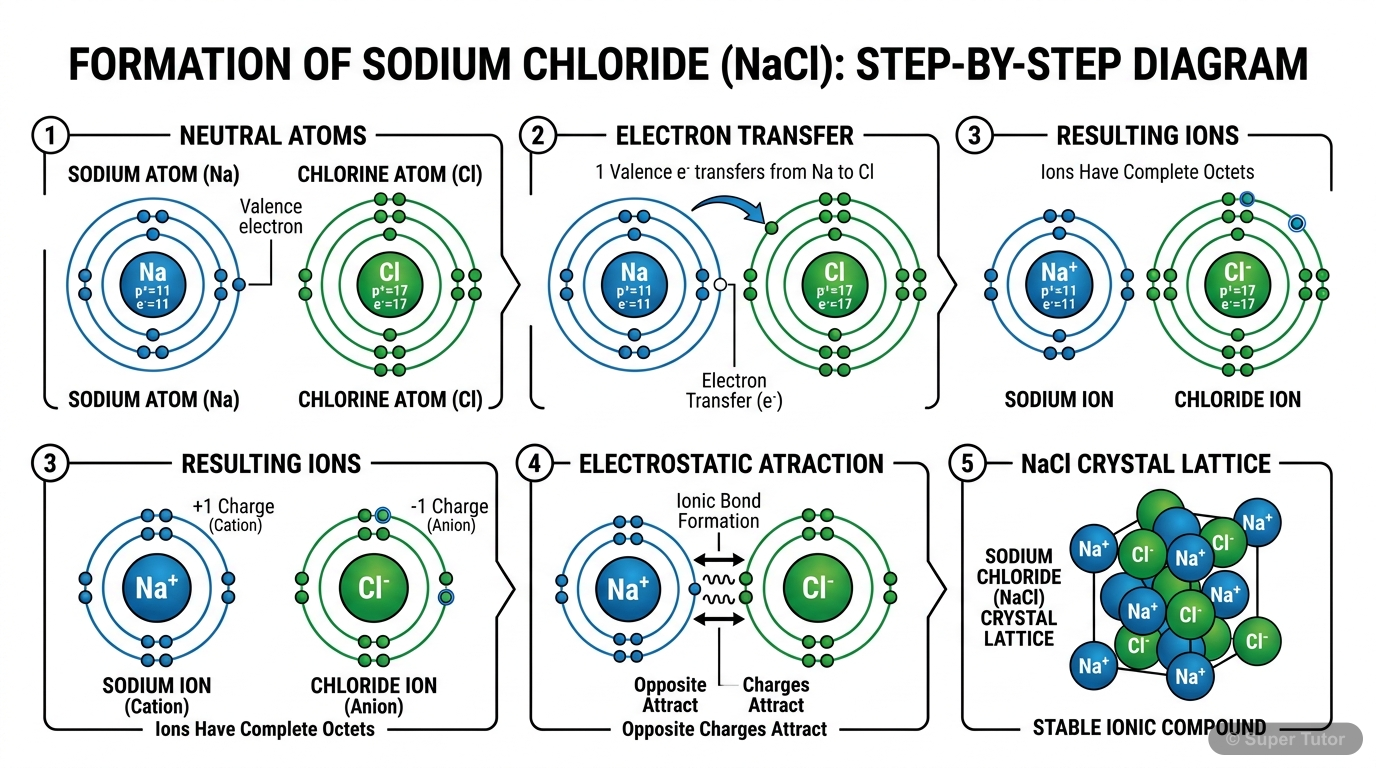
One of 13 illustrations for Chemical Bonding in Super Tutor — alongside flashcards, concept maps and practice questions.
Chemical Bonding Overview
The map in words
- Chemical Bonding
- Why Atoms Combine
- Noble Gas Stability
- Octet Rule
- Energy Lowering
- Ionic Bonding
- Electron Transfer
- Metal to Nonmetal
- Electrostatic Attraction
- Properties
- High Melting Point
- Conduct Electricity
- Water Soluble
- Covalent Bonding
- Electron Sharing
- Nonmetal to Nonmetal
- Shared Electron Pairs
- Types
- Single Bond
- Double Bond
- Triple Bond
- Properties
- Low Melting Point
- Poor Conductor
- Organic Solvent Soluble
- Why Atoms Combine
Chemical Bonding Overview
The map in words
- Chemical Bonding
- Why Atoms Combine
- Noble Gas Stability
- Octet Rule
- Energy Minimization
- Ionic Bonding
- Electron Transfer
- Cations and Anions
- Electrostatic Forces
- Properties
- High Melting Point
- Conducts in Solution
- Crystalline Solid
- Water Soluble
- Covalent Bonding
- Electron Sharing
- Single Double Triple
- Lewis Structures
- Properties
- Low Melting Point
- Non Conductor
- Molecular Structure
- Organic Solvent Soluble
- Why Atoms Combine
Chemical Bonding Overview
The map in words
- Chemical Bonding
- Why Atoms Combine
- Noble Gas Stability
- Octet Rule
- Duplet Rule for H
- Ionic Bonding
- Electron Transfer
- Metal to Non-metal
- Cations and Anions
- Crystal Lattice
- Covalent Bonding
- Electron Sharing
- Non-metal to Non-metal
- Single Double Triple
- Discrete Molecules
- Properties
- Ionic Properties
- High MP BP
- Conducts when molten
- Water soluble
- Covalent Properties
- Low MP BP
- Poor conductor
- Organic soluble
- Ionic Properties
- Why Atoms Combine
Chemical bonding as the cause of stable substance formation through transfer or sharing of electrons
The map in words
- Chemical bonding as the cause of stable substance formation through transfer or sharing of electrons
- Need for bonding
- Noble gases
- Ionic bonding
- Ionic compounds
- Covalent bonding
- Covalent compounds
- Specific ionic examples
- Specific covalent examples
Explore these maps interactively
Explore DiagramsFrequently Asked Questions
What are the important topics in Chemical Bonding for NIOS Class 10 Science & Tech?
What do the concept maps for Chemical Bonding show?
How should I revise Chemical Bonding for the NIOS Class 10 board exam?
Sources & Official References
Content is aligned to the official syllabus. Refer to the board website for the latest curriculum.
More resources for Chemical Bonding
Practice Quiz
Test yourself with a quick quiz
Important Questions
Exam-style questions with answers
Revision Notes
Key points for last-minute revision
Formula Sheet
The chapter's formulas in one place
Chapter Summary
Understand the chapter at a glance
Study Plan
Step-by-step plan for this chapter
Flashcards
Quick-fire cards for active recall
Syllabus
What topics to cover
For serious students
Get the full Chemical Bonding chapter — start free.
Quizzes, flashcards, an AI doubt solver and a study plan for NIOS Class 10 Science & Tech. Free to start, no card needed.