Chemical Bonding — Important Questions
NIOS · Class 10 · Science & Tech
42 important questions from Chemical Bonding for NIOS Class 10 Science & Tech, with answers. Written for the board exams 2027.
Interactive on Super Tutor
Studying Chemical Bonding? Get the full interactive chapter.
Quizzes, flashcards, AI doubt-solver and a step-by-step study plan — built for important questions and more.
Free trial, no card needed.
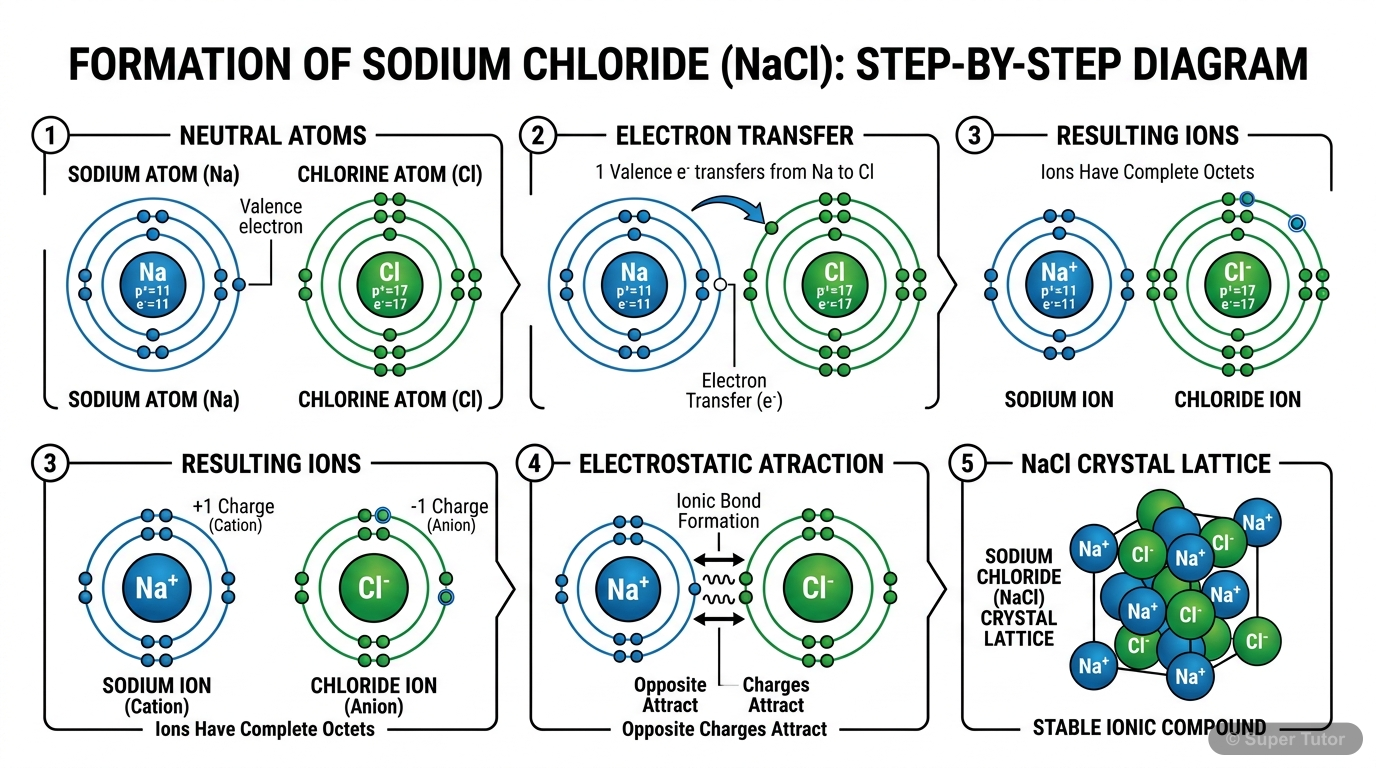
One of 13 illustrations for Chemical Bonding in Super Tutor — alongside flashcards, concept maps and practice questions.
Important Questions from Chemical Bonding
In a chlorine molecule (Cl₂), how many electrons are shared between the two chlorine atoms?
Show answer
2 electrons
Step 1: Each chlorine atom has electronic configuration 2,8,7, meaning it has 7 electrons in its outer shell. Step 2: Each chlorine atom needs 1 more electron to complete its octet (8 electrons). Step 3: When two chlorine atoms come together, each contributes 1 electron for sharing. Step 4: This creates one shared pair of electrons (2 electrons total) between the two atoms. Step 5: Both chlorine atoms can now count these 2 shared electrons as part of their outer shell, giving each atom 8 electrons and completing their octets.
What is the electronic configuration of a chloride ion (Cl⁻)?
Show answer
2,8,8
Step 1: A neutral chlorine atom has atomic number 17, so it has 17 electrons with configuration 2,8,7. Step 2: To form a chloride ion (Cl⁻), the chlorine atom gains one electron. Step 3: This additional electron goes into the outermost shell, making it 2,8,8. Step 4: The chloride ion now has 18 electrons but still has 17 protons, giving it a -1 charge. Step 5: The configuration 2,8,8 is the same as argon (a noble gas), making the chloride ion very stable.
Why do covalent compounds have lower melting points than ionic compounds?
Show answer
They have weak intermolecular forces between molecules
Step 1: Covalent compounds exist as discrete molecules held together by sharing electrons within the molecule. Step 2: The forces between different molecules (intermolecular forces) are much weaker than the ionic forces in ionic compounds. Step 3: To melt a covalent compound, you only need to overcome these weak intermolecular forces, not break the strong covalent bonds within molecules. Step 4: In contrast, melting ionic compounds requires breaking strong electrostatic attractions between ions. Step 5: Since less energy is needed to overcome weak intermolecular forces, covalent compounds melt
How many covalent bonds are present in a nitrogen molecule (N₂)?
Show answer
3 bonds
Step 1: Each nitrogen atom has electronic configuration 2,5, meaning it has 5 electrons in its outer shell. Step 2: Each nitrogen atom needs 3 more electrons to complete its octet (8 electrons). Step 3: When two nitrogen atoms bond, each contributes 3 electrons for sharing. Step 4: This creates 3 shared pairs of electrons (6 electrons total) between the two atoms. Step 5: These 3 pairs of shared electrons form 3 covalent bonds, creating a triple bond (N≡N), which is very strong.
+38 more questions on Chemical Bonding (NIOS Class 10 Science & Tech)
Practise AllFrequently Asked Questions
What are the important topics in Chemical Bonding for NIOS Class 10 Science & Tech?
How many important questions are there in Chemical Bonding?
Sources & Official References
Content is aligned to the official syllabus. Refer to the board website for the latest curriculum.
More resources for Chemical Bonding
Practice Quiz
Test yourself with a quick quiz
Revision Notes
Key points for last-minute revision
Formula Sheet
The chapter's formulas in one place
Chapter Summary
Understand the chapter at a glance
Concept Maps
See how topics connect
Study Plan
Step-by-step plan for this chapter
Flashcards
Quick-fire cards for active recall
Syllabus
What topics to cover
For serious students
Get the full Chemical Bonding chapter — start free.
Quizzes, flashcards, an AI doubt solver and a study plan for NIOS Class 10 Science & Tech. Free to start, no card needed.