Chemical Bonding — Revision Notes
NIOS · Class 10 · Science & Tech
Chemical Bonding revision notes for NIOS Class 10 Science & Tech: 4 topics in quick points. Part of the NIOS Class 10 Science & Tech syllabus.
Interactive on Super Tutor
Studying Chemical Bonding? Get the full interactive chapter.
Quizzes, flashcards, AI doubt-solver and a step-by-step study plan — built for revision notes and more.
Free trial, no card needed.
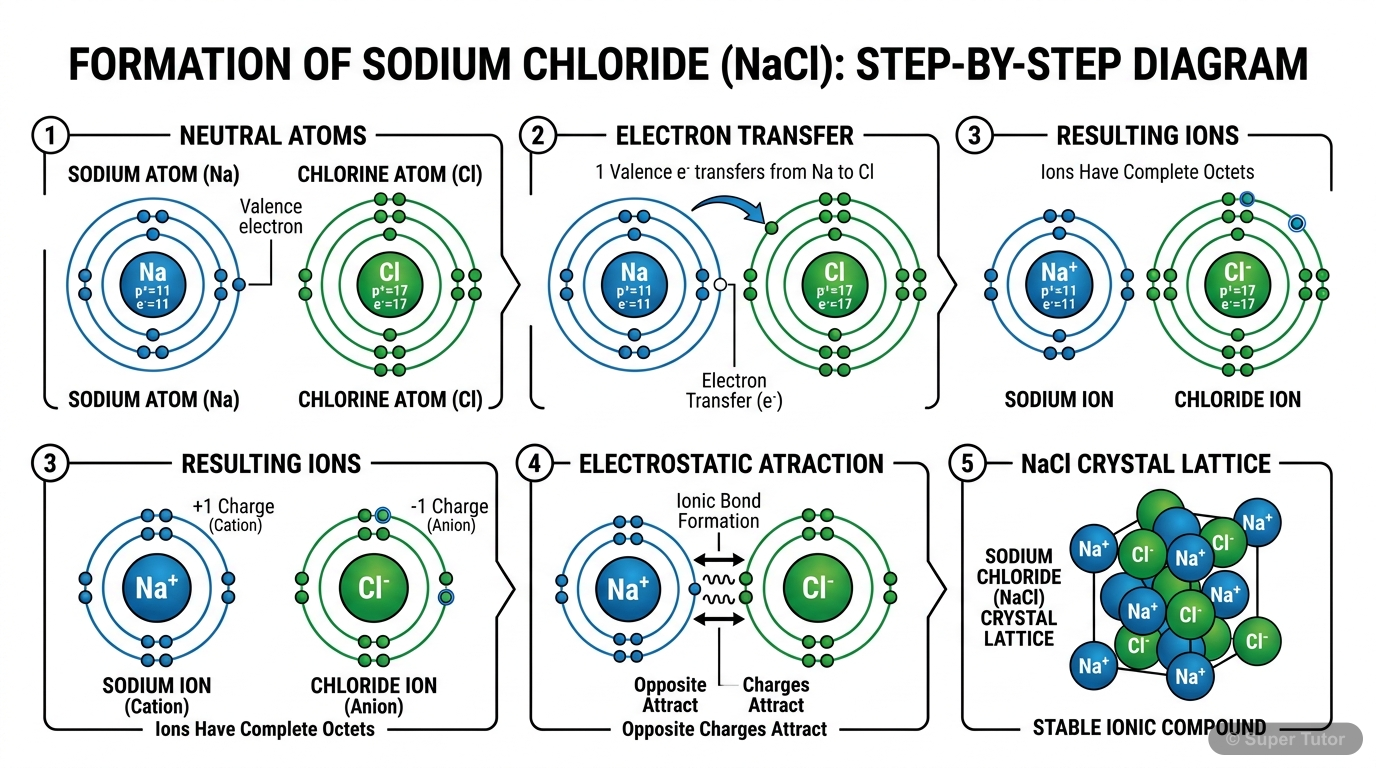
One of 13 illustrations for Chemical Bonding in Super Tutor — alongside flashcards, concept maps and practice questions.
Key Topics to Revise
1. Why atoms combine
- Noble gases are non-reactive because they have stable electronic configurations.
- Except helium, noble gases have 8 electrons in the outermost shell.
- Helium is the exception with 2 electrons in the outermost shell.
2. Ionic bonding and ionic compounds
- Ionic bonding is formed by transfer of electron from a metal to a non-metal.
- The positively charged ion formed is called a cation.
- The negatively charged ion formed is called an anion.
3. Properties of ionic compounds
- Ionic compounds are crystalline, hard, and brittle solids.
- They have high melting and boiling points because strong electrostatic forces must be overcome.
- Sodium chloride has melting point 1074 K (801°C) and boiling point 1686 K (1413°C).
4. Covalent bonding and covalent compounds
- Covalent bonding is formed by sharing of electrons between atoms.
- A covalent bond forms when attraction and repulsion balance and potential energy is minimum.
- Hydrogen molecule forms by sharing one electron pair.
Get complete notes with diagrams and examples
Full NotesKey Concepts
Frequently Asked Questions
What are the important topics in Chemical Bonding for NIOS Class 10 Science & Tech?
How should I revise Chemical Bonding for the NIOS Class 10 board exam?
Sources & Official References
Content is aligned to the official syllabus. Refer to the board website for the latest curriculum.
More resources for Chemical Bonding
Practice Quiz
Test yourself with a quick quiz
Important Questions
Exam-style questions with answers
Formula Sheet
The chapter's formulas in one place
Chapter Summary
Understand the chapter at a glance
Concept Maps
See how topics connect
Study Plan
Step-by-step plan for this chapter
Flashcards
Quick-fire cards for active recall
Syllabus
What topics to cover
For serious students
Get the full Chemical Bonding chapter — start free.
Quizzes, flashcards, an AI doubt solver and a study plan for NIOS Class 10 Science & Tech. Free to start, no card needed.