Chemical Bonding — Flashcards
NIOS · Class 10 · Science & Tech
37 flashcards for Chemical Bonding (NIOS Class 10 Science & Tech) to test yourself on key terms and facts. Sample: "Why do atoms combine to form chemical.
Interactive on Super Tutor
Studying Chemical Bonding? Get the full interactive chapter.
Quizzes, flashcards, AI doubt-solver and a step-by-step study plan — built for flashcards and more.
Free trial, no card needed.
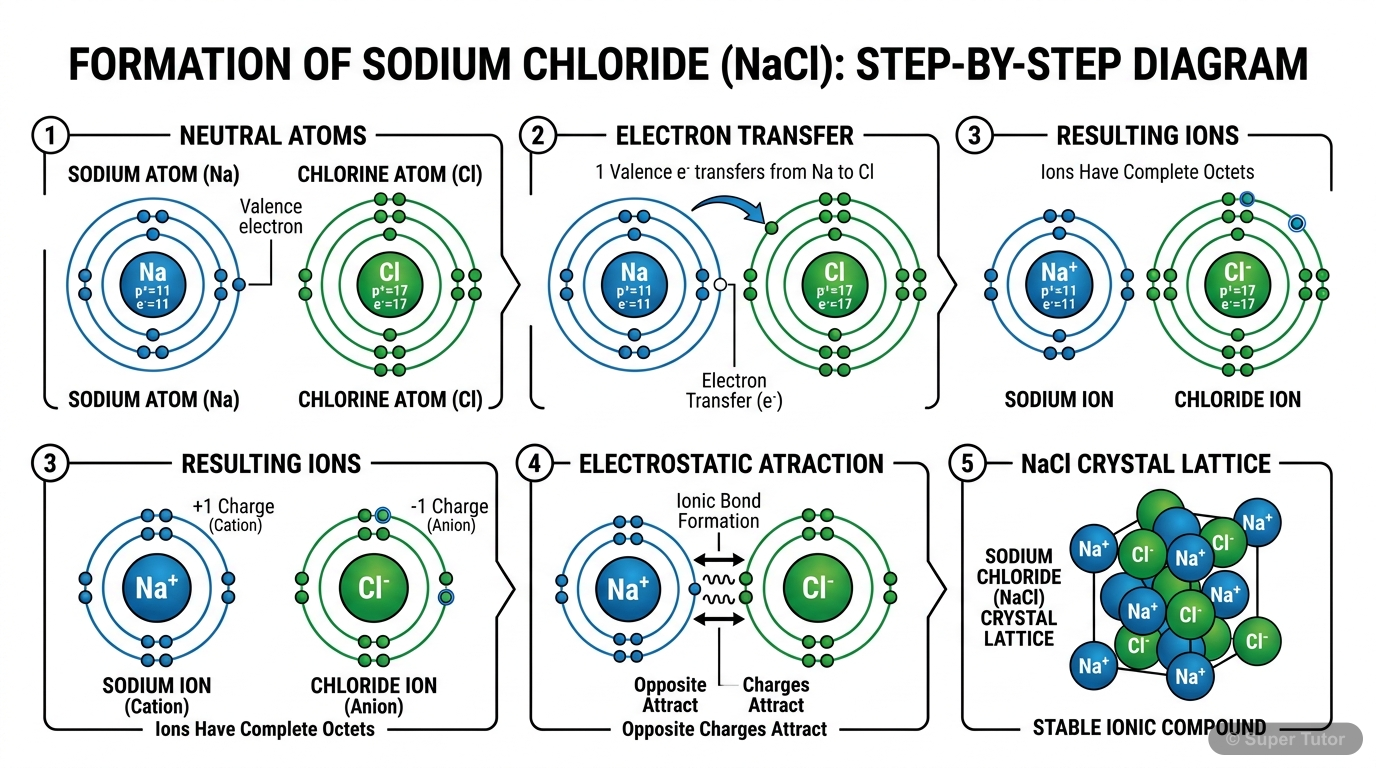
One of 13 illustrations for Chemical Bonding in Super Tutor — alongside flashcards, concept maps and practice questions.
Why do atoms combine to form chemical bonds?
Answer
Atoms combine to attain a stable noble gas configuration. Most atoms try to complete 8 electrons in the outermost shell, called the octet rule. Helium is the exception because it is stable with 2 elec…
What is the octet rule?
Answer
The octet rule states that atoms tend to attain 8 electrons in their outermost shell to become stable. This is the basic reason behind many chemical bonds.
Why are noble gases non-reactive?
Answer
Noble gases are non-reactive because they already have a stable electronic configuration. Except helium, all noble gases have 8 electrons in the outermost shell.
How is sodium atom different from sodium ion?
Answer
Sodium atom has electronic configuration 2,8,1. When it loses one electron, it becomes sodium ion Na+ with 11 protons and 10 electrons. This gives it a stable outer shell.
What is a cation?
Answer
A cation is a positively charged ion. Sodium ion Na+ is a cation because sodium loses one electron and becomes positively charged.
What is an anion?
Answer
An anion is a negatively charged ion. Chloride ion Cl- is an anion because chlorine gains one electron and becomes negatively charged.
How is ionic bond formed?
Answer
An ionic bond is formed by transfer of electron from a metal to a non-metal. The positive and negative ions are then held together by electrostatic force of attraction.
Write the overall reaction for the formation of sodium chloride.
Answer
2Na(s) + Cl2(g) → 2NaCl(s). Sodium and chlorine react to form sodium chloride.
+29 more flashcards
Practise AllFrequently Asked Questions
What are the important topics in Chemical Bonding for NIOS Class 10 Science & Tech?
How many flashcards are available for Chemical Bonding?
How should I revise Chemical Bonding for the NIOS Class 10 board exam?
Sources & Official References
Content is aligned to the official syllabus. Refer to the board website for the latest curriculum.
More resources for Chemical Bonding
Practice Quiz
Test yourself with a quick quiz
Important Questions
Exam-style questions with answers
Revision Notes
Key points for last-minute revision
Formula Sheet
The chapter's formulas in one place
Chapter Summary
Understand the chapter at a glance
Concept Maps
See how topics connect
Study Plan
Step-by-step plan for this chapter
Syllabus
What topics to cover
For serious students
Get the full Chemical Bonding chapter — start free.
Quizzes, flashcards, an AI doubt solver and a study plan for NIOS Class 10 Science & Tech. Free to start, no card needed.