Indian National Movement — Concept Maps
NIOS · Class 10 · Social Studies
4 concept maps of Indian National Movement for NIOS Class 10 Social Studies, each also written out as a text outline.
Interactive on Super Tutor
Studying Indian National Movement? Get the full interactive chapter.
Quizzes, flashcards, AI doubt-solver and a step-by-step study plan — built for concept maps and more.
Free trial, no card needed.
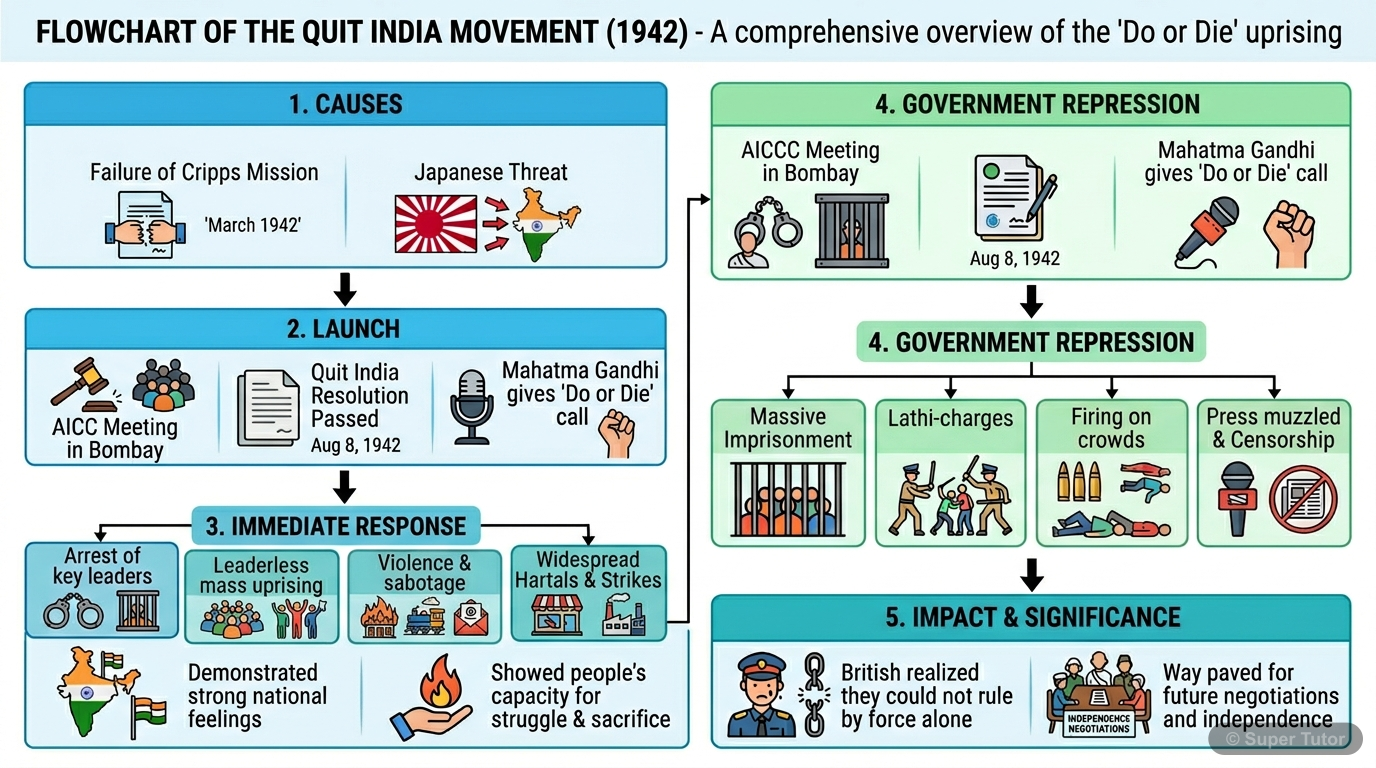
One of 14 illustrations for Indian National Movement in Super Tutor — alongside flashcards, concept maps and practice questions.
Key Events in Indian National Movement
The map in words
- 1885
- Formation of Indian National Congress
- 1905
- Partition of Bengal and Swadeshi Movement
- 1906
- Formation of Muslim League
- 1919
- Jallianwala Bagh Massacre
- 1920
- Non-Cooperation Movement begins
- 1930
- Dandi March and Civil Disobedience
- 1942
- Quit India Movement launched
- 1947
- Independence and Partition
Indian National Movement - Complete Overview
The map in words
- Indian National Movement
- Origins
- Renaissance Impact
- Anti Colonial Sentiment
- Social Reform Movements
- Economic Exploitation
- Early Phase 1885-1905
- Congress Formation
- Moderate Leaders
- Constitutional Methods
- Limited Success
- Radical Phase 1905-1918
- Bengal Partition
- Swadeshi Movement
- Lal Bal Pal
- Muslim League Formation
- Gandhi Era 1915-1947
- Satyagraha
- Non Cooperation
- Civil Disobedience
- Quit India
- Revolutionary Movement
- Armed Struggle
- Bhagat Singh
- HSRA
- Youth Inspiration
- Final Phase 1935-1947
- Act of 1935
- World War Impact
- INA Movement
- Partition Independence
- Origins
Major Milestones in Indian National Movement
The map in words
- 1857
- Revolt of 1857
- First War of Independence
- 1885
- Formation of INC
- Moderate Phase begins
- 1905
- Bengal Partition
- Swadeshi Movement
- 1906
- Muslim League formed
- Extremist Phase
- 1915
- Gandhi returns to India
- Satyagraha begins
- 1920
- Non-Cooperation Movement
- Mass participation starts
- 1930
- Dandi March
- Civil Disobedience
- 1942
- Quit India Movement
- Do or Die call
- 1947
- Independence and Partition
- End of British Rule
The Indian National Movement was the long struggle for freedom from British rule, shaped by nationalism, Congress politics, mass movements, revolutionaries, communal politics, and the final transfer of power in 1947.
The map in words
- The Indian National Movement was the long struggle for freedom from British rule, shaped by nationalism, Congress politics, mass movements, revolutionaries, communal politics, and the final transfer of power in 1947.
- Rise of Nationalism
- Indian National Congress
- Moderates
- British repression and Partition of Bengal
- Radical Nationalists
- Muslim League and communal politics
- Constitutional reforms
- First World War phase
Explore these maps interactively
Explore DiagramsFrequently Asked Questions
What are the important topics in Indian National Movement for NIOS Class 10 Social Studies?
What do the concept maps for Indian National Movement show?
How should I revise Indian National Movement for the NIOS Class 10 board exam?
Sources & Official References
Content is aligned to the official syllabus. Refer to the board website for the latest curriculum.
More resources for Indian National Movement
Practice Quiz
Test yourself with a quick quiz
Important Questions
Exam-style questions with answers
Revision Notes
Key points for last-minute revision
Chapter Summary
Understand the chapter at a glance
Study Plan
Step-by-step plan for this chapter
Flashcards
Quick-fire cards for active recall
Syllabus
What topics to cover
For serious students
Get the full Indian National Movement chapter — start free.
Quizzes, flashcards, an AI doubt solver and a study plan for NIOS Class 10 Social Studies. Free to start, no card needed.