Indian National Movement — Chapter Summary
NIOS · Class 10 · Social Studies
Summary of Indian National Movement for NIOS Class 10 Social Studies. Part of the NIOS Class 10 Social Studies syllabus.
Interactive on Super Tutor
Studying Indian National Movement? Get the full interactive chapter.
Quizzes, flashcards, AI doubt-solver and a step-by-step study plan — built for chapter summary and more.
Free trial, no card needed.
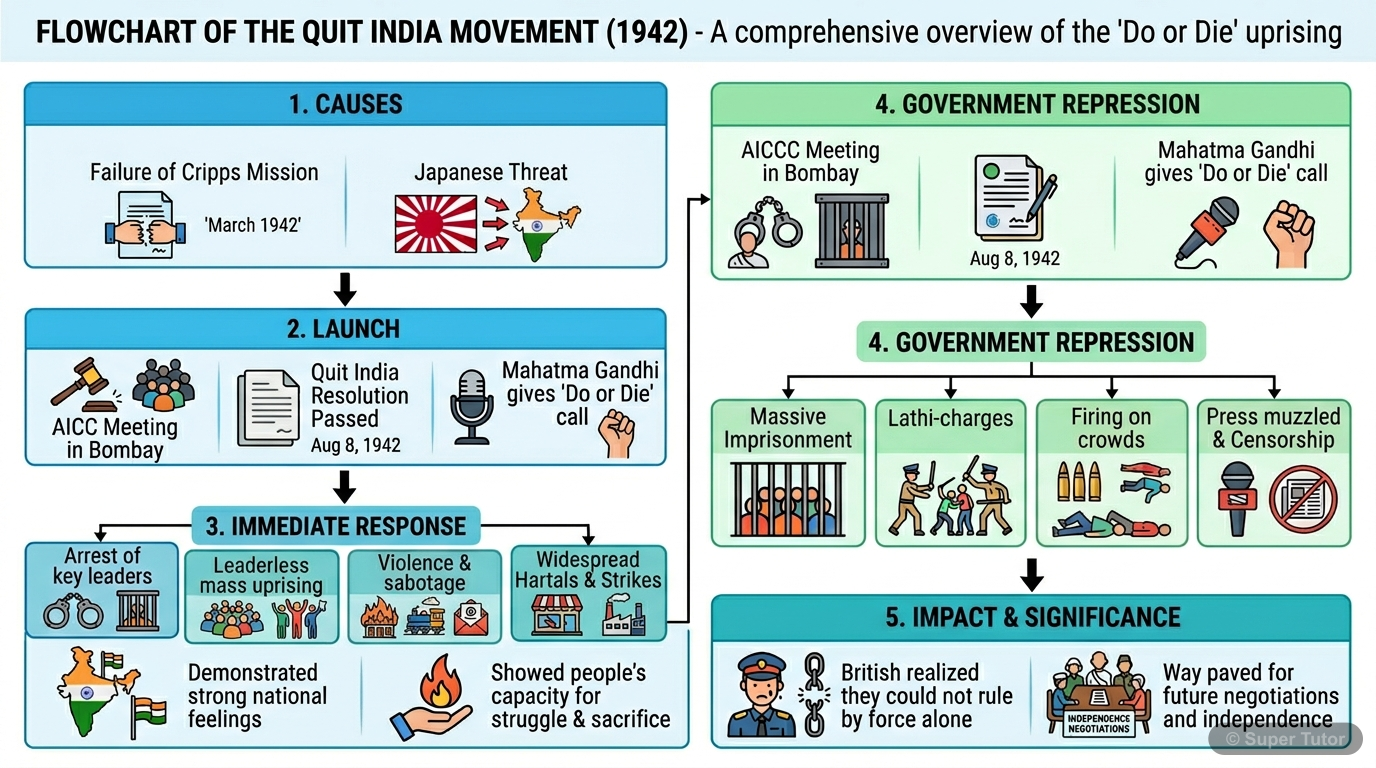
One of 14 illustrations for Indian National Movement in Super Tutor — alongside flashcards, concept maps and practice questions.
Overview
The Indian National Movement was the long struggle against British rule that grew from early political awareness to mass participation and finally to independence in 1947. It passed through many stages: the rise of nationalism, the founding of the Indian National Congress, the Moderate and Radical p
Key Concepts
Nationalism in India grew in
Nationalism in India grew in the 19th century because people were affected by colonial rule, political and administrative unity under the British, eco
The Indian National Congress was founded
The Indian National Congress was founded in 1885 by Allan Octavian Hume with support from Lord Dufferin. Womesh Chandra Banerjee became its first Pres
The early Congress leaders were called
The early Congress leaders were called Moderates because they believed in petitions, lawful methods, and constitutional reforms. Their main demands in
The Radical Nationalists
The Radical Nationalists, also called Garam Dal, included leaders like Bal Gangadhar Tilak, Lala Lajpat Rai, and Bipin Chandra Pal. They supported boy
Lord Curzon announced the Partition
Lord Curzon announced the Partition of Bengal in 1905. Indians saw it as a divide and rule move, so they responded with protest, Swadeshi, boycott, na
Learning Objectives
- Understand the causes behind the rise of nationalism in India.
- Trace the founding and growth of the Indian National Congress.
- Distinguish between Moderates and Radicals in the freedom struggle.
- Explain the impact of the Partition of Bengal, Muslim League, and Morley-Minto Reforms.
- Describe Gandhi's role in major movements like Non-Cooperation, Civil Disobedience, and Quit India.
Frequently Asked Questions
What are the important topics in Indian National Movement for NIOS Class 10 Social Studies?
How should I revise Indian National Movement for the NIOS Class 10 board exam?
Sources & Official References
Content is aligned to the official syllabus. Refer to the board website for the latest curriculum.
More resources for Indian National Movement
For serious students
Get the full Indian National Movement chapter — start free.
Quizzes, flashcards, an AI doubt solver and a study plan for NIOS Class 10 Social Studies. Free to start, no card needed.