Challenges To Indian Democracy — Revision Notes
NIOS · Class 10 · Social Studies
Challenges To Indian Democracy revision notes for NIOS Class 10 Social Studies: 4 topics in quick points. Includes Meaning and Forms of Democracy.
Interactive on Super Tutor
Studying Challenges To Indian Democracy? Get the full interactive chapter.
Quizzes, flashcards, AI doubt-solver and a step-by-step study plan — built for revision notes and more.
Free trial, no card needed.
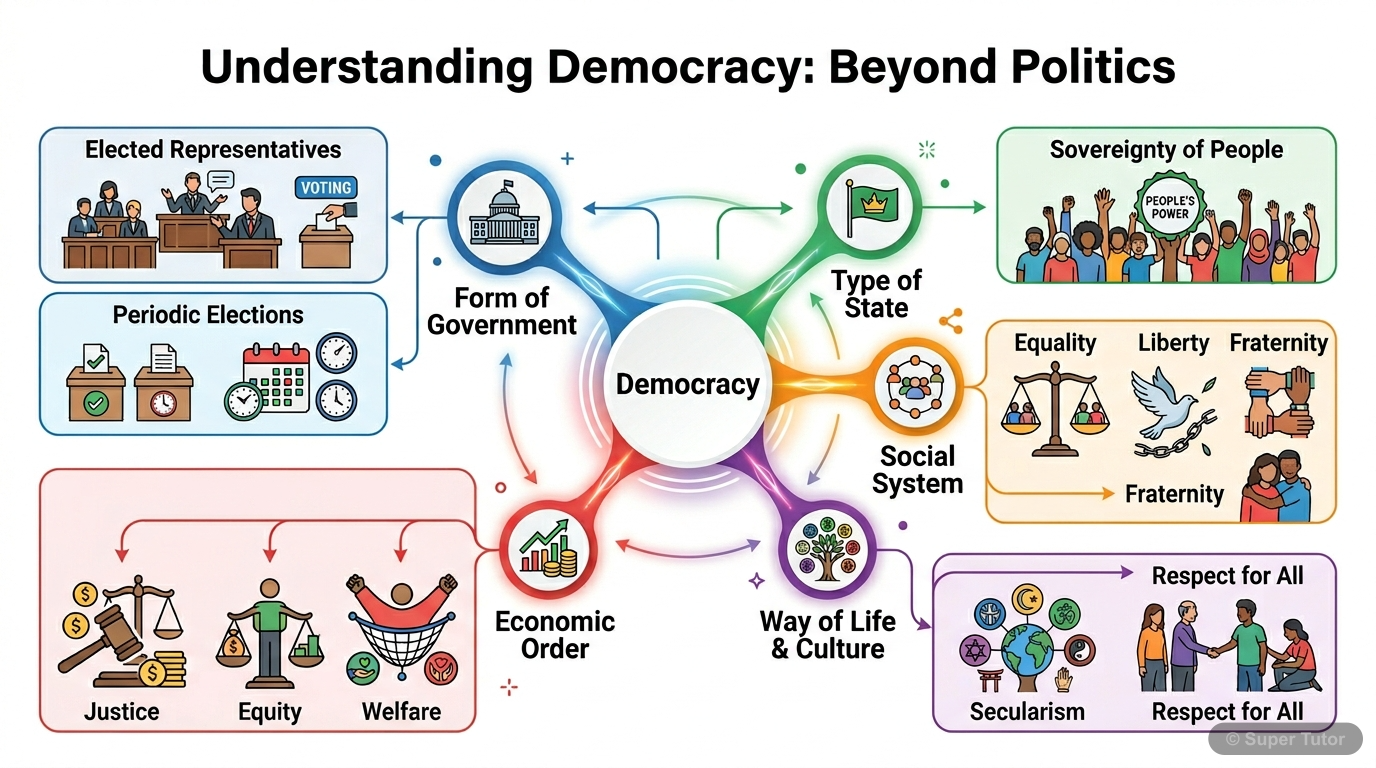
One of 8 illustrations for Challenges To Indian Democracy in Super Tutor — alongside flashcards, concept maps and practice questions.
Key Topics to Revise
1. Meaning and Forms of Democracy
- Democracy means government of the people, for the people, and by the people.
- The word democracy comes from the Greek word demokratia, formed from demos meaning people and Kratos meaning power.
- Abraham Lincoln defined democracy as a government of the people, for the people, and by the people.
2. Essential Conditions of Democracy
- A genuine democracy must satisfy both political and socio-economic conditions.
- Political conditions include a Constitution that vests supreme power in the people.
- Fundamental rights and human rights must be protected.
3. Major Challenges to Indian Democracy
- The major challenges are illiteracy, poverty, gender discrimination, casteism, communalism, religious fundamentalism, regionalism, corruption, criminalization of politics, and political violence.
- These challenges weaken equality, justice, participation, and stability in democracy.
- Many of these problems are linked with social inequality and lack of development.
4. Illiteracy and Poverty
- Illiteracy was a serious challenge at independence and remains a challenge.
- The literacy rate in India in 1951 was 18.33 per cent and female literacy was 8.9 per cent.
- According to the 2011 Census, the overall literacy rate rose to 74.04 per cent and female literacy rate was 65.46 per cent.
Get complete notes with diagrams and examples
Full NotesKey Concepts
Frequently Asked Questions
What are the important topics in Challenges To Indian Democracy for NIOS Class 10 Social Studies?
How should I revise Challenges To Indian Democracy for the NIOS Class 10 board exam?
Sources & Official References
Content is aligned to the official syllabus. Refer to the board website for the latest curriculum.
More resources for Challenges To Indian Democracy
For serious students
Get the full Challenges To Indian Democracy chapter — start free.
Quizzes, flashcards, an AI doubt solver and a study plan for NIOS Class 10 Social Studies. Free to start, no card needed.