Challenges To Indian Democracy — Practice Quiz
NIOS · Class 10 · Social Studies
Try a 4-question quiz on Challenges To Indian Democracy for NIOS Class 10 Social Studies: tap an answer to check it and see why.
Interactive on Super Tutor
Studying Challenges To Indian Democracy? Get the full interactive chapter.
Quizzes, flashcards, AI doubt-solver and a step-by-step study plan — built for practice quiz and more.
Free trial, no card needed.
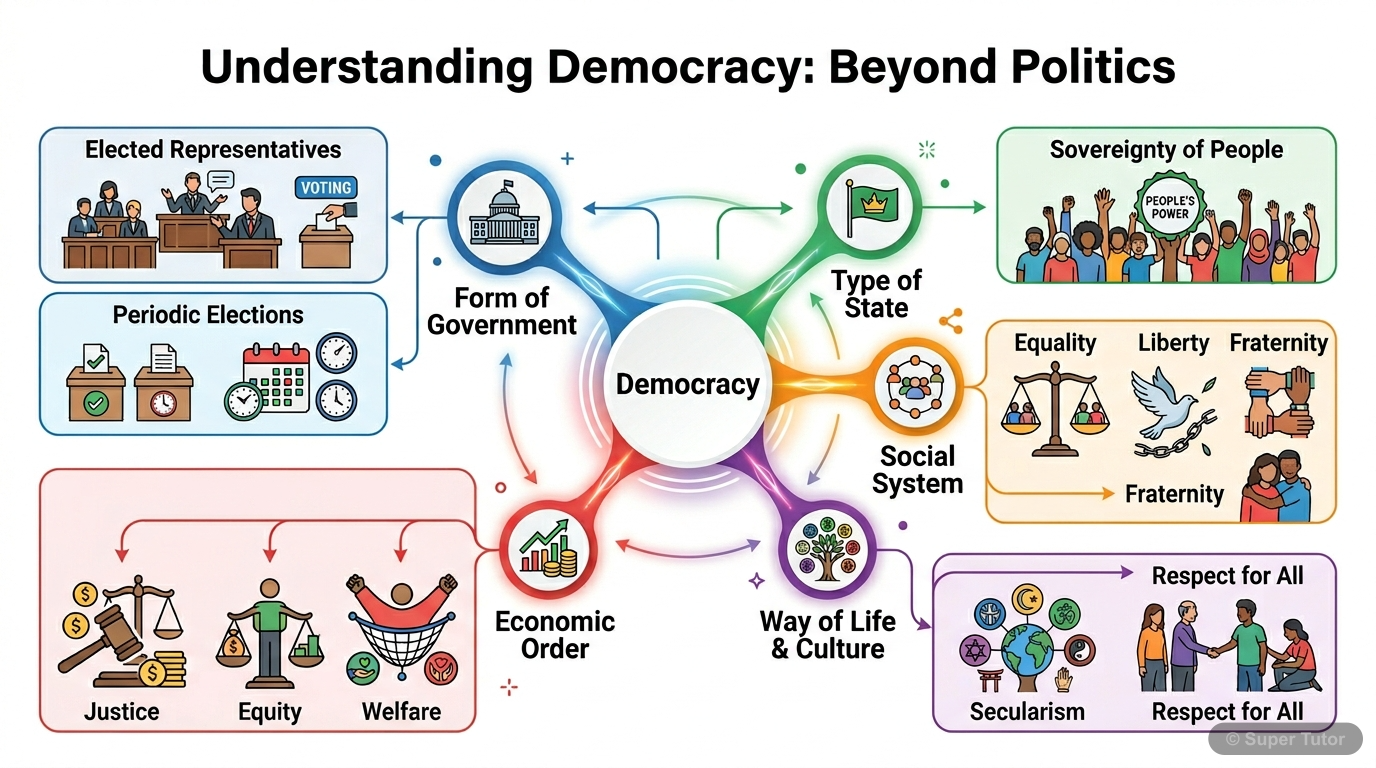
One of 8 illustrations for Challenges To Indian Democracy in Super Tutor — alongside flashcards, concept maps and practice questions.
Quick Quiz: Challenges To Indian Democracy
0/4Tap an answer to check it instantly. No sign-up needed for these 4.
What does the term 'democracy' literally mean?
According to the 2011 Census, what is the literacy rate in India?
What is the poverty line?
Which Constitutional Amendments provided reservation for women in Panchayati Raj Institutions?
Sample Questions
What does RTI stand for?
Show answer
Right to Information
RTI stands for 'Right to Information'. The Right to Information Act, 2005 is a significant legislation that empowers citizens to seek information from government authorities, making the government more transparent and accountable. This act enables citizens to ask questions about government decisions, expenditure, and functioning, thereby strengthening democracy. The other options - Right to Income, Right to Independence, and Right to Instruction - are not what RTI represents and are not specific legislative acts in the Indian context.
According to the text, what is the child sex ratio in India as per 2011 Census?
Show answer
914 females per 1000 males
According to the 2011 Census, the child sex ratio (0-6 years) in India is 914 female children per 1000 male children. This is a matter of grave concern as it shows a decline from the 2001 Census figure of 927 females per 1000 males. This declining trend indicates gender discrimination through practices like female infanticide and foeticide. The figure 940 represents the overall sex ratio, 927 was the 2001 child sex ratio, and 877 is specifically for Haryana state, which has one of the worst sex ratios in the country.
Which program guarantees 100 days of wage employment to rural households?
Show answer
MNREGA
MNREGA (Mahatma Gandhi National Rural Employment Guarantee Act) guarantees 100 days of wage-employment in a financial year to rural households whose adult members volunteer to do unskilled manual work. This program aims to enhance livelihood security in rural areas and is a significant poverty alleviation measure. SGSY (Swarnajayanti Gram Swarozgar Yojana) focuses on self-help groups and micro-enterprises, JGSY (Jawahar Gram Samridhi Yojana) creates rural economic infrastructure, and EAS (Employment Assurance Scheme) covers specific drought-prone and tribal areas, but none of these guarantee 1
What does sustainable development aim to achieve?
Show answer
Meeting present needs without compromising future generations
Sustainable development, as defined by the Brundtland Commission (1987), is development that 'meets the needs of the present without compromising the ability of future generations to meet their own needs'. It aims for balanced economic, social, and environmental development that can be sustained over time. This concept is crucial for Indian democracy as it ensures that development benefits all sections of society while preserving resources for future generations. The other options are incorrect as they represent only partial aspects - sustainable development integrates economic growth, environ
+76 more questions on Challenges To Indian Democracy (NIOS Class 10 Social Studies)
Practise AllFrequently Asked Questions
What are the important topics in Challenges To Indian Democracy for NIOS Class 10 Social Studies?
How many practice questions are there for Challenges To Indian Democracy?
Sources & Official References
Content is aligned to the official syllabus. Refer to the board website for the latest curriculum.
More resources for Challenges To Indian Democracy
Important Questions
Exam-style questions with answers
Revision Notes
Key points for last-minute revision
Chapter Summary
Understand the chapter at a glance
Concept Maps
See how topics connect
Study Plan
Step-by-step plan for this chapter
Flashcards
Quick-fire cards for active recall
Syllabus
What topics to cover
For serious students
Get the full Challenges To Indian Democracy chapter — start free.
Quizzes, flashcards, an AI doubt solver and a study plan for NIOS Class 10 Social Studies. Free to start, no card needed.