Governance At The State Level — Revision Notes
NIOS · Class 10 · Social Studies
Governance At The State Level revision notes for NIOS Class 10 Social Studies: 4 topics in quick points. Part of the NIOS Class 10 Social Studies syllabus.
Interactive on Super Tutor
Studying Governance At The State Level? Get the full interactive chapter.
Quizzes, flashcards, AI doubt-solver and a step-by-step study plan — built for revision notes and more.
Free trial, no card needed.
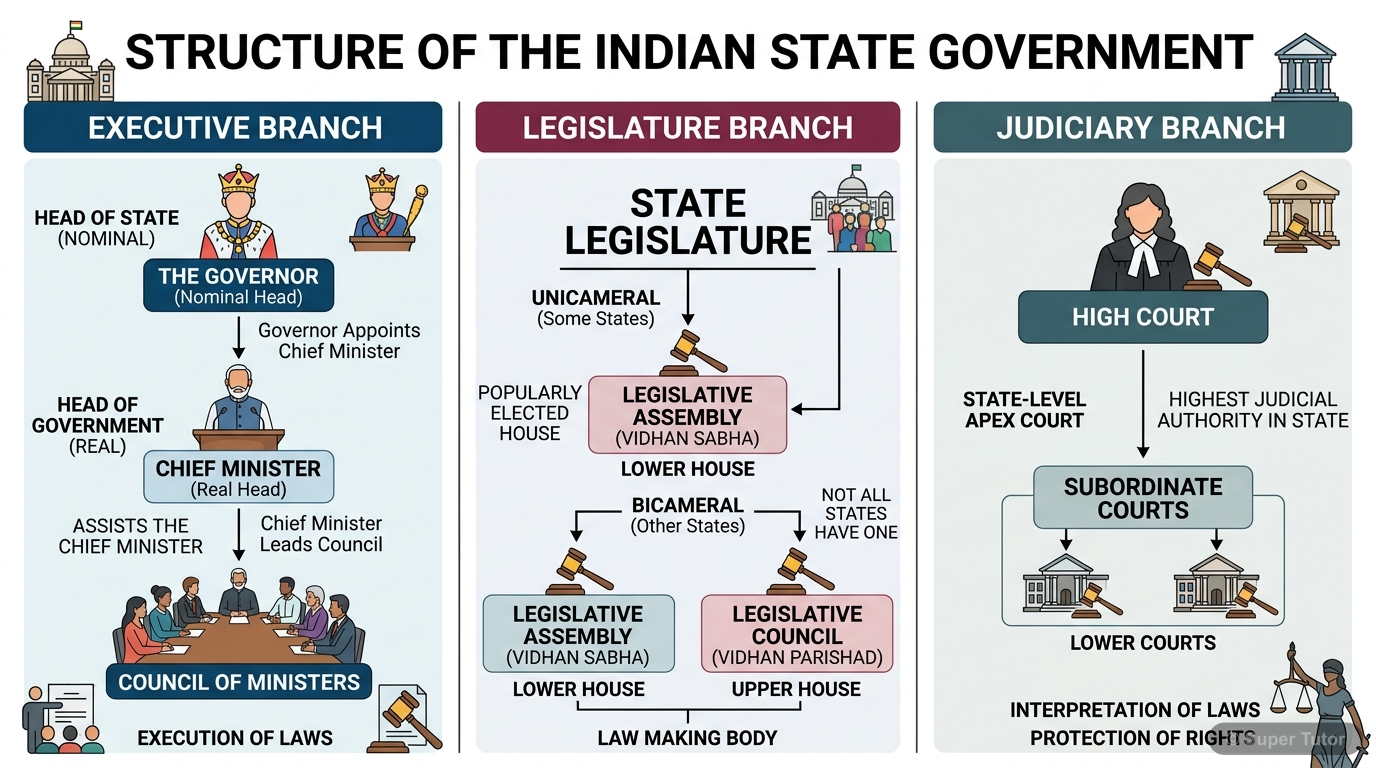
Learn better with visuals Super Tutor pairs illustrations like this with notes and quizzes for Governance At The State Level.
Key Topics to Revise
1. Governor: Position, Appointment, Powers
- The Governor is the nominal head of the State and the executive power of the State is vested in the Governor.
- The Governor is appointed by the President of India.
- To be appointed Governor, a person must be a citizen of India, at least 35 years old, and must not hold any office of profit during tenure.
2. Chief Minister and Council of Ministers
- The Chief Minister is the real executive head of the State.
- The Council of Ministers is headed by the Chief Minister and exercises the real executive power of the State.
- The Chief Minister and other ministers are appointed by the Governor.
3. State Legislature: Structure and Functions
- Every State has a Legislature.
- Some States have a bicameral legislature with two houses: the Legislative Assembly and the Legislative Council.
- Most States have a unicameral legislature with only the Legislative Assembly.
4. High Court and Subordinate Courts
- There has to be a High Court for every State.
- A High Court may have more than one State under its jurisdiction.
- Guwahati High Court acts as a common High Court for Assam, Meghalaya, Arunachal Pradesh, Nagaland, Mizoram, Manipur and Tripura.
Get complete notes with diagrams and examples
Full NotesKey Concepts
Frequently Asked Questions
What are the important topics in Governance At The State Level for NIOS Class 10 Social Studies?
How should I revise Governance At The State Level for the NIOS Class 10 board exam?
Sources & Official References
Content is aligned to the official syllabus. Refer to the board website for the latest curriculum.
More resources for Governance At The State Level
For serious students
Get the full Governance At The State Level chapter — start free.
Quizzes, flashcards, an AI doubt solver and a study plan for NIOS Class 10 Social Studies. Free to start, no card needed.