Chapter 11 of 26
Revision Notes
Agriculture In India — Revision Notes
NIOS · Class 10 · Social Studies
Agriculture In India revision notes for NIOS Class 10 Social Studies: 4 topics in quick points. Part of the NIOS Class 10 Social Studies syllabus.
85 questions48 flashcards5 concepts
Interactive on Super Tutor
Studying Agriculture In India? Get the full interactive chapter.
Quizzes, flashcards, AI doubt-solver and a step-by-step study plan — built for revision notes and more.
Free trial, no card needed.
Super Tutor
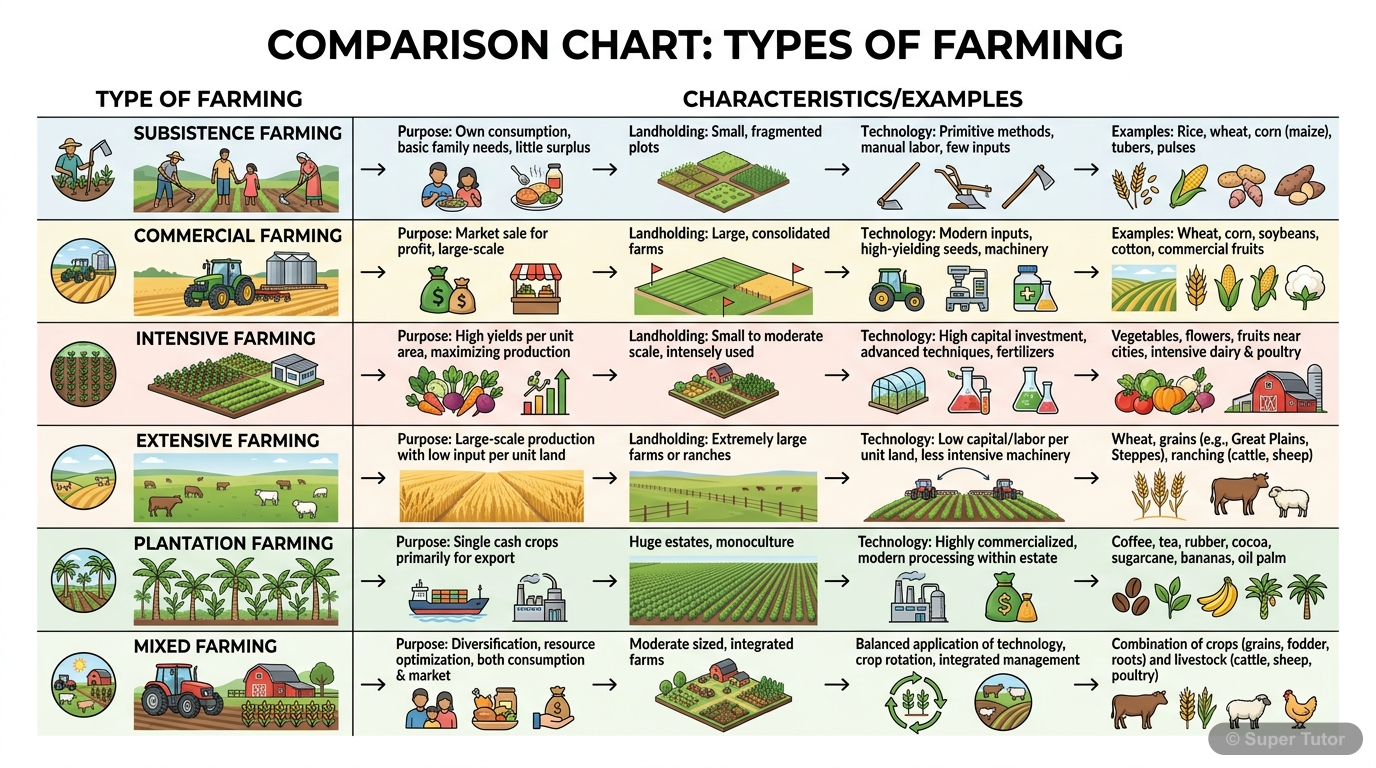
Learn better with visuals Super Tutor pairs illustrations like this with notes and quizzes for Agriculture In India.
Key Topics to Revise
1
1. Types of Farming in India
- Subsistence farming means farming for family use. Most of the produce is consumed by the farmer and little or nothing is sold.
- Commercial farming means farming for sale in the market. It uses better inputs such as irrigation, fertilizers, pesticides, and HYV seeds.
- Rice farming in Haryana is mainly commercial because people there are mainly wheat eaters.
2
2. Salient Features of Indian Agriculture
- About 70% of India's population depends on agriculture directly or indirectly.
- Only about one third of the total cropped area is irrigated.
- Indian agriculture is still largely subsistence-based.
3
3. Major Food Crops
- Major food crops are rice, wheat, maize, millets, and pulses.
- Rice is the most important food crop of India.
- Rice is predominantly a kharif or summer crop.
4
4. Cash Crops, Plantation Crops, and Oilseeds
- Cash crops are grown for sale in raw or semi-processed form.
- Cotton, jute, sugarcane, tobacco, and oilseeds are cash crops.
- Sugarcane is a kharif cash crop and belongs to the bamboo family.
Get complete notes with diagrams and examples
Full NotesKey Concepts
Subsistence farming is done mainlyExtensive farming uses a large areaPlantation farming is an artificialThe Green Revolution was a majorThe White Revolution means a remarkable
Frequently Asked Questions
What are the important topics in Agriculture In India for NIOS Class 10 Social Studies?
Key topics in Agriculture In India include Types of Farming in India, Salient Features of Indian Agriculture, Major Food Crops, Cash Crops, Plantation Crops, and Oilseeds. Study these first, then practise questions on each for the NIOS Class 10 board exam.
How should I revise Agriculture In India for the NIOS Class 10 board exam?
Learn the core ideas first, then work through the 85 practice questions on Agriculture In India. Revise definitions regularly and use flashcards for quick recall before the exam.
Sources & Official References
Content is aligned to the official syllabus. Refer to the board website for the latest curriculum.
More resources for Agriculture In India
For serious students
Get the full Agriculture In India chapter — start free.
Quizzes, flashcards, an AI doubt solver and a study plan for NIOS Class 10 Social Studies. Free to start, no card needed.