Governance At The Union Level — Revision Notes
NIOS · Class 10 · Social Studies
Governance At The Union Level revision notes for NIOS Class 10 Social Studies: 4 topics in quick points. Part of the NIOS Class 10 Social Studies syllabus.
Interactive on Super Tutor
Studying Governance At The Union Level? Get the full interactive chapter.
Quizzes, flashcards, AI doubt-solver and a step-by-step study plan — built for revision notes and more.
Free trial, no card needed.
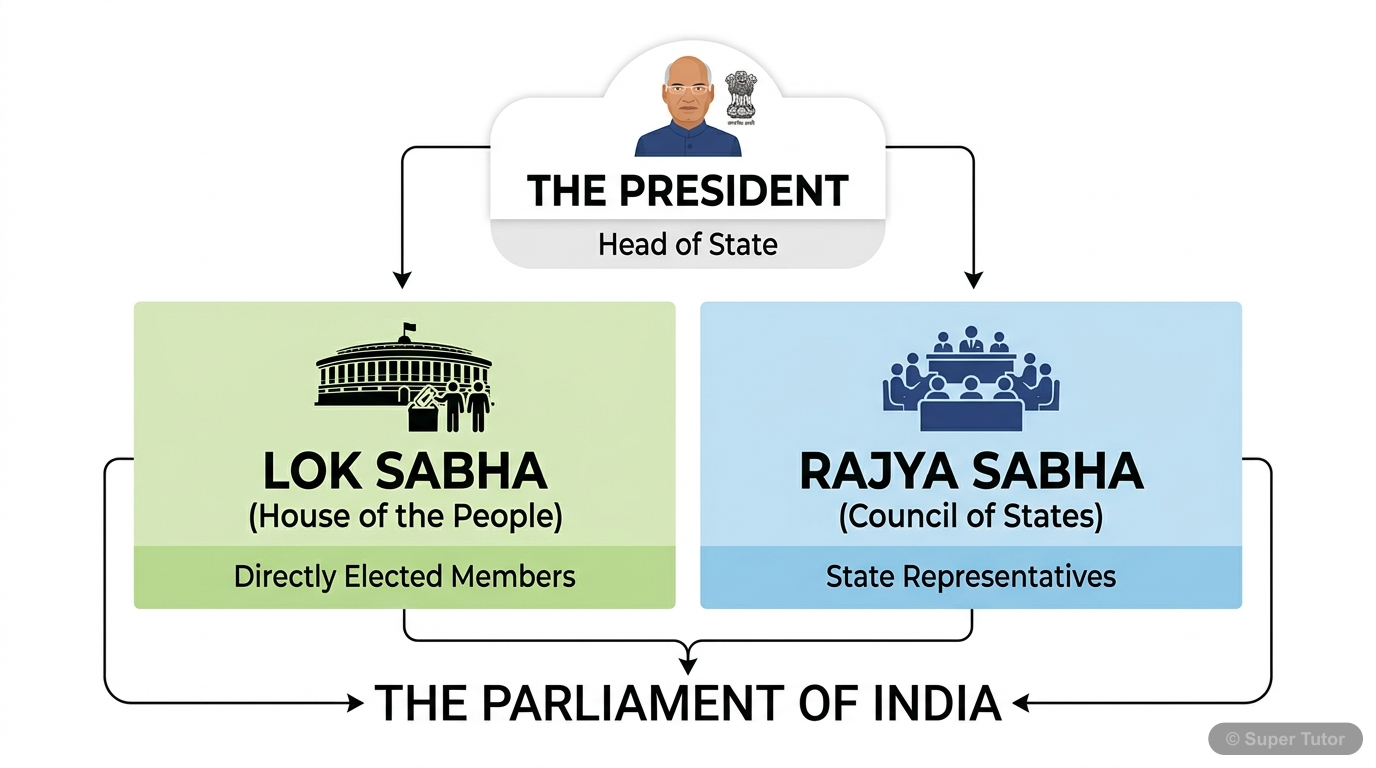
Learn better with visuals Super Tutor pairs illustrations like this with notes and quizzes for Governance At The Union Level.
Key Topics to Revise
1. The President of India
- The President is the Head of State and the nominal or constitutional executive.
- The President is elected indirectly by an Electoral College through secret ballot by proportional representation using the single transferable vote.
- The Electoral College consists of elected members of both Houses of Parliament and the State Legislative Assemblies; elected members of the Legislative Assemblies of Delhi and Puducherry also particip
2. Vice President and Prime Minister
- The Vice President acts as President during a vacancy for a maximum of six months.
- The Vice President is the ex-officio Chairman of Rajya Sabha and is not a member of Rajya Sabha.
- The Vice President is elected by an electoral college consisting of members of both Houses of Parliament by proportional representation and single transferable vote.
3. Union Council of Ministers
- The Council of Ministers consists of Cabinet Ministers, Ministers of State, and Deputy Ministers.
- It is headed by the Prime Minister.
- It aids and advises the President, and its advice is binding.
4. Parliament: Lok Sabha and Rajya Sabha
- Parliament consists of the President, Lok Sabha, and Rajya Sabha.
- Lok Sabha is the House of the People and the lower house.
- Lok Sabha is directly elected by the people.
Get complete notes with diagrams and examples
Full NotesKey Concepts
Frequently Asked Questions
What are the important topics in Governance At The Union Level for NIOS Class 10 Social Studies?
How should I revise Governance At The Union Level for the NIOS Class 10 board exam?
Sources & Official References
Content is aligned to the official syllabus. Refer to the board website for the latest curriculum.
More resources for Governance At The Union Level
For serious students
Get the full Governance At The Union Level chapter — start free.
Quizzes, flashcards, an AI doubt solver and a study plan for NIOS Class 10 Social Studies. Free to start, no card needed.