Governance At The State Level — Important Questions
NIOS · Class 10 · Social Studies
77 important questions from Governance At The State Level for NIOS Class 10 Social Studies, with answers. Written for the board exams 2027.
Interactive on Super Tutor
Studying Governance At The State Level? Get the full interactive chapter.
Quizzes, flashcards, AI doubt-solver and a step-by-step study plan — built for important questions and more.
Free trial, no card needed.
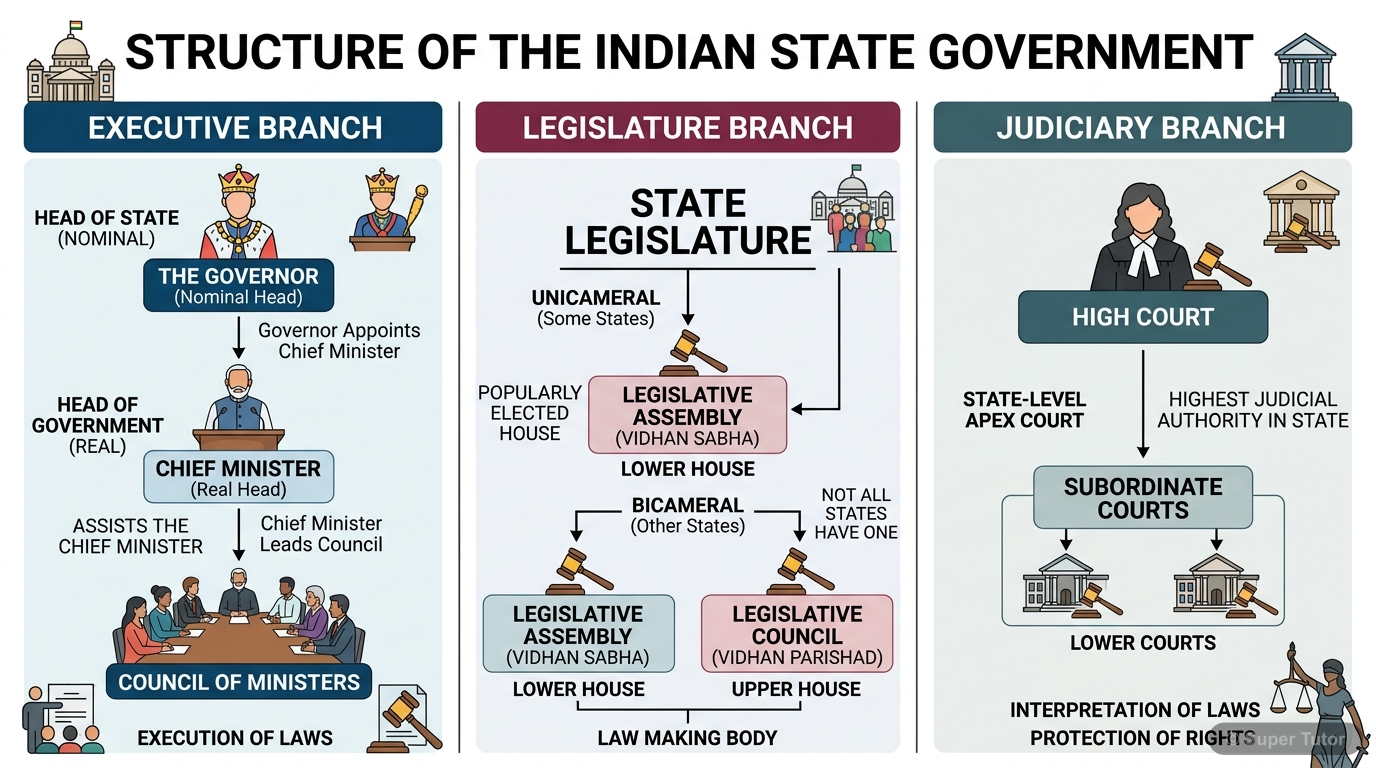
Learn better with visuals Super Tutor pairs illustrations like this with notes and quizzes for Governance At The State Level.
Important Questions from Governance At The State Level
Which house of the state legislature is directly elected by the people?
Show answer
Legislative Assembly
Step 1: The Legislative Assembly (Vidhan Sabha) is directly elected by the people through universal adult franchise. Step 2: Members of Legislative Assembly (MLAs) are elected directly by voters in their constituencies. Step 3: The Legislative Council members are elected indirectly through various electoral colleges or nominated. Step 4: This direct election makes Legislative Assembly more representative of people's will. Step 5: Only Legislative Assembly exists in most states, making it the primary democratic institution at state level.
What is the maximum strength of a State Legislative Assembly?
Show answer
500 members
Step 1: According to the Constitution, a State Legislative Assembly cannot have more than 500 members. Step 2: The minimum strength is 60 members, though some small states have been allowed less. Step 3: This range ensures adequate representation while maintaining functional efficiency. Step 4: The actual number varies by state based on population and constitutional provisions. Step 5: These limits prevent assemblies from becoming too large to function effectively while ensuring sufficient representation.
Who appoints the Chief Justice of a High Court?
Show answer
President of India
Step 1: The President of India appoints the Chief Justice of High Courts as per constitutional provisions. Step 2: The President consults the Chief Justice of Supreme Court before making this appointment. Step 3: This ensures judicial independence by keeping appointments away from state government influence. Step 4: The Governor of the state is also consulted but has no appointing power. Step 5: This system maintains the federal structure while ensuring judicial independence from state politics.
At what age do High Court judges retire?
Show answer
65 years
Step 1: High Court judges retire at the age of 65 years as prescribed by the Constitution. Step 2: This is different from Supreme Court judges who retire at 65 years (same age). Step 3: The retirement age ensures experienced judges while allowing for regular renewal. Step 4: This age limit is higher than most government servants to utilize judicial expertise. Step 5: After retirement, they cannot practice in the same High Court to maintain dignity and avoid conflicts.
+73 more questions on Governance At The State Level (NIOS Class 10 Social Studies)
Practise AllFrequently Asked Questions
What are the important topics in Governance At The State Level for NIOS Class 10 Social Studies?
How many important questions are there in Governance At The State Level?
Sources & Official References
Content is aligned to the official syllabus. Refer to the board website for the latest curriculum.
More resources for Governance At The State Level
For serious students
Get the full Governance At The State Level chapter — start free.
Quizzes, flashcards, an AI doubt solver and a study plan for NIOS Class 10 Social Studies. Free to start, no card needed.