Governance At The Union Level — Important Questions
NIOS · Class 10 · Social Studies
73 important questions from Governance At The Union Level for NIOS Class 10 Social Studies, with answers. Written for the board exams 2027.
Interactive on Super Tutor
Studying Governance At The Union Level? Get the full interactive chapter.
Quizzes, flashcards, AI doubt-solver and a step-by-step study plan — built for important questions and more.
Free trial, no card needed.
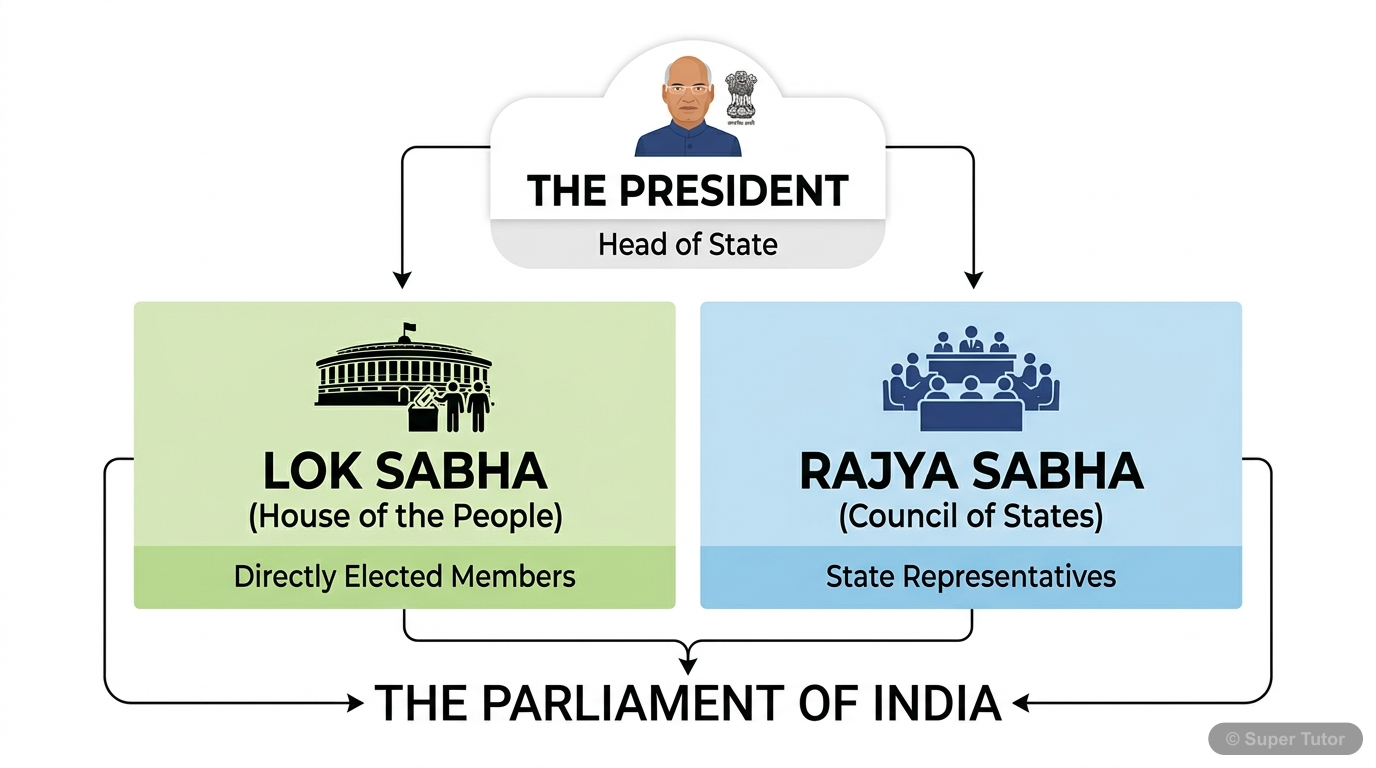
Learn better with visuals Super Tutor pairs illustrations like this with notes and quizzes for Governance At The Union Level.
Important Questions from Governance At The Union Level
What is the tenure of Rajya Sabha members?
Show answer
6 years
Members of Rajya Sabha serve for a term of 6 years. However, unlike Lok Sabha which dissolves completely every 5 years, Rajya Sabha is a permanent body with a unique system where one-third of its members retire every 2 years. This ensures continuity in the upper house while allowing for regular renewal. Retiring members can be re-elected, and this staggered retirement system maintains the institutional memory and stability of the Rajya Sabha.
Who presides over the joint sessions of Parliament?
Show answer
Speaker of Lok Sabha
The Speaker of Lok Sabha presides over joint sessions of Parliament. Joint sessions are called by the President to resolve deadlocks between the two houses on ordinary bills (not money bills). Since Lok Sabha is the directly elected house representing the people and has more members, its Speaker is given the authority to preside over such sessions. This gives Lok Sabha an advantage in joint sessions as the Speaker maintains order and decides voting procedures, and Lok Sabha's larger membership (550 vs 250 maximum) usually ensures passage of bills.
What is the retirement age for Supreme Court judges?
Show answer
65 years
Supreme Court judges retire at the age of 65 years. This retirement age ensures that judges serve with experience and wisdom while also providing opportunities for new judicial talent. The mandatory retirement age helps maintain the independence of judiciary by ensuring judges don't have to worry about reappointment. Judges can only be removed before this age through impeachment for proven misbehavior or incapacity, which requires a special majority in both houses of Parliament.
Which type of emergency has never been declared in India?
Show answer
Financial Emergency
Financial Emergency has never been declared in India. This type of emergency can be proclaimed when the financial stability or credit of India is threatened. While National Emergency has been declared multiple times (1962, 1965, 1971, 1975) and President's Rule has been imposed in various states many times, the financial emergency provision has never been used. This shows that despite various economic challenges, India's financial stability has never reached a crisis point requiring such drastic constitutional measures.
+69 more questions on Governance At The Union Level (NIOS Class 10 Social Studies)
Practise AllFrequently Asked Questions
What are the important topics in Governance At The Union Level for NIOS Class 10 Social Studies?
How many important questions are there in Governance At The Union Level?
Sources & Official References
Content is aligned to the official syllabus. Refer to the board website for the latest curriculum.
More resources for Governance At The Union Level
For serious students
Get the full Governance At The Union Level chapter — start free.
Quizzes, flashcards, an AI doubt solver and a study plan for NIOS Class 10 Social Studies. Free to start, no card needed.