Modern World-II — Practice Quiz
NIOS · Class 10 · Social Studies
Try a 4-question quiz on Modern World-II for NIOS Class 10 Social Studies: tap an answer to check it and see why. 84 questions in the full chapter test.
Interactive on Super Tutor
Studying Modern World-II? Get the full interactive chapter.
Quizzes, flashcards, AI doubt-solver and a step-by-step study plan — built for practice quiz and more.
Free trial, no card needed.
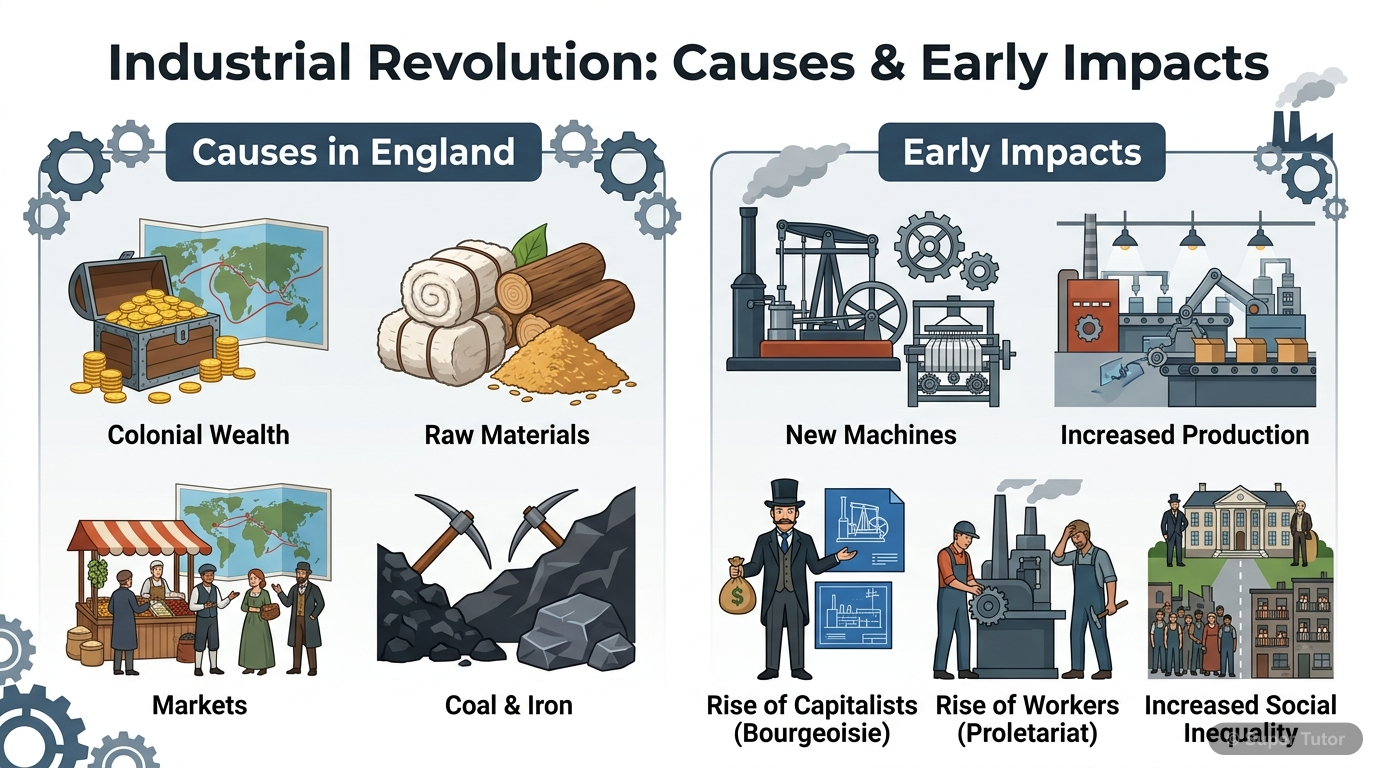
Learn better with visuals Super Tutor pairs illustrations like this with notes and quizzes for Modern World-II.
Quick Quiz: Modern World-II
0/4Tap an answer to check it instantly. No sign-up needed for these 4.
Which invention by James Watt in 1769 was crucial for the Industrial Revolution?
Which country was the first to experience the Industrial Revolution?
What does the term 'Imperialism' mean?
Which continent was known as the 'Dark Continent' before European exploration?
Sample Questions
The immediate cause of World War I was:
Show answer
Assassination of Archduke Francis Ferdinand
The immediate cause of World War I was the assassination of Archduke Francis Ferdinand, the heir to the Austrian throne, on June 28, 1914, in Sarajevo by a Serbian youth. This event triggered a chain reaction: Austria blamed Serbia and declared war, Russia supported Serbia, Germany declared war on Russia, and Britain entered when Germany invaded Belgium. The sinking of Lusitania occurred during World War I in 1915 and brought the US closer to joining the war. Military alliances and other factors were underlying causes, but the assassination was the immediate spark that lit the fire of war.
Which treaty ended World War I for Germany?
Show answer
Treaty of Versailles
The Treaty of Versailles signed in 1919 ended World War I for Germany. This treaty was extremely harsh on Germany - it held Germany responsible for the war, imposed heavy reparations, returned Alsace-Lorraine to France, demilitarized the Rhineland, restricted German army to 100,000 soldiers, and took away all German colonies. The Treaty of St. Germain was signed with Austria, the Treaty of Sevres with Turkey, and there was no Treaty of Paris after World War I. The harsh terms of Versailles created resentment in Germany and contributed to the rise of Hitler and World War II.
Who led the Fascist movement in Italy?
Show answer
Benito Mussolini
Benito Mussolini led the Fascist movement in Italy and came to power in 1922 with the support of the Italian King. He ruled as a dictator from 1925 to 1943, banning all political parties and establishing a totalitarian state. The term 'Fascism' comes from the Latin word 'fasces' meaning symbols of authority in Ancient Rome. Adolf Hitler led the Nazi movement in Germany, Francisco Franco was the fascist leader in Spain, and Joseph Stalin was the communist leader of Soviet Union. Mussolini's fascist ideology inspired similar movements across Europe.
When was the United Nations Organisation (UNO) formed?
Show answer
1945
The United Nations Organisation (UNO) was formed on October 24, 1945, at a conference in San Francisco where the UN Charter was adopted by 50 nations. This date is now celebrated as UN Day every year worldwide. The UNO was established after World War II ended to maintain international peace and security, prevent future wars, solve disputes peacefully, and promote international cooperation. The organization was formed from the lessons learned from the failure of the League of Nations and the horrors of two world wars.
+80 more questions on Modern World-II (NIOS Class 10 Social Studies)
Practise AllFrequently Asked Questions
What are the important topics in Modern World-II for NIOS Class 10 Social Studies?
How many practice questions are there for Modern World-II?
Sources & Official References
Content is aligned to the official syllabus. Refer to the board website for the latest curriculum.
More resources for Modern World-II
Important Questions
Exam-style questions with answers
Revision Notes
Key points for last-minute revision
Chapter Summary
Understand the chapter at a glance
Concept Maps
See how topics connect
Study Plan
Step-by-step plan for this chapter
Flashcards
Quick-fire cards for active recall
Syllabus
What topics to cover
For serious students
Get the full Modern World-II chapter — start free.
Quizzes, flashcards, an AI doubt solver and a study plan for NIOS Class 10 Social Studies. Free to start, no card needed.