Modern World-II — Syllabus
NIOS · Class 10 · Social Studies
What Modern World-II covers in NIOS Class 10 Social Studies: 4 topics, for the 2026-27 session. Part of the NIOS Class 10 Social Studies syllabus.
Interactive on Super Tutor
Studying Modern World-II? Get the full interactive chapter.
Quizzes, flashcards, AI doubt-solver and a step-by-step study plan — built for syllabus and more.
Free trial, no card needed.
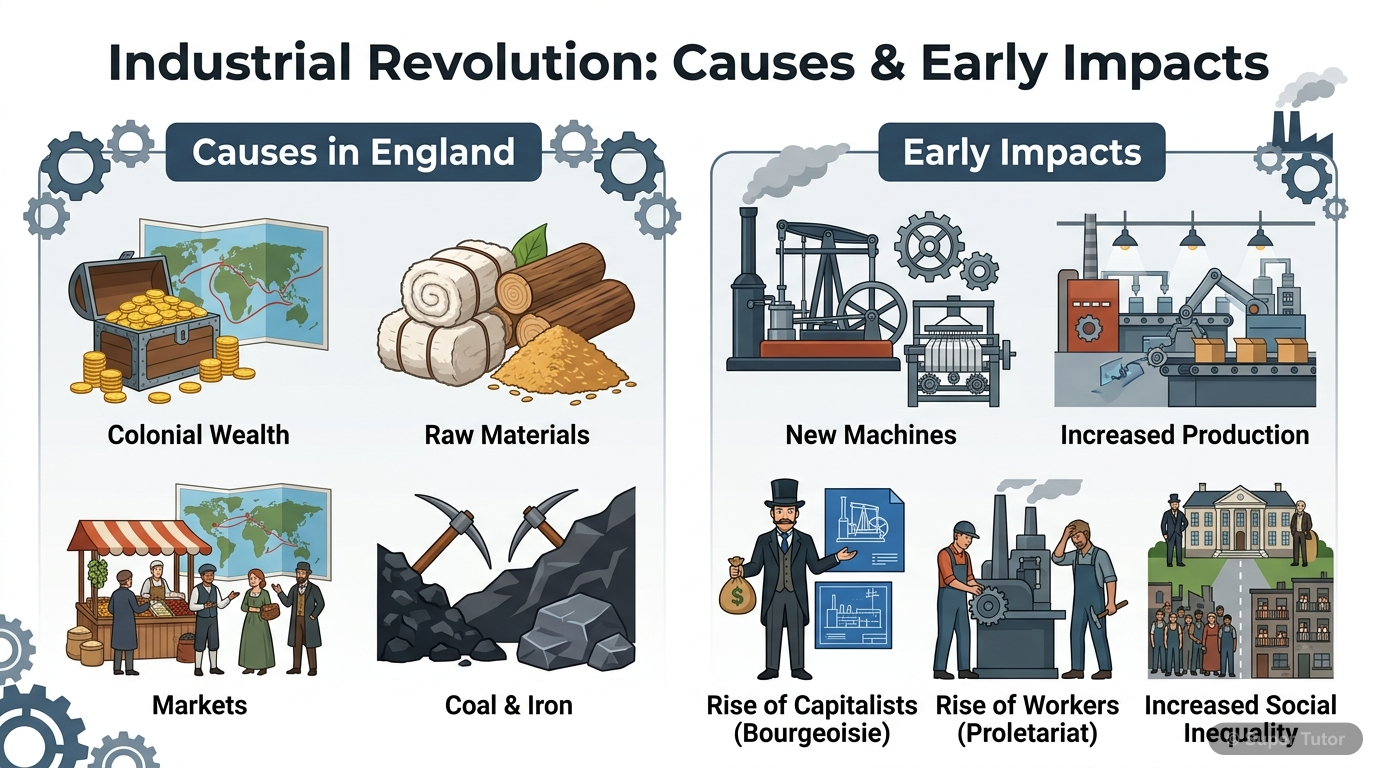
Learn better with visuals Super Tutor pairs illustrations like this with notes and quizzes for Modern World-II.
Topics in Modern World-II
1. Industrial Revolution
- The Industrial Revolution refers to the period in British history from 1750 to 1850.
- It changed society from an agricultural and commercial system to a modern industrial system.
- The factory system developed when rich merchants set up factories, installed machinery, brought raw materials, and employed workers on fixed wages.
2. Imperialism and Colonialism
- Imperialism means extending control or rule over the political and economic life of another country.
- Colonialism means acquiring colonies and making them dependent by conquest or other means.
- Industrial countries needed raw materials, markets, and places for investment of capital.
3. World War I and the League of Nations
- World War I began in Europe in 1914 and soon became a world war.
- The main causes were imperial rivalry, military alliances, nationalism, and Balkan tensions.
- Austria annexed Bosnia and Herzegovina in 1908, which increased hostility with Serbia.
4. Fascism, Nazism, World War II, and the United Nations
- The period between the two World Wars saw dictatorship, economic crisis, and political unrest.
- Fascism is the dictatorship introduced in Italy by Mussolini.
- Mussolini came to power in 1922 with support of the Italian King and ruled as dictator from 1925 to 1943.
Key Concepts
Central concept: Modern World-II: Industrial Revolution, Imperialism, World Wars, and the United Nations
Work through every topic in Modern World-II with notes and quizzes
Start This ChapterFrequently Asked Questions
What are the important topics in Modern World-II for NIOS Class 10 Social Studies?
How should I revise Modern World-II for the NIOS Class 10 board exam?
Sources & Official References
Content is aligned to the official syllabus. Refer to the board website for the latest curriculum.
More resources for Modern World-II
Practice Quiz
Test yourself with a quick quiz
Important Questions
Exam-style questions with answers
Revision Notes
Key points for last-minute revision
Chapter Summary
Understand the chapter at a glance
Concept Maps
See how topics connect
Study Plan
Step-by-step plan for this chapter
Flashcards
Quick-fire cards for active recall
For serious students
Get the full Modern World-II chapter — start free.
Quizzes, flashcards, an AI doubt solver and a study plan for NIOS Class 10 Social Studies. Free to start, no card needed.