Absorption, Transport And Water Loss In Plants — Chapter Summary
NIOS · Class 12 · Biology
Summary of Absorption, Transport And Water Loss In Plants for NIOS Class 12 Biology. Part of the NIOS Class 12 Biology syllabus.
Interactive on Super Tutor
Studying Absorption, Transport And Water Loss In Plants? Get the full interactive chapter.
Quizzes, flashcards, AI doubt-solver and a step-by-step study plan — built for chapter summary and more.
Free trial, no card needed.
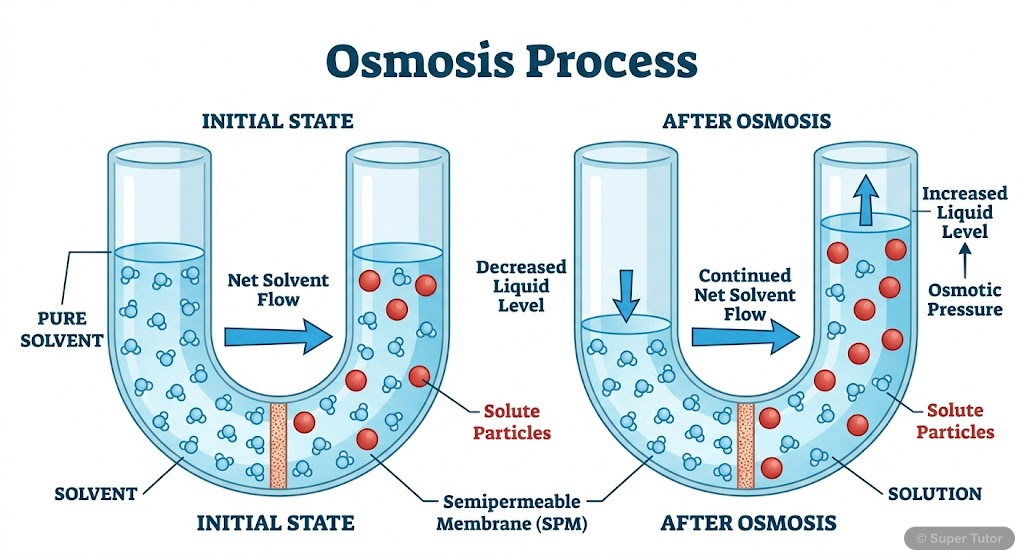
One of 2 illustrations for Absorption, Transport And Water Loss In Plants in Super Tutor — alongside flashcards, concept maps and practice questions.
Overview
Water is the most essential component of living cells and is fundamental to plant survival and growth. This chapter explores how plants absorb water through their roots, transport it to various parts of the plant body, and lose it through transpiration. Understanding these processes helps explain ho
Key Concepts
Permeability is the property of
Permeability is the property of a membrane to allow substances to pass through it. Plant cell walls are fully permeable, allowing both solvent and sol
Diffusion is the spontaneous intermingling
Diffusion is the spontaneous intermingling of molecules of the same or different substances as a result of their random movement, from regions of high
Osmosis is a special type
Osmosis is a special type of diffusion where water molecules move from a region of higher water concentration (lower solute concentration) to a region
Solutions are classified based on their
Solutions are classified based on their solute concentration relative to cell sap: (1) Isotonic solutions have equal solute concentration as the cell,
Plasmolysis occurs when a cell
Plasmolysis occurs when a cell is placed in a hypertonic solution - water leaves the cell, causing the protoplasm to shrink and detach from the cell w
Learning Objectives
- Define and differentiate between permeability, diffusion, osmosis, and plasmolysis
- Distinguish between active and passive water absorption
- Explain concepts of imbibition, water potential, turgor pressure, and wall pressure
- Describe the pathways of water movement from root hair to leaf
- Explain the mechanism of translocation of organic solutes in phloem
Frequently Asked Questions
What are the important topics in Absorption, Transport And Water Loss In Plants for NIOS Class 12 Biology?
How should I revise Absorption, Transport And Water Loss In Plants for the NIOS Class 12 board exam?
Sources & Official References
Content is aligned to the official syllabus. Refer to the board website for the latest curriculum.
More resources for Absorption, Transport And Water Loss In Plants
For serious students
Get the full Absorption, Transport And Water Loss In Plants chapter — start free.
Quizzes, flashcards, an AI doubt solver and a study plan for NIOS Class 12 Biology. Free to start, no card needed.