Absorption, Transport And Water Loss In Plants
NIOS · Class 12 · Biology
Most important questions from Absorption, Transport And Water Loss In Plants for NIOS Class 12 Biology board exam 2026. MCQs, short answer, and long answer questions with marks.
Interactive on Super Tutor
Studying Absorption, Transport And Water Loss In Plants? Get the full interactive chapter.
Quizzes, flashcards, AI doubt-solver and a step-by-step study plan — built for important questions and more.
1,000+ Class 12 students started this chapter today
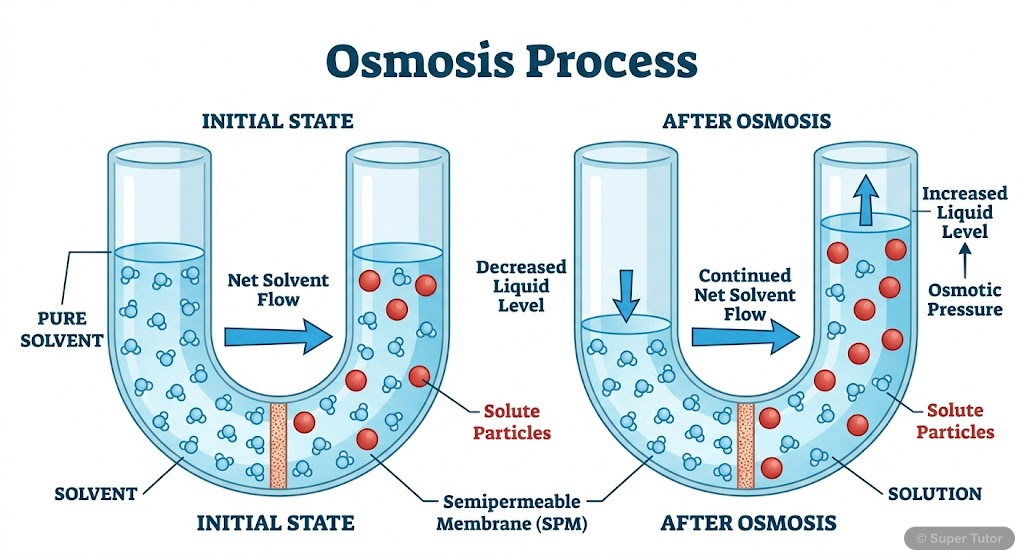
Super Tutor has 5+ illustrations like this for Absorption, Transport And Water Loss In Plants alone — flashcards, concept maps, and step-by-step visuals.
See them allSample Questions
What is the water potential of pure water?
Show answer
Zero
Step 1: Water potential (ψ) represents the tendency of water to move or do work. Step 2: Pure water has the highest possible water potential, which is taken as the reference point and assigned a value of zero (ψ = 0). Step 3: When solutes are dissolved in water, some water molecules are used up in dissolving, reducing the free energy of water. Step 4: Therefore, any solution (with dissolved solutes) has a water potential LESS than zero — a negative value. Step 5: The more concentrated the solution, the more negative its water potential. This is why water always moves from pure water (ψ = 0) in
The pressure exerted by the protoplasm against the cell wall in a turgid cell is called:
Show answer
Turgor pressure
Step 1: When water enters a plant cell by osmosis, the protoplasm expands and pushes against the cell wall. Step 2: The pressure exerted by the protoplasm (cell contents) against the cell wall is called turgor pressure (TP). Step 3: In response, the cell wall pushes back with an equal and opposite pressure called wall pressure (WP). Step 4: Osmotic pressure is the pressure needed to prevent osmotic entry of water. Root pressure is developed in roots due to osmotic absorption. Step 5: Turgor pressure is important for maintaining the shape of the plant and for stomatal opening.
Which type of soil water is most readily available and easily utilized by plant roots?
Show answer
Capillary water
Step 1: There are three main types of soil water — gravitational, hygroscopic, and capillary. Step 2: Gravitational water drains downward to the water table and is generally not available to plant roots. Step 3: Hygroscopic water is tightly held around soil particles by strong adhesive forces and is NOT available to plants — it remains in dry soils. Step 4: Capillary water is held in the fine pores between soil particles by capillary forces (surface tension) and is the most readily available water for plant roots. Step 5: The condition when soil holds good capillary water is called field capac
The two pathways through which water moves from the soil into the root and then upward are:
Show answer
Symplast and apoplast
Step 1: Water absorbed by root hairs moves inward through two main pathways. Step 2: The symplast pathway uses the plasmodesmata — protoplasmic connections between cells — through which water moves by osmosis. Step 3: The apoplast pathway uses the cell walls and intercellular spaces — water moves through this pathway by capillarity and adsorption. Step 4: Phloem and xylem are vascular tissues — xylem conducts water upward but these are not the entry pathways. Step 5: Cortex and endodermis are layers that water passes through, but they are not the names of the pathways themselves.
+40 more questions available
Practice AllFrequently Asked Questions
What are the important topics in Absorption, Transport And Water Loss In Plants for NIOS Class 12 Biology?
How to score full marks in Absorption, Transport And Water Loss In Plants — NIOS Class 12 Biology?
How many important questions are there in Absorption, Transport And Water Loss In Plants?
Sources & Official References
Content is aligned to the official syllabus. Refer to the board website for the latest curriculum.
More resources for Absorption, Transport And Water Loss In Plants
Practice Quiz
Test yourself with a quick quiz
Revision Notes
Key points for last-minute revision
Formula Sheet
All formulas in one place
Chapter Summary
Understand the chapter at a glance
Concept Maps
See how topics connect visually
Study Plan
Step-by-step plan to ace this chapter
Flashcards
Quick-fire cards for active recall
Syllabus
What topics to cover
NCERT Solutions
Every textbook question solved step by step
For serious students
Get the full Absorption, Transport And Water Loss In Plants chapter — for free.
Quizzes, flashcards, AI doubt-solver and a step-by-step study plan for NIOS Class 12 Biology.