Chapter 7 of 9
Revision Notes
Absorption, Transport And Water Loss In Plants — Revision Notes
NIOS · Class 12 · Biology
Absorption, Transport And Water Loss In Plants revision notes for NIOS Class 12 Biology: 4 topics in quick points.
44 questions25 flashcards5 concepts
Interactive on Super Tutor
Studying Absorption, Transport And Water Loss In Plants? Get the full interactive chapter.
Quizzes, flashcards, AI doubt-solver and a step-by-step study plan — built for revision notes and more.
Free trial, no card needed.
Super Tutor
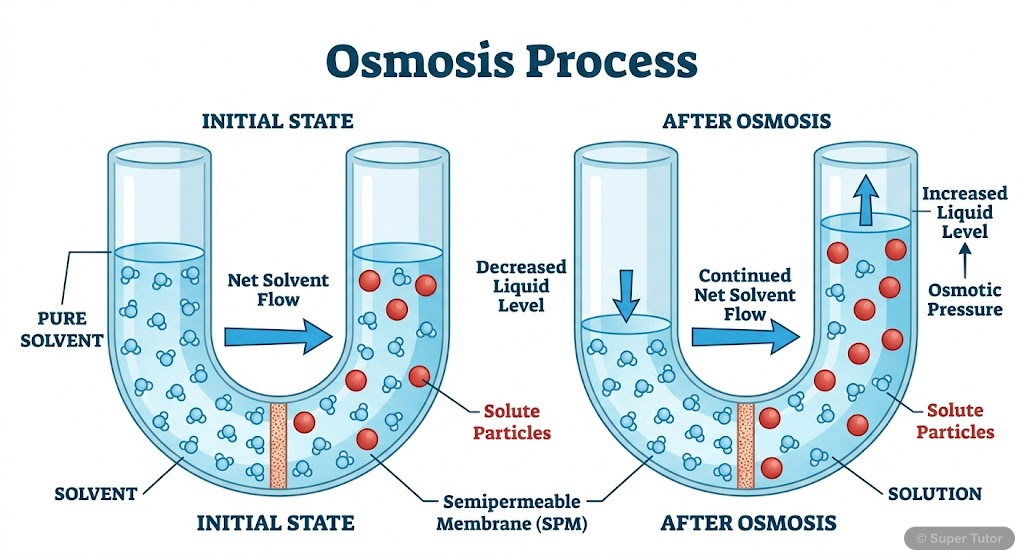
One of 2 illustrations for Absorption, Transport And Water Loss In Plants in Super Tutor — alongside flashcards, concept maps and practice questions.
Key Topics to Revise
1
8.1 Four Basic Phenomena - Permeability, Diffusion, Osmosis, and Plasmolysis
- Permeability is the property of a membrane to allow passage of substances. Plant cell walls are fully permeable; biological membranes are selectively permeable
- Diffusion is the random movement of molecules from high to low concentration, independent of membrane presence. Requires fully permeable membrane if one is present
- Osmosis is the movement of water molecules through a semipermeable membrane from high water concentration to low water concentration region
2
8.2 Water Potential and Related Concepts
- Water potential (ψ) is the energy or tendency of water molecules to do work or leave a system
- Pure water has the highest water potential set as zero (ψ = 0)
- Solutions have negative water potential values because dissolved solutes reduce available water molecules
3
8.3 Absorption of Water by Plants
- Water is primarily absorbed by root hairs (modified epidermal cells) from soil capillary water
- Root hairs increase surface area for water absorption
- Water can also be absorbed by leaves and stems in some cases
4
8.4 Translocation of Organic Solutes (Phloem Transport)
- Translocation is the movement of organic and inorganic solutes from one plant part to another
- Phloem is the tissue responsible for translocating sugars produced in photosynthesis
- Leaf is the source where food (sugars) is produced through photosynthesis
Get complete notes with diagrams and examples
Full NotesKey Concepts
Permeability is the property ofDiffusion is the spontaneous interminglingOsmosis is a special typeSolutions are classified based on theirPlasmolysis occurs when a cell
Frequently Asked Questions
What are the important topics in Absorption, Transport And Water Loss In Plants for NIOS Class 12 Biology?
Key topics in Absorption, Transport And Water Loss In Plants include 1 Four Basic Phenomena - Permeability, Diffusion, Osmosis, and Plasmolysis, 2 Water Potential and Related Concepts, 3 Absorption of Water by Plants, 4 Translocation of Organic Solutes (Phloem Transport). Study these first, then practise questions on each for the NIOS Class 12 board exam.
How should I revise Absorption, Transport And Water Loss In Plants for the NIOS Class 12 board exam?
Learn the core ideas first, then work through the 44 practice questions on Absorption, Transport And Water Loss In Plants. Revise definitions regularly and use flashcards for quick recall before the exam.
Sources & Official References
Content is aligned to the official syllabus. Refer to the board website for the latest curriculum.
More resources for Absorption, Transport And Water Loss In Plants
For serious students
Get the full Absorption, Transport And Water Loss In Plants chapter — start free.
Quizzes, flashcards, an AI doubt solver and a study plan for NIOS Class 12 Biology. Free to start, no card needed.