Absorption, Transport And Water Loss In Plants — Flashcards
NIOS · Class 12 · Biology
25 flashcards for Absorption, Transport And Water Loss In Plants (NIOS Class 12 Biology) to test yourself on key terms and facts.
Interactive on Super Tutor
Studying Absorption, Transport And Water Loss In Plants? Get the full interactive chapter.
Quizzes, flashcards, AI doubt-solver and a step-by-step study plan — built for flashcards and more.
Free trial, no card needed.
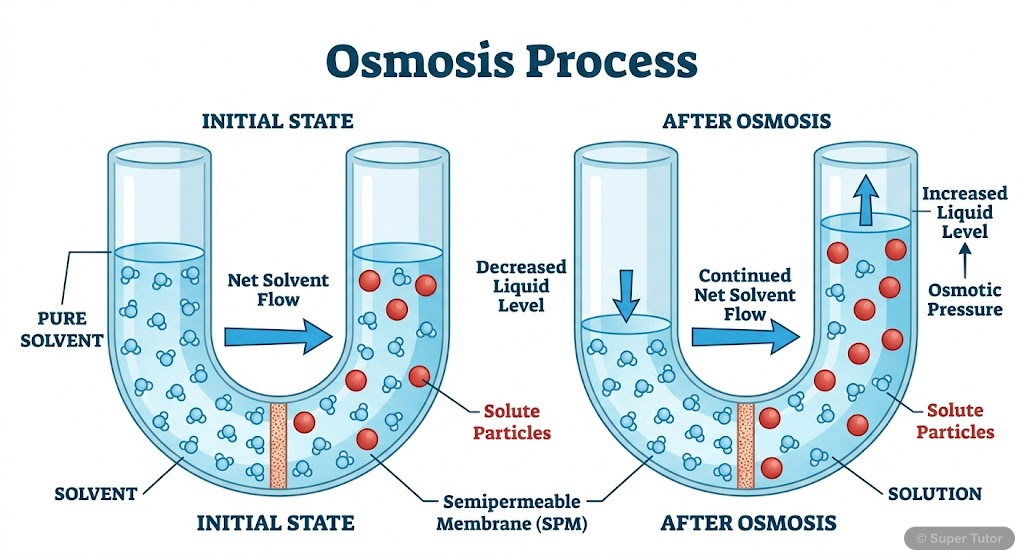
One of 2 illustrations for Absorption, Transport And Water Loss In Plants in Super Tutor — alongside flashcards, concept maps and practice questions.
What is permeability in the context of plant cell membranes?
Answer
Permeability is the property of a membrane to allow the passage of substances through it. Plant cell walls are fully permeable, allowing both solvent and solute molecules to pass through. In contrast,…
Define diffusion and explain why it does not require a membrane.
Answer
Diffusion is the intermingling of molecules of the same or different substances as a result of their random movement from a region of higher concentration to lower concentration. It does not require a…
What is osmosis and how does it differ from diffusion?
Answer
Osmosis is the special type of diffusion of solvent molecules (typically water) from a region of higher water concentration to a region of lower water concentration through a semipermeable membrane. K…
Explain the potato osmoscope experiment and what it demonstrates.
Answer
The potato osmoscope experiment demonstrates osmosis through the following steps: (1) A large potato tuber is peeled and a cavity is cut into one end; (2) Sugar solution is poured into the cavity to f…
What happens to a plant cell when placed in a hypertonic solution?
Answer
When a plant cell is placed in a hypertonic solution (where the external solution has higher solute concentration than the cell sap), water moves out of the cell by osmosis. This causes the protoplasm…
Distinguish between isotonic, hypotonic, and hypertonic solutions with reference to plant cells.
Answer
Isotonic Solution: Has the same concentration of solutes as the cell sap. The cell neither swells nor shrinks; it remains in a stable, turgid state with no net movement of water. Hypotonic Solution: H…
What is imbibition and why is it important for seed germination?
Answer
Imbibition is the absorption and adsorption of water by protoplasmic and cell wall constituents of dry plant material (seeds, dry wood) when they come in contact with water. Water is absorbed through …
Define water potential and explain why it is negative for solutions.
Answer
Water potential (ψ, psi) is the energy of water molecules or the tendency of water to leave a system—essentially, the ability of free water molecules to do work or move. Pure water has the highest wat…
+17 more flashcards
Practise AllFrequently Asked Questions
What are the important topics in Absorption, Transport And Water Loss In Plants for NIOS Class 12 Biology?
How many flashcards are available for Absorption, Transport And Water Loss In Plants?
How should I revise Absorption, Transport And Water Loss In Plants for the NIOS Class 12 board exam?
Sources & Official References
Content is aligned to the official syllabus. Refer to the board website for the latest curriculum.
More resources for Absorption, Transport And Water Loss In Plants
For serious students
Get the full Absorption, Transport And Water Loss In Plants chapter — start free.
Quizzes, flashcards, an AI doubt solver and a study plan for NIOS Class 12 Biology. Free to start, no card needed.